Care Home Insolvency in the UK: Causes, Risks & Solutions for Owners and Directors




Care home insolvency is not the same problem as ordinary corporate insolvency. The arithmetic on the management accounts may look familiar to any insolvency practitioner.
The thing on top of it is the human and regulatory layer: residents in beds, the local authority asking about continuity of placements, and agency wages going out at premium rates.
The CQC may also be entitled to information you have not yet provided. That makes the timing and routing of a rescue completely different.
If you run a UK care home and your cash position is tight, you have a narrower decision window than other SMEs because the regulator and the placing council both have a stake in what happens next.
We have advised care home owners through CVAs, pre-pack sales and Administrations
and the consistent pattern is that owners who ring a specialist while there is still cover for the night shift keep more options open than owners who wait for the LA (Local Authority) duty officer to call them first.
This page is general guidance, not legal advice.
Where insolvency or business failure is in view, take advice from a licensed insolvency practitioner with care-sector experience and notify CQC, Care Inspectorate Wales, Care Inspectorate (Scotland) or RQIA (Northern Ireland) as the registration requires.
Care Home Insolvency at a Glance
Care home insolvency carries a regulatory overlay no other sector has. The Care Quality Commission must be notified under regulation 5A of the Care Quality Commission (Registration) Regulations 2009. Local authorities have ongoing duties to residents under the Care Act 2014. Director options are narrower than in standard insolvency: an uncontrolled CVL can trigger emergency resident transfers; a sale of the registered service through administration is usually the better route where viability remains, and an early conversation with both CQC and commissioning local authorities is the difference between a controlled handover and a crisis.
Quick Answer: What Care Home Insolvency Means for an Owner
Care home insolvency is the point at which a registered care provider can no longer meet its debts as they fall due, or its liabilities exceed its assets, while still carrying a duty to provide regulated care to people living in the home.
Two regimes apply at once: the Insolvency Act 1986 tests for the company, and the adult social care regime that imposes continuity-of-care duties on the local authority and notification duties on you.
When Care Home Rescue Is Realistic and When It Is Not
Rescue is realistic where occupancy is reasonable, the staffing rota is intact, the regulator has no live enforcement notice, and the cash gap is sized for a CVA, refinance, or going-concern sale.
Rescue narrows sharply where staffing has fractured, agency cover is consuming margin, or CQC has issued a Notice of Decision affecting registration.
At that point, going-concern Administration with a care-aware IP is usually the only route that keeps residents in their rooms.
Main Director Risk in Care Home Insolvency
You face the standard director risks (wrongful trading under s.214 Insolvency Act 1986, misfeasance under s.212, disqualification under the Company Directors Disqualification Act 1986) and a sector-specific risk:
continuing to take admissions, deposits, or top-up fees once you knew, or ought to have known, the home could not safely meet its obligations.
That conduct draws scrutiny from the Insolvency Service and the regulator simultaneously.
What to Do Next About Care Home Insolvency
Take licensed insolvency advice within the working day, draft a 13-week cash-flow that distinguishes self-funder fees from LA placements and NHS commissioning income, and prepare to notify CQC and the placing local authority before either of them notify you.
Document every decision in dated board minutes. The minutes are the first thing a liquidator or administrator will read.
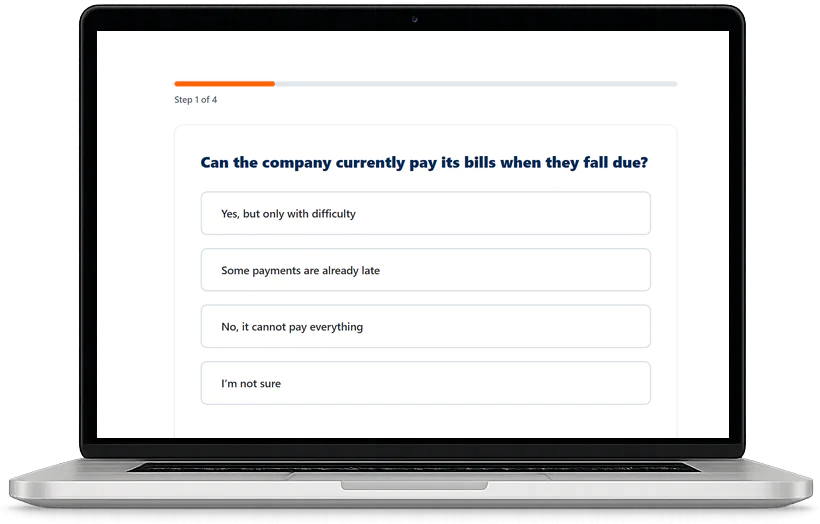
Could Your Company Be Insolvent?
Answer four short questions to see which warning signs apply, how serious the position may be and how soon you may need to act.
See which options may fit your company’s circumstances.
Check my company’s positionSee your result online and receive a copy by email. We only call if you ask.
What Care Home Insolvency Actually Means
Care Home Insolvency Meaning Under the Insolvency Act 1986
Section 123 of the Insolvency Act 1986 sets two tests. The cash-flow test asks whether the company can pay its debts as they fall due. The balance-sheet test asks whether liabilities (including contingent and prospective ones) exceed assets.
A care home that is missing PAYE, deferring agency invoices, and running rates and rent into arrears has typically failed the cash-flow test before its accounts catch up to the position.
Difference Between Care Home Insolvency and a Provider Business Failure Event
Adult social care legislation defines “business failure” separately from insolvency.
A business failure event happens when the provider enters a formal insolvency or restructuring process and, as a result, becomes unable to carry on the regulated activity.
Triggering a business failure event activates the local authority’s temporary continuity-of-care duty under sections 48 to 52 of the Care Act 2014 in England (and equivalents elsewhere).
You can be insolvent under the Insolvency Act without yet having triggered a business failure event, and you can be running a wound-down home without being technically insolvent.
When Care Home Insolvency Becomes Probable Rather Than Possible
The shift from “possible” to “probable” matters because that is when your director duties under section 172 of the Companies Act 2006 reorient toward creditors.
The classic markers in a care home: agency invoices being delayed past 60 days, key staff resigning citing unpaid wages, payroll only making it through after a director loan, and the bank tightening covenants.
Once two of those four are live, you should treat insolvency as probable.
How to Assess Whether Care Home Insolvency Is Avoidable
Care Home Viability Test: Occupancy, Fees and Staffing
Viability turns on three numbers. Occupancy in the high 80s percent, an average weekly fee that recovers the actual staffing cost (not the budgeted one), and an agency reliance ratio you can defend to a regulator.
If your occupancy is in the low 70s, your LA placements pay below your cost-per-bed-night, and 40% of your nursing rota is agency, the home is structurally insolvent rather than cyclically distressed.
That is a different problem with a different answer.
Cash-Flow Forecasting for a Distressed Care Home
A 13-week rolling forecast for a care home is not the same model as a generic SME forecast.
You need fees split by funding source (self-funder, LA-placed, NHS-funded), agency exposure modelled at week-by-week worst case, and a separate line for known regulatory or insurance renewals.
We routinely see directors hand us a forecast that nets fees down to a single weekly figure, then discover the LA placements are paid four weeks in arrears and the self-funders are paid by direct debit on the 1st.
That timing gap is often where the home actually fails.
Creditor Outcome: What Each Creditor Class Recovers in Care Home Insolvency
Secured lenders (often the property mortgagee) recover first against the registered care home asset. HMRC ranks as a secondary preferential creditor for VAT, PAYE and employee NIC under the Finance Act 2020 reinstatement of Crown preference.
Employees are preferential for arrears of wages up to £800 (Schedule 6 Insolvency Act 1986) and holiday pay. Trade creditors, agency suppliers, and unsecured lenders rank below.
Residents holding deposits are unsecured unless the deposit was held on trust under the contract terms, which is not the norm.
Options for Care Home Rescue or Closure
HMRC Time to Pay and Refinance for a Solvent Care Home Under Cash Strain
If the underlying business is viable and the strain is one VAT quarter or one PAYE month, an Time to Pay arrangement spreads tax arrears over 6 to 12 months.
The application succeeds where the cause is genuinely a one-off (an LA payment delay, an insurance renewal stacking with a quarter-end) and you can evidence future compliance.
This is often the cheapest intervention for a care home, far cheaper than a CVA.
Company Voluntary Arrangement (CVA) for a Care Home With Multi-Creditor Arrears
A CVA binds creditors to accept a percentage of their debt over typically three to five years, with the company continuing to trade under the existing directors.
For a care home, the CVA is most viable where occupancy is recovering, registration is intact, and the principal creditor pressure is HMRC, trade and agency arrears (not the secured lender). It needs 75% creditor approval by value.
The advantage for residents is that nothing visibly changes in the home: same staff, same rooms, same care plans.
Going-Concern Administration or Pre-Pack Sale of a Care Home
Where the cash gap is too large for a CVA but the home is clinically and operationally functional, going-concern Administration or a pre-pack sale protects continuity of care while the business is sold to a new operator.
Administrators in care frequently prefer pre-packs because they avoid resident displacement: residents stay in their rooms, staff transfer under TUPE, and the property and registration are sold as a unit.
The practical catch is that CQC must register the new operator, and that re-registration timing must align with completion. Administrators experienced in care plan that timing into the deal.
Creditors’ Voluntary Liquidation Where Care Home Trading Cannot Continue
Where viability is gone, occupancy is in collapse, or the regulator has taken enforcement action affecting registration, a Creditors’ Voluntary Liquidation is the orderly closure route.
Trading typically ceases, but a controlled run-off period is common in care to allow the placing local authority time to find alternative placements under its s.48 duty.
Liquidator and council coordinate the wind-down; you do not get to manage the timeline alone.
Director Risks During Care Home Insolvency
Wrongful Trading Risk Specific to Care Home Directors
Section 214 Insolvency Act 1986 makes a director personally liable to contribute to losses caused by continuing to trade once they knew, or ought to have known, that there was no reasonable prospect of avoiding insolvent liquidation.
In a care home, that exposure compounds because every additional week of trading means more wages, more agency costs, more food and medication purchasing, all of which deepen creditor losses.
The defence is documented contemporaneous advice and a clear board record showing why continuing to trade was reasonable on the day the decision was taken.
Preference and Undervalue Risk When Selling Care Home Assets
Selling the home, or transferring registration, to a connected party at less than market value, or repaying a director loan ahead of trade creditors, is reviewable as a transaction at undervalue (s.238) or a preference (s.239) for up to two years before insolvency.
The dangerous payment is the quiet one to a spouse’s company, not the noisy one. If you are considering any pre-insolvency restructure, get independent valuations and licensed advice in writing.
Board Evidence and Advice the Liquidator Will Read
The single best protection a care home director has is a clean board minute trail showing the date insolvency became probable, the advice taken, and the rationale for each material decision (continuing to admit residents, paying agency over HMRC, drawing on a director loan).
A liquidator does not read minutes to find what was decided; they read them to find what was not. Silence in the minutes on the week the regulator first raised concerns is itself a finding.
What Directors Should Do About Care Home Insolvency
Notify CQC and the Placing Local Authority Without Delay
Under your conditions of registration with CQC (or the equivalent regulator in Wales, Scotland, or Northern Ireland) you have a duty to notify material changes affecting the operation of the regulated activity. A live insolvency risk is one.
Local authorities placing residents need to know in advance because their s.48 Care Act duty to maintain continuity of care is easier to deliver with notice than without it.
Owners who pre-empt that conversation are taken seriously; owners who hide the position until payroll bounces lose control of the wind-down.
Forecast and Document the Care-Specific Cash Position
Build the 13-week forecast with fees split by funding stream, agency at worst-case rota cover, and a contingency line for a CQC inspection visit (which often follows an insolvency notification).
Save it dated, save the assumptions, and circulate it to the board. The version on the management accountant’s laptop the night before payroll is not the version a court will accept later as evidence of director care.
Get Licensed Care-Aware Insolvency Advice Within the Working Day
Generic insolvency advice is not enough for a care home.
The IP needs to know how registration transfers work, how LA placement contracts unwind, what TUPE looks like for a 60-staff home with agency overlay, and how to coordinate a sale or closure with the placing council.
We see two or three care home cases a quarter where the director rang a generalist accountant first, lost a fortnight, and arrived in our diary with the choice already narrowed to controlled closure.
Earlier specialist advice usually keeps a sale option alive.
Continuity of Care: What Happens to Residents in Care Home Insolvency
Local Authority Duty Under the Care Act 2014 (England)
Sections 48 to 52 of the Care Act 2014 impose a temporary duty on the local authority where the home is located to ensure residents’ care continues if the provider can no longer carry on as a result of business failure.
That duty applies to every resident, regardless of who funds the placement. Self-funders are not excluded. The council can later recover its costs from the resident or the insolvent estate, but in the moment, continuity is the priority.
Equivalent Duties in Wales, Scotland and Northern Ireland
In Wales, the Social Services and Well-being (Wales) Act 2014 and supporting regulations provide an equivalent continuity duty. In Northern Ireland, Health and Social Care trusts hold a corresponding duty when a regulated provider fails.
Scotland does not have a direct statutory equivalent, but local authorities operate under COSLA closure protocols and Care Inspectorate guidance that produce a similar managed-transfer process.
The legal basis differs; the practical effect on you as the owner does not.
NHS Commissioning Contracts and Step-In Rights
Where the home holds NHS-funded placements (CHC, Section 117 aftercare, or commissioned beds for an Integrated Care Board under the Health and Care Act 2022), the underlying contract may include step-in or assignment-restriction clauses.
An administrator selling the home as a going concern needs to identify those clauses early because they affect what can be transferred without commissioner consent.
A solicitor reviewing the contract bundle in week one of distress is far cheaper than discovering a non-assignment clause in week six of a sale process.
Your Next Step on Care Home Insolvency
Three different owners read this page, and the next step splits cleanly between them.
If your home is occupied, the rota is intact, registration is clean, and the cash strain is one or two creditors deep, you are looking at a TTP or refinance question.
The phone call to make is to a licensed IP and your accountant on the same day, with the management accounts in front of you. That conversation is usually short and inexpensive.
If the cash position is structurally short and HMRC, agency and trade creditors are stacking, but the home is operationally functional, a CVA or going-concern Administration with a care-aware IP is the route that protects residents and gives you a path through.
The earlier you start that conversation, the more leverage the IP has with the secured lender and the placing council.
If staffing has collapsed, the regulator has issued a Notice of Decision, or you cannot fund the next two payroll runs even with a director loan, the only safe route is going-concern Administration or a controlled CVL coordinated with the local authority.
The decision has effectively been made by the operational reality. Trying to trade out at that point increases your wrongful trading exposure rather than saving the home.
Whichever group you are in, the best protective action you take today is the same: ring a licensed insolvency practitioner with care-sector experience, document the call, and prepare to notify the regulator.
Our team takes care home calls daily on 0800 074 6757, and the initial conversation is confidential and free of charge.
Not Sure Where Your Company Stands?
Use the two-minute test to check the warning signs and see how soon you may need to act.
Check my company’s positionEstimates are fineWe only call if you ask us to
Frequently Asked Questions About Care Home Insolvency
Can a care home keep trading during Administration?
Yes, and care home Administrations frequently do trade. The administrator’s statutory objective is to rescue the company as a going concern or, failing that, to achieve a better outcome for creditors than liquidation.
In care, continuing to trade while marketing the home for sale protects residents in their rooms and preserves the value of the registration. The administrator has to be satisfied that ongoing trading is funded and that care standards remain met; CQC engagement is part of that.
Who pays the staff if our care home enters insolvency?
Wages and holiday pay accrued before the insolvency rank as preferential creditor claims up to £800 per employee under Schedule 6 Insolvency Act 1986. Beyond that cap, employees claim through the government’s Redundancy Payments Service, with statutory redundancy pay subject to the £751 weekly cap from 6 April 2026.
Where the home continues to trade in Administration, ongoing wages rank as expenses of the Administration and are paid in priority. Agency staff invoiced as services rank as ordinary unsecured creditors unless secured.
Are self-funded residents protected if the care home becomes insolvent?
Yes. Sections 48 to 52 of the Care Act 2014 impose a temporary continuity-of-care duty on the local authority for every resident in a failed home, regardless of who funds the placement.
The council steps in to ensure care continues while alternative arrangements are made. The council can later recover its costs from the self-funder or the insolvent estate, but the immediate obligation to safeguard care is unconditional.
Does care home insolvency mean the regulator closes the home?
Not automatically. CQC (and equivalents in the devolved nations) only takes registration enforcement action if the fundamental standards under the Health and Social Care Act 2008 (Regulated Activities) Regulations 2014 cannot be met.
A solvent operator, including an administrator running the home as a going concern, can usually continue regulated activity while a sale completes. Closure follows where care standards are at risk, not where the company has entered an insolvency process.
Are directors’ personal guarantees enforceable after care home insolvency?
Yes. Personal guarantees survive the insolvency of the company that holds the underlying debt. A bank or landlord with a guarantee can pursue you personally for the unpaid balance after the company has entered Administration or Liquidation.
Whether the guarantee is enforceable in your specific case depends on how it was signed, what disclosure was made, and whether undue influence or non-disclosure arguments apply. Take guarantee-specific advice as part of any care home insolvency.
How long does a care home Administration take?
An Administration runs for 12 months by default under Schedule B1 Insolvency Act 1986, extendable by creditor or court consent.
In care, the practical timeline is shorter: a going-concern sale of a registered home usually completes within 8 to 16 weeks of appointment, because residents, staff, the regulator and the placing council all need certainty. A pre-pack sale completes faster again, often on or close to the day of appointment, with marketing handled in advance.
Can I start a new care home company after this one is liquidated?
You can, but two regulators sit on top of the question. Section 216 Insolvency Act 1986 restricts reuse of the prohibited name of a liquidated company for five years. CQC, separately, will assess any new application against the fit-and-proper-person test, which considers your conduct in the previous insolvency.
A new application that comes attached to a director who took deposits in the last weeks of the failed home, paid connected parties ahead of HMRC, or did not notify CQC of the failure will struggle to clear that test. Good conduct in the wind-down is what keeps the next registration possible.
We test the editorial points in this guide against the case files we handle in England and Wales.
Where our reading of a statute is novel, or where our recommendation cuts against industry default, we say so explicitly and we tell you why we hold that view.