Can’t Pay Corporation Tax: What are the Options?




If you cannot pay your Corporation Tax bill, the debt does not sit quietly waiting for you to find the money.
Most directors who land on this page have the return done and the money not there, half-wondering whether that makes them a failure. It does not. More often it is a timing gap, not proof the business is finished.
HMRC charges interest from day one, and it can escalate an unpaid bill through collection and enforcement action and, eventually, a winding-up petition. Left alone, this debt compounds in pressure even though the interest itself does not.
By the time a director calls us, it has usually played out the same way. Corporation Tax was the one bill that could wait while payroll went out, the pressing supplier was paid, and the VAT was found from somewhere.
So the balance sat untouched for a few months, growing month by month, until the brown envelope arrived that could not wait any longer. That is the point most directors go looking for help.
HMRC may agree a Time to Pay arrangement where the proposal is affordable and the company can keep up with its current tax liabilities. Contacting them early usually leaves you more room to move, and less interest stacked on top.
Quick Answer: What to Do When You Cannot Pay Corporation Tax
If the deadline has already passed, call HMRC’s payment problems line on 0300 200 3840 (Monday to Friday, 8am to 6pm) and request a Time to Pay arrangement. If you can see the shortfall coming before the due date, HMRC’s Business Payment Support Service on 0300 200 3835 is the earlier, pre-demand route. Propose a realistic monthly repayment you can actually sustain.
File your Corporation Tax return on time even if you cannot pay. Late filing triggers its own penalties, which are a separate matter from the interest that builds on the unpaid tax. If the debt is too large for a TTP, or HMRC rejects your application, speak to a licensed insolvency practitioner about alternatives.
Figures on this page were checked against GOV.UK on 23 July 2026.
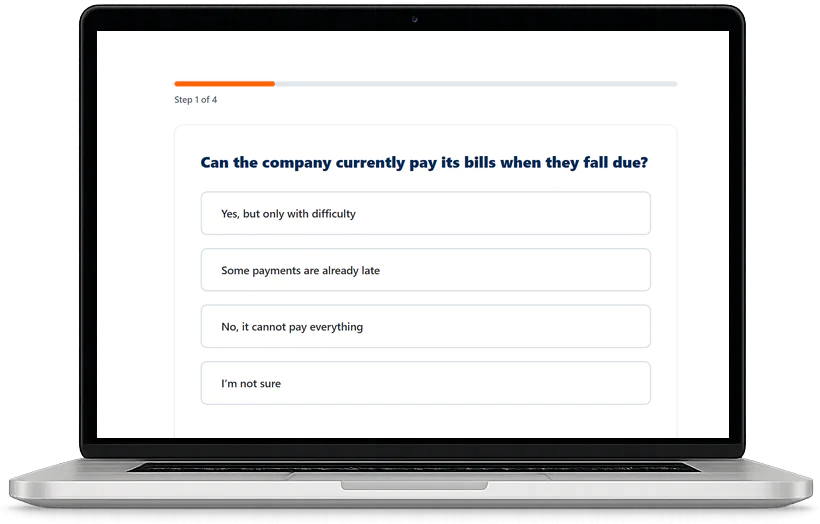
Could Your Company Be Insolvent?
Answer four short questions to see which warning signs apply, how serious the position may be and how soon you may need to act.
See which options may fit your company’s circumstances.
Check my company’s positionSee your result online and receive a copy by email. We only call if you ask.
How Corporation Tax Debt Escalates with HMRC
For most companies, Corporation Tax falls due 9 months and 1 day after the accounting period ends. Large companies pay in quarterly instalments instead. Miss that date and two things start at once: interest on the balance, and HMRC’s right to pursue it.
Here is where a lot of guidance gets it wrong. Paying Corporation Tax late does not trigger a fixed percentage penalty. What accrues is interest. The scheduled percentage penalties people brace for belong to a different regime, and to late filing, not late payment.
| Stage | What can happen |
|---|---|
| Day 1 after the deadline | Interest accrues on the unpaid balance at HMRC’s late payment rate, 7.75% a year from 9 January 2026, calculated daily on what you owe. It does not compound, and it is interest, not a penalty. |
| Reminders and contact | HMRC issues payment reminders and refers the debt to its debt management team. A call to the payment support line can often resolve matters with a Time to Pay arrangement at this stage. |
| Collection action | If the debt is left unpaid, HMRC can instruct debt collection agents, recover the tax directly from your bank account, or take control of company goods to sell. |
| Formal insolvency action | Where the tax is still unpaid and ignored, HMRC can serve a statutory demand and, ultimately, present a winding-up petition. |
HMRC does not publish a fixed timetable for this. The pace varies with the size of the debt, your compliance history, and how you engage.
Because the charge is interest rather than a fixed penalty, you can work out roughly what late payment costs. HMRC’s daily method is: unpaid tax multiplied by the annual rate, multiplied by the days overdue, divided by 365. At the current 7.75% rate, simple (non-compounding) interest works out as:
- £10,000 unpaid for 90 days: about £191 in interest.
- £25,000 unpaid for six months: about £969.
- £50,000 unpaid for a full year: about £3,875.
These are simple-interest illustrations. HMRC’s actual daily calculation can run across periods where the rate itself changes, so treat them as a guide rather than an exact figure.
There is a small mercy buried in the detail. The late payment interest you pay HMRC is deductible for Corporation Tax, which shaves a little off the true cost. No reason to leave the bill unpaid, but worth knowing.
By the time HMRC is weighing a winding-up petition, the options narrow quickly. That is why early contact matters more than almost anything else here.
Filing Late and Paying Late Are Two Different Problems
Directors, and a fair amount of online guidance, blur these two together. We regularly speak to someone who filed the return on time, felt they had done the responsible thing, and cannot see why HMRC keeps adding to the bill.
Filing and paying are separate obligations, with separate consequences. You can be clean on one and exposed on the other.
| If you file your return late | If you pay your tax late |
|---|---|
| A separate penalty regime applies: £200 the day the return is late, another £200 at three months, then 10% of the unpaid tax at six months and a further 10% at twelve months. | No fixed percentage penalty applies to late payment of standard Corporation Tax. Interest accrues daily on the balance at HMRC’s late payment rate instead. |
| If a return is more than six months late, HMRC can issue its own determination of the tax due. You cannot appeal a determination, you can only displace it by filing the actual return. | HMRC can pursue the debt through collection and enforcement action, up to a winding-up petition. |
| You must still file even if you cannot pay. Filing and paying are separate obligations. | Time to Pay may be available to spread the payment, but it does not remove the duty to file. |
Corporation Tax vs Other HMRC Debts: One Key Difference
Unlike VAT and PAYE, Corporation Tax is not a preferential debt in insolvency. It ranks as an unsecured claim in the creditor priority order, alongside trade suppliers and other unsecured creditors.
In a liquidation, an unsecured Corporation Tax claim ranks behind qualifying VAT and PAYE claims in the statutory order of priority. The amount recovered still depends on the assets available.
In practice this changes where HMRC sits in the queue, not how hard it pushes. HMRC still petitions over unpaid Corporation Tax.
Do not read “unsecured” as “less serious”. It describes what HMRC recovers if the company is wound up, not its appetite to act long before then. The debt is no less real for ranking lower.
Could Trading Losses Reduce Your Corporation Tax Bill?
Before you treat the bill as fixed, check whether it is even the right number. We often see directors assume the figure is settled when it is not.
The common case is a company taxed on a strong year that has since fallen away. The profit that created the bill has gone, but the bill itself has not moved.
If the company has swung from profit into loss, the tax charged on that earlier, profitable period may no longer reflect where the business actually stands.
Under the loss relief rules, a company that makes a qualifying trading loss can often carry that loss back against the profits of the previous accounting period, and in some circumstances further back.
Where that applies, it can reduce, and occasionally cancel out, the Corporation Tax due on the earlier period, either generating a repayment or wiping out the outstanding charge.
This is an accountant-led check, not a DIY fix. Eligibility depends on the type of loss, the periods involved, and strict time limits for making the claim, and carry-back is not available in every case. But if there is any chance your position has swung from profit to loss, ask your accountant to review it before you commit to a payment plan for a figure that might come down.
Time to Pay for Corporation Tax: How It Works
The process is the same as for any HMRC debt. Call HMRC (0300 200 3840 if the deadline has already passed, or the Business Payment Support Service on 0300 200 3835 if you are getting ahead of it), explain the position honestly, and propose a repayment schedule. We advise:
- Be realistic. Propose what you can actually pay, not what you think HMRC wants to hear. A TTP that you cannot sustain will fail within months and leave you in a worse position.
- Be current on everything else. HMRC assesses your full compliance record. If you are also behind on VAT and PAYE, a Corporation Tax TTP is much harder to negotiate.
- File the return first. HMRC will not normally agree a TTP until it knows the amount owed. File the Corporation Tax return before calling, even if you cannot pay.
- Call before the deadline where possible. Early contact gives you more time to prepare a proposal and avoids allowing the debt and interest to build unnecessarily.
In our experience, HMRC often agrees Corporation Tax TTPs running over roughly 6 to 12 months, with longer terms possible for larger debts backed by stronger evidence of viability. HMRC assesses affordability case by case, though, so there is no guaranteed standard term.
Interest continues to accrue on the balance throughout the arrangement. HMRC will normally pause active recovery of the debt covered by the arrangement while the company keeps to its agreed payments and other conditions.
The calls that go worst are the unprepared ones. HMRC’s adviser asks what you can afford this month, and there is a silence while you try to work it out live. Before you dial, we suggest having ready:
- your Corporation Tax UTR and payment reference;
- the exact amount owed and the payment deadline;
- the reason for the shortfall;
- how much you can pay immediately;
- the monthly payment you are proposing;
- current income and expenditure, and a short cash-flow forecast;
- any other HMRC liabilities, including VAT and PAYE;
- available assets, savings or finance you could draw on;
- evidence that future tax liabilities can be paid on time.
When Corporation Tax Debt Signals a Bigger Solvency Problem
This is the harder part of the page, and if you have jumped straight to it, we understand why. Behind the tax question sits a bigger one: whether the business still works, sometimes with a personal guarantee or the family home riding on the answer.
A single missed Corporation Tax payment may be nothing more than a timing problem. Repeated arrears across several taxes, a stack of overdue creditors, and no credible way to meet debts as they fall due are a different signal: the company may be insolvent.
The distinction matters because TTP fixes the first problem but not the second.
If your company has been behind on Corporation Tax for more than one year, if you are also behind on VAT and PAYE, and if you are choosing which creditors to pay each month, the question is no longer “how do I pay this tax bill?”
It is “should I still be trading?” A licensed insolvency practitioner can assess whether the business is viable with restructured debt or whether formal insolvency is the appropriate route.
Once insolvency becomes probable, a director’s duty starts to shift toward the interests of creditors. In practice that means protecting company assets, not taking on credit you may not be able to repay, and avoiding any step that worsens the position for creditors as a whole. Our guide on when to stop trading sets out where that line sits.
A fair few directors ask us whether they can simply strike the company off and make the problem disappear. They can apply, but that does not end the debt: HMRC, as a creditor, must be sent a copy of the application and can object while tax is owed.
HMRC can object to a strike-off where tax is outstanding, and the duty to file and to settle the company’s liabilities continues throughout any closing-down process. A dissolution attempted over the top of unpaid tax tends to be stopped, not waved through.
Which Route Fits Your Situation?
Every case is different and none of this replaces advice on your specific position. But broadly, the first move we point directors toward tends to follow the shape of the problem:
- Temporary shortfall, viable business, future taxes you can afford: this is Time to Pay territory. Get the return filed and call HMRC.
- A bill you suspect is wrong or too high: speak to your accountant first about loss relief or corrections before agreeing to pay a figure that may come down.
- A viable business but several creditors you cannot pay: this is the point for restructuring advice, which may include a Company Voluntary Arrangement or other alternatives where they fit.
- No credible path back to solvency: take insolvency advice urgently rather than letting the position drift.
- A statutory demand or winding-up petition already served: this is urgent. Get legal and insolvency advice straight away, because the timetable is now out of your hands.
What to Do About Unpaid Corporation Tax Right Now
- File your Corporation Tax return if you have not already. Late filing triggers separate penalties.
- Call 0300 200 3840 (or 0300 200 3835 if you are contacting HMRC before the deadline) and request a Time to Pay arrangement. Have your UTR and the amount owed ready.
- Check your other tax obligations. Identify all outstanding VAT, PAYE and other tax liabilities before calling. HMRC will consider the company’s overall compliance position, so disclose the full position rather than discussing the Corporation Tax bill in isolation.
- If the debt is large, multi-year, or part of a wider cash-flow crisis, speak to a licensed insolvency practitioner. Company Debt’s insolvency practitioners handle HMRC debt cases regularly.
A free, confidential consultation will tell you whether a TTP is realistic or whether a different route is needed.
FAQs on Unpaid Corporation Tax
How long can you owe HMRC Corporation Tax before they take action?
There is no published timetable, and the honest answer is that it varies with the size of the debt, your compliance history, and whether you engage. Interest starts building on the unpaid balance from day one.
From there HMRC can move through reminders, collection action, and ultimately a winding-up petition, but the pace is circumstance-dependent, not a fixed calendar. The longer you wait, the higher the balance and the less room there is to negotiate. Note that late payment carries interest, not a fixed percentage penalty. Separate penalties apply only where the return itself is filed late.
Is Corporation Tax a preferential debt in insolvency?
No. Corporation Tax is an unsecured debt. It ranks equally with trade creditors and other unsecured claims. Unlike VAT and PAYE (which have preferential status since December 2020), HMRC’s Corporation Tax claim does not receive priority treatment in the creditor distribution.
Can HMRC wind up my company for unpaid Corporation Tax?
Yes. Under section 123 of the Insolvency Act 1986, a company may be treated as unable to pay its debts where a creditor owed more than £750 serves a statutory demand and the debt remains unpaid for three weeks.
This does not mean HMRC routinely petitions over every £750 debt, but the legal threshold is low and unpaid Corporation Tax should not be ignored on the assumption the sum is too small to matter. Being unsecured does not stop HMRC petitioning, it only affects how much it recovers in the distribution.
Am I personally liable for unpaid Corporation Tax?
Not directly. Corporation Tax is the company’s liability and does not automatically transfer to directors. It is normally the company’s debt alone. HMRC can make a director personally liable only in specific cases, such as a joint and several liability notice where there has been tax avoidance, evasion or repeated insolvency.
Wrongful trading under section 214 of the Insolvency Act is the main HMRC-adjacent exposure: if the company enters insolvent liquidation or administration, a court can order a director to contribute where they kept trading after they knew, or ought to have concluded, that insolvency could not be avoided.
Other routes sit outside the tax debt itself. A personal guarantee given to a lender or landlord is a separate contractual liability that stands regardless of HMRC’s claim. Fraudulent trading (deliberate dishonesty) or misfeasance (a breach of duty causing the company loss) may also expose a director, but only where that conduct is present, not as a default result of owing Corporation Tax.
What happens to interest and penalties during a Time to Pay arrangement?
Interest continues to accrue on the outstanding balance throughout the TTP. There is no late payment surcharge on standard Corporation Tax to suspend, only interest, and interest keeps running.
What the arrangement holds off is active enforcement. Keep to the agreed instalments and HMRC leaves the recovery machinery parked. Miss an instalment and HMRC can terminate the arrangement and resume collection and enforcement action on the full outstanding balance.
Will HMRC accept a longer Time to Pay if my company has been hit by something specific?
Sometimes. We see HMRC extend Corporation Tax TTPs beyond 12 months where the company can show a specific shock (a major customer failure, a delayed contract, a one-off cash impact) and a credible recovery plan. The longer the term, the more documentary evidence HMRC will want before agreeing.
Not Sure Where Your Company Stands?
Use the two-minute test to check the warning signs and see how soon you may need to act.
Check my company’s positionEstimates are fineWe only call if you ask us to