



Company liquidation is the formal legal process for closing a UK limited company: selling its assets, paying creditors in the legal order of priority, and removing the company from the register at Companies House. It covers solvent companies closing cleanly and insolvent ones that cannot pay their debts.
If the company cannot pay what it owes, the practical question is not what liquidation means. It is whether you start the process or a creditor does.
The first questions we ask are rarely about the size of the debt, because the debt is the company’s problem rather than yours. We ask what you have signed personally.
Start with personal guarantees. If you have signed one, on a lease, an overdraft or an invoice finance facility, that debt follows you after the company has gone and it is the first thing to get advice on.
Then check whether your director’s loan account is overdrawn. If you have drawn more than the company paid you, the liquidator will ask for it back, and directors are often surprised to learn that counts as a debt at all.
If you start the process, you choose the timing and you choose the insolvency practitioner who handles it.
If you wait, a creditor can petition the court to wind the company up instead. That is compulsory liquidation, and the case goes to the Official Receiver, a government official who runs it to their own timetable rather than yours.
In both routes the liquidator files a report on how the company was run. This is routine and is not an accusation. The Insolvency Service reads every one of them and decides separately whether anything needs following up.
This guide is written by the Company Debt team and reviewed by Chris Andersen, a licensed insolvency practitioner (IPA). We advise directors across the UK on CVLs, compulsory liquidation, MVLs, and company rescue.
Scope: the steps and deadlines here are the ones that apply in England and Wales. Scotland and Northern Ireland run liquidation under separate rules, so the timings and court stages differ.
If you are unsure whether to liquidate or wait, speak to a licensed insolvency practitioner before you pay any creditor, move assets, or reply to HMRC. We can tell you whether a CVL, compulsory liquidation, MVL, administration, or strike-off fits your situation, and what to do first. You can talk to our team whenever you are ready.
Company Liquidation at a Glance
| What you need to know | The detail |
|---|---|
| Meaning | The formal legal process of winding up a limited company: realising its assets, paying creditors in priority order, and ultimately dissolving it at Companies House. |
| Main routes | Creditors’ Voluntary Liquidation (insolvent, voluntary); Compulsory Liquidation (creditor petitions the court); Members’ Voluntary Liquidation (solvent, tax-efficient). |
| Used for | Insolvent companies that cannot pay their debts (CVL or compulsory) and solvent companies seeking a tax-efficient wind-down (MVL). |
| Who runs it | A licensed insolvency practitioner in a CVL or MVL. On a compulsory winding-up order the Official Receiver acts as liquidator first. Directors lose control on the day of appointment. |
| Who authorises them | The IPA, ICAEW or ICAS. The Insolvency Service oversees those bodies rather than licensing practitioners itself. |
| Typical CVL cost | Our fee is £3,500, plus £500 to £1,500 of external costs: £4,000 to £5,000 before VAT. Compulsory differs: a £352 court fee and £2,600 deposit, then OR fees. |
| Typical timeline | 10 to 21 days from instruction to the liquidator taking office, in the cases we handle. Their work then runs 6 to 12 months on a straightforward case; dissolution follows three months later. |
| Director priority | Stop paying any one creditor ahead of the others. Preserve records. Take advice before moving money. Acting voluntarily keeps timing and choice of IP with you; it does not settle the conduct question. |
Which route applies to you?
Served, in the rows below, means a copy of the petition has been formally delivered to your registered office. Until that happens you still have the wider set of choices.
| Your situation | Likely route | What to do next |
|---|---|---|
| You cannot pay your debts, but no winding-up petition has been served | CVL | Take advice before you pay any single creditor |
| A winding-up petition is threatened or already served | Urgent insolvency advice: options are narrowing | A petition can severely restrict what you are able to do. Get same-day advice before taking any further action |
| The company is solvent with retained profit to extract | MVL | Confirm the solvency position before signing anything |
| No debts, no real assets, no recent trading | Strike-off may be enough | Check the HMRC and creditor position first |
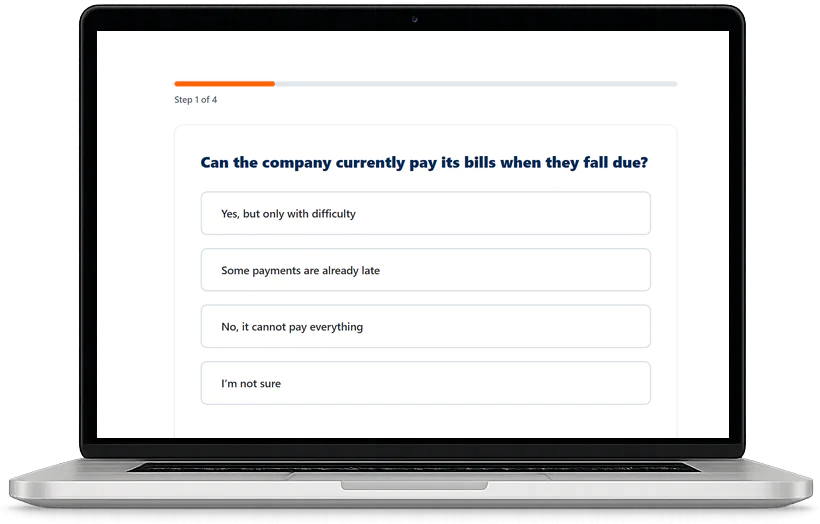
How Serious Is Your Company’s Position?
Answer four short questions to see how urgent the situation may be and which options could fit your company’s circumstances.
Check my company’s positionSee your result online and receive a copy by email. We only call if you ask.
What Is Company Liquidation?
From the day a liquidator is appointed, you stop running the company. You cannot sign off payments, enter new contracts, or speak on the company’s behalf. The liquidator answers to the creditors, not to you.
This is not a rescue: the company is formally closed, its assets are sold, proceeds are distributed in the order the law sets out, and the legal entity is dissolved. Anything you do in the company’s name after appointment can expose you personally. This is what changes on that day:
- Your control ends immediately: you no longer run the company, sign cheques, or speak for it to customers or suppliers. The liquidator steps into that role on appointment day.
- Creditors are paid in a strict legal order: the order comes from the Insolvency Act 1986 and the 2016 Rules taken together, not from any single provision. Fixed-charge realisations go to the secured lender first, then the liquidator’s costs and expenses, then preferential creditors, then floating-charge holders (less the prescribed part set aside for unsecured creditors), then unsecured creditors. Schedule 6 is the part that defines who counts as preferential: employees for arrears of wages up to £800 each, and HMRC for VAT, PAYE, employee NIC, deductions under the Construction Industry Scheme (CIS) and student-loan deductions, a secondary preferential status restored on 1 December 2020.
- The liquidator gains wide powers over you: section 235 IA 1986 lets them demand books, records, and explanations from you and from former employees; sections 236 and 237 give them a route to court-ordered private examinations on oath. They can also sue former directors for misfeasance (misusing company money or breaking a duty owed to the company), wrongful trading, preferences, and transactions at undervalue.
- Acting in the company’s name now is risky: anything done after appointment carries personal risk for the director who does it. The instinct is to tidy up, settle the last supplier invoice, chase in the money a customer still owes. Both leave a trail the liquidator will find and ask you about.
Types of Company Liquidation
Which route fits depends on two facts: whether your company is solvent, and who starts the process. Misjudge either and a creditor picks the route instead, at a moment that suits them. UK law provides three statutory options.
| Type | Used when | Who starts it | Who controls the process | Best next guide |
|---|---|---|---|---|
| Creditors’ Voluntary Liquidation (CVL) | The company is insolvent and the directors choose to close voluntarily before a creditor forces the issue. | The directors, with shareholder resolution. | An IP chosen by the directors and approved (or replaced) by creditors. | CVL guide |
| Compulsory Liquidation | A creditor (most often HMRC) petitions the court to wind up an insolvent company. | A creditor, via a winding-up petition. | The Official Receiver initially, sometimes replaced by a private IP. | Compulsory liquidation guide |
| Members’ Voluntary Liquidation (MVL) | The company is solvent and shareholders want a tax-efficient closure, commonly using Business Asset Disposal Relief. | The directors and shareholders, with a sworn declaration of solvency. | An IP appointed by the shareholders. | MVL guide |
When Should a Company Go Into Liquidation?
Liquidation is the right route when there is no realistic way to trade out, and carrying on would start to expose you to personal liability for company debts. Four things tell you the voluntary window is open and closing:
- Cannot pay debts as they fall due. Time to Pay, HMRC’s instalment plan for tax arrears, will not close the cash-flow gap. The lender will not extend, and the customer book will not pay quickly enough to cover the shortfall.
- No realistic rescue route. A CVA, refinance, or sale has been ruled out, or the timeline for any rescue would expire before the next major creditor demand arrives.
- Creditor legal action is likely. Tax is overdue and a Time to Pay arrangement has failed or been refused, a statutory demand has expired, or a winding-up petition has been threatened or served.
- Continuing to trade may worsen creditor losses. Once a reasonably diligent director would have concluded that insolvent liquidation cannot be avoided, section 214 puts the onus on you to take every step you reasonably can to minimise creditor losses. Taking on more credit after that point is where the exposure builds, and each purchase becomes something you may have to justify.
HMRC is a creditor in a great many company liquidations, typically through unpaid VAT, PAYE, or Corporation Tax, and that shapes what you should do next. Do not keep paying some creditors while HMRC goes unpaid, or HMRC while others go unpaid, without taking advice first; selective payments are exactly what a liquidator later questions.
If the business is still viable, a Time to Pay arrangement may give you room. But once HMRC threatens or issues a winding-up petition, the window to choose your own route closes fast.
What changes between taking advice early and taking it late is not the outcome for the company. It is how many of the surrounding problems can still be dealt with separately.
Before a petition, there is time to check the records, establish which creditors actually hold security, and work out whether a personal guarantee can be negotiated rather than simply called in. After a petition, those conversations happen under a deadline set by someone else.
If you are not yet under that kind of pressure but you know the company cannot pay its way, take the two-minute insolvency test to see where you stand.
After that, stop paying any one creditor ahead of the rest. Payments to connected parties get the closest look, and a repayment to a family member or a director is examined further back in time than an ordinary trade payment.
Speak to us or another licensed insolvency practitioner before you move any more money. You do not need the answers ready, or the accounts tidied up, before you make that call.
Company Liquidation Process
A CVL runs in four stages, from instruction to dissolution. The first two stages demand most from you; the last two are run by the liquidator.
From instruction to the liquidator taking office takes 10 to 21 days. The liquidator’s work then runs 6 to 12 months on a straightforward case, and the company is dissolved three months after the final account is filed.
What decides whether an appointment takes three weeks or six is rarely the size of the debt. In our experience it is missing records, assets whose ownership is disputed, and shareholders who cannot agree.
Step 1
Appoint a Licensed Insolvency Practitioner
You instruct a licensed IP, who issues a Letter of Engagement and starts work alongside you on the Statement of Affairs, the formal schedule of the company’s assets and liabilities. Shareholders pass a winding-up resolution; in practice, we convene this on the same day as the creditors’ decision.
Creditors then decide on the liquidator, by deemed consent or, where a creditor (typically HMRC) asks for one, at a virtual meeting.
The rules fix that window at both ends. The decision date must be at least three business days after the notice reaches creditors, and no more than 14 days after the shareholders pass the winding-up resolution (rule 6.14).
Creditors can put forward a different practitioner at this point. Where that happens, it is normally because a creditor has a concern about independence.
Step 2
Prepare and Verify the Statement of Affairs
You prepare a Statement of Affairs: a formal schedule of the company’s assets and liabilities, down to every creditor and every contingent claim. You verify it by a statement of truth rather than swearing it before a solicitor, which is how it has worked since the 2016 Rules came in.
Knowingly understating assets or leaving creditors out is a criminal offence under section 210 IA 1986. An honest mistake is a different matter, and the answer to one is to tell the liquidator and correct it. The document goes on the public record either way.
Directors most often get this wrong by omission rather than concealment: a director’s loan balance they had not thought of as a debt, or a contingent liability under a lease or guarantee that has not yet been called.
The IP cross-checks against bank statements, VAT returns, and HMRC records, and discrepancies surface quickly.
We ask for management accounts, board minutes, payroll records, BBL and CBILS paperwork, the director loan ledger, leases, and personal-guarantee documents. A noted gap in the records looks better in the conduct report than a silent one.
Step 3
Realise Assets and Pay Creditors
The liquidator collects the company’s assets through sale, debt collection, or transfer, and distributes the proceeds in the statutory order of priority.
In practice: stock is cleared at trade price, plant and vehicles are sold by an auctioneer the IP appoints, and the customer ledger is chased by the IP’s recovery team. You stop being the person who decides what something is worth.
A personal guarantee sits outside the liquidation. Once the company can no longer meet the guaranteed debt, the lender can pursue the director for it directly, and the liquidation does not touch that.
This is why we ask about guarantees at the beginning rather than once the liquidation is under way. There is more room to negotiate with a lender while the company estate is still open than after it closes.
Step 4
Dissolve the Company
Once asset realisation and creditor distribution are complete, the liquidator files a final report and applies to Companies House for dissolution. The company is struck from the register roughly three months after that filing.
Bank accounts close, VAT and PAYE registrations end, and any uncollected assets pass to the Crown as bona vacantia.
Outstanding contracts do not all simply stop on a set date: the liquidator works through them, settling, completing, assigning or bringing each to an end as the case requires. The legal entity ceases to exist, and the matter is closed.
What Directors Should Do During Company Liquidation
A conduct report goes to the Insolvency Service in every insolvent liquidation. That is routine, not a sign anything has gone wrong.
What happens next is a separate decision, turning on whether further investigation or action is in the public interest. Directors who act early, preserve records, and cooperate fully are in a far stronger position when it is taken.
Conduct that commonly draws scrutiny includes trading on after the position was clearly hopeless, BBL misuse, unrecorded director-loan repayments, and concealment of assets or transactions. The table below sets out what the liquidator will look for evidence of.
| Director action | Why it matters | Risk if ignored |
|---|---|---|
| Stop selective or preferential payments | A payment that improves the position of one creditor can be challenged as a preference under section 239 IA 1986, where the statutory tests are met. Lookback: 6 months, 2 years for connected parties. | Personal liability for the value of the preference; adverse conduct finding; potential disqualification. |
| Prepare accurate company records | Management accounts, board minutes, payroll, tax workings, director loan ledger, BBL paperwork. Gaps and inconsistencies invite questions, and are better flagged and explained than left to be found. | Criminal offence under section 208 IA 1986; adverse conduct finding; extended investigation by the liquidator. |
| Complete the Statement of Affairs honestly | Every asset and creditor listed, verified by a statement of truth. Knowingly understating or omitting is an offence under section 210 IA 1986, and the IP cross-checks against HMRC and bank records. | Criminal prosecution where the falsehood was knowing or material; personal liability for assets understated or debts omitted. |
| Cooperate fully with the liquidator | Statutory duty under section 235 IA 1986: hand over books, records, and explanations on request. Failure to deliver up records is itself an offence under section 208. | Private examination on oath under sections 236 and 237; contempt of court if compliance is refused. |
| Take advice before using company money | Once insolvency is in prospect, payments and asset transfers can come under later scrutiny. Transfers to connected parties attract more of it than ordinary trade payments. | Transaction at undervalue claim (s.238) or preference claim (s.239); misfeasance finding under s.212. |
Company Liquidation Costs and Timelines
Most cost guides quote a single liquidation figure. That is not how the money works, because it depends entirely on who starts the process.
We checked the current statutory charges against the Insolvency Proceedings (Fees) Order 2016 on 8 August 2026. A compulsory liquidation carries a £6,000 Official Receiver administration fee and a £7,200 general fee. Both are payable. They are not alternatives, though plenty of pages online treat them as one charge.
That is £13,200 charged to the company before any creditor receives a distribution, plus 15% of whatever the Official Receiver realises, so the charge rises with the value of the remaining assets.
A voluntary liquidation costs £4,000 to £5,000 before VAT. Both figures come out of the same estate, so the route a company takes into liquidation has a direct effect on what is left for creditors.
Our own figures below reflect cases we handle directly. Disputed assets, employee claims or live litigation push a case above the range, and we price from the Statement of Affairs work rather than guessing at the outset.
| Cost | Who pays it | Current figure | Notes |
|---|---|---|---|
| Our CVL fee | The company, or the director where the company has nothing | £3,500 + VAT | Company Debt pricing. Fixed fee for a straightforward case: single director, no employees, no leases. Trading companies with staff are priced case by case. |
| External costs on a CVL | Same | £500 to £1,500 | Company Debt pricing. Bond, Gazette notices, Companies House filing, statutory mailings. So £4,000 to £5,000 before VAT. |
| Winding-up petition court fee | The petitioning creditor | £352 | Statutory. HMCTS civil court fees, checked 8 August 2026. Compulsory liquidation only. |
| Petition deposit | The petitioning creditor | £2,600 | Statutory. Security for the Official Receiver’s administration fee, drawn on if company assets fall short. |
| Official Receiver’s administration fee | The company estate | £6,000 | Statutory. Payable on the winding-up order, covering the duty to investigate and report. Fees Order 2016, this rate since 9 January 2025. |
| Official Receiver’s general fee | The company estate | £7,200 | Statutory. A separate charge for costs the administration fee does not recover. Both are payable; they are not alternatives. |
| Official Receiver’s fee as liquidator | The company estate | 15% of receipts realised | Statutory. Applies where the OR acts as liquidator and brings money in. Nothing realised, nothing charged. |
| Voluntary strike-off | The applicant | £13 online / £18 by paper | Companies House filing fee, checked 8 August 2026. Not a liquidation cost, and not a route for a company with debts it cannot pay. |
| Director redundancy claim | The Redundancy Payments Service, not company cash | Depends on age, service and pay | Reduces what the director has to find, where they qualify. Not automatic; see below. Weekly pay capped at £751 from 6 April 2026. |
| Time from instruction to the liquidator taking office | — | 10 to 21 days | Company Debt case experience. Faster where HMRC pressure is already active. |
| Liquidator’s active work | — | 6 to 12 months | Company Debt case experience, for a straightforward case. Longer where asset realisations are disputed or director-conduct investigations continue. |
| Dissolution | — | 3 months after we file the final account | Fixed by statute. Insolvency Service research found a median of 712 days from appointment to dissolution across all CVLs. |
What Happens After Company Liquidation?
For many directors, liquidation ends with the company and nothing more. But some things can outlast it, and those are the ones worth planning for before you start rather than after. Here is what happens to each party once the company is dissolved.
Company debts. Unpaid company debts are normally written off when the company is dissolved, but that write-off protects the company, not you.
It does not touch a personal guarantee you signed, and the lender will pursue you for that next. Nor does it touch an overdrawn director’s loan the liquidator can call in, or HMRC debts made personal through a Personal Liability Notice or Joint and Several Liability Notice.
A wrongful trading claim survives the company too, as does a breach of the prohibited-name rule in section 216 of the Insolvency Act if you reuse the company name.
Employees. Employment usually ends when the business stops trading or the liquidator terminates the contracts. In an insolvent liquidation that is often at or soon after appointment, though it varies with the case.
Staff become preferential creditors for unpaid wages, but only up to £800 each. Anything owed above that drops down to rank with the ordinary unsecured creditors, which in most insolvent estates means they will not see it.
The real money for them comes from the government rather than the company: redundancy, unpaid wages, holiday and notice pay through the Redundancy Payments Service. Tell them that early. It is the difference between a frightening announcement and a manageable one.
Directors ask us whether to tell employees before or after the liquidator is appointed. It depends on whether the business is still trading and how the appointment is being handled, so agree the timing with the proposed liquidator rather than deciding it alone.
If 20 or more redundancies are involved, collective consultation obligations apply and need to start before the resolution, not after it.
Director redundancy. A director can claim through the same route, but only by establishing that they were also an employee, and that is not a formality.
The Redundancy Payments Service looks for a genuine contract of employment, a real salary through PAYE rather than dividends alone, and duties beyond the boardroom. It assesses each claim on its own facts and can refuse one.
Where a claim succeeds, the government pays it rather than the company, and it often goes a long way towards the cost of the liquidation.
What we will not tell you is that it covers the fee. For some directors it does not, and finding that out after you have committed is the wrong order to do things in. Work the figure out first, on the gov.uk redundancy calculator, and treat it as an estimate until the claim is assessed.
Directors. Liquidating a company does not put a personal insolvency marker on your credit file. It is not bankruptcy and it is not recorded against you as an individual.
What can reach your finances is everything sitting alongside it: a personal guarantee you signed, an overdrawn director’s loan the liquidator calls in, an HMRC liability made personal, or a court order to contribute. Three things in particular can follow you out.
Personal guarantees remain enforceable, and the call from the lender typically lands within weeks of the company estate closing.
Reusing the company name, or anything confusingly similar, is barred for five years by section 216 of the Insolvency Act, the prohibited-name rule.
Three statutory exceptions exist: notice to creditors and in the Gazette where you buy the business from the liquidator, permission from the court, or a company that has already traded under the name for the previous 12 months.
Get that wrong and you are personally liable for the new company’s debts. It is worth twenty minutes of advice before you reserve a name.
A disqualification order runs from 2 to 15 years and is published on a register anyone can search, including your bank and your customers. Even at the short end it stops you running a company for the rest of most business plans. Plan for these three before you start, not after.
Creditors. The statutory order of priority determines who gets paid and in what sequence. Most unsecured creditors recover little or nothing in a typical insolvent liquidation, and the supplier whose invoice is six months old is usually the one who feels the loss most sharply.
How well anyone further up does depends on what security they hold and what the assets actually fetch. A lender with a fixed charge over a property is in a very different position from one relying on a floating charge over stock.
HMRC ranks as a secondary preferential creditor, but only for the taxes the company collected from other people: VAT, PAYE, employee NIC, CIS deductions from subcontractors, and student-loan deductions. Corporation Tax and employer NIC rank alongside every other unsecured creditor.
Personal-guarantee creditors turn to the director once the company estate is exhausted. That claim is against you personally and is unaffected by the company being dissolved.
Company Liquidation vs Other Closure Options
Choosing the wrong route rarely causes a problem immediately. It causes one later, when a creditor objects, or applies to restore a dissolved company to the register, and the closure has to be done again under worse conditions.
The cost gap is what drives most of these decisions. A £13 strike-off against a £4,000 liquidation is not a close comparison on price.
It only holds if the strike-off succeeds. HMRC objects routinely where tax is outstanding, and a restored company can end up in compulsory liquidation, where the Official Receiver fees above apply and the director no longer chooses the practitioner or the timing.
Whether liquidation is the right answer comes down to your company’s solvency, whether the business itself is still viable, and whether creditors are about to move.
| Route | Best used when | What happens | Director consideration |
|---|---|---|---|
| Liquidation (CVL) | Insolvent with no realistic recovery; voluntary action still available. | IP closes the company, realises assets, distributes to creditors in priority order, dissolves the entity. | Conduct report is filed; IP choice and timing are preserved if you act before a creditor petitions. |
| Strike-Off | Trading has stopped, liabilities have been dealt with, and there are no material assets left to distribute. | £13 online or £18 by paper; company struck off the register after 2 months if uncontested. | Creditors including HMRC can object to a strike-off, and can apply to restore a company already dissolved. It should not be used simply to avoid dealing with an insolvent company’s debts. |
| Administration | The business is viable but needs protection from creditors while being restructured or sold as a going concern. | Administrator takes control; business may continue to trade; a sale or restructuring plan follows. | A statutory moratorium, a legal pause stopping creditors chasing or suing, holds while the sale runs; outcome depends on the saleable value of the business. |
| Company Voluntary Arrangement (CVA) | Insolvent but viable; cash-flow gap repayable over 3 to 5 years from trading income. | Creditors vote on a proposal to repay an agreed proportion of debts. A 75% majority binds the rest. | Director keeps running the company under supervisor oversight. Failure to make payments ends in liquidation. |
| Members’ Voluntary Liquidation (MVL) | Solvent with retained profit; tax-efficient distribution to shareholders wanted. | IP closes the company; reserves distributed under capital-gains treatment, often with Business Asset Disposal Relief. | Requires a sworn declaration of solvency. A mis-declaration, or a solvency position that was not checked properly, converts the MVL to a CVL and brings personal penalties. |
FAQs About Company Liquidation
Can I liquidate my company without an insolvency practitioner?
No. A CVL or an MVL can only be carried out by a licensed insolvency practitioner, authorised by one of the recognised professional bodies: the IPA, ICAEW or ICAS. The Insolvency Service oversees those bodies; it does not license practitioners itself.
Compulsory liquidation works differently. When the court makes a winding-up order, the Official Receiver, a civil servant in the Insolvency Service, becomes liquidator automatically. A private practitioner may be appointed later, usually where there are assets worth realising, but the case does not start with one.
If anyone offers to liquidate your company without being a licensed IP, walk away. Verify any IP’s licence on the gov.uk register before paying.
What is the difference between liquidation and dissolution?
Dissolution is the final removal of a company from the Companies House register. It happens at the end of liquidation, and it can also happen via voluntary strike-off for solvent companies with no creditors. Liquidation is the formal process that realises assets and pays creditors; dissolution is the closing administrative step.
If a company has unpaid debts, strike-off followed by dissolution is rarely safe: any creditor can object and restore the company to the register, and HMRC routinely does so. Liquidation is the proper closure route when debts exist.
How long does company liquidation take?
In the cases we handle, a CVL takes 10 to 21 days from instruction to the liquidator taking office. The liquidator’s work then runs 6 to 12 months on a straightforward case, and the company is dissolved three months after the final account is filed.
Disputed assets, employee claims, litigation or a conduct investigation push it well beyond that. Across all CVLs, Insolvency Service research found a median of 712 days from appointment to dissolution. Our timeline guide separates the clocks.
The director’s active involvement is heaviest in the first 4 weeks (instruction, Statement of Affairs, creditors’ decision), then drops off significantly as the IP runs the formal process.
How much does company liquidation cost?
Our fee for a straightforward CVL is £3,500, with £500 to £1,500 of external costs on top: £4,000 to £5,000 before VAT. That covers the IP’s work, the statutory filings, and running the creditors’ decision.
Court costs are separate and only arise in compulsory liquidation: a £352 court fee and a £2,600 deposit from the petitioning creditor, with Official Receiver fees then charged to the company estate.
Many directors meet part or all of the cost from a statutory redundancy claim, paid by the government’s Redundancy Payments Service rather than the company. It is not automatic.
You have to qualify as an employee as well as a director, the claim is assessed on its facts, and the amount turns on your age, length of service and weekly pay, capped at £751 from 6 April 2026. Work out your own figure before you rely on it.
Will liquidation automatically disqualify me as a director? Can I face personal liability?
No. Liquidation triggers a conduct review, not an automatic ban. The liquidator reports to the Insolvency Service, who decide whether to pursue disqualification under the Company Directors Disqualification Act 1986.
Where the director acted responsibly, kept records, and cooperated, disqualification is unlikely. Where it does follow, periods run from 2 to 15 years depending on severity. The order is published.
Personal liability is a separate question. Courts can impose personal liability through a misfeasance order (s.212), a wrongful trading order (s.214), or a fraudulent trading contribution order (s.213).
The exposure sits with directors who kept trading well past the point where insolvent liquidation could not be avoided. Keeping records, stopping when the position was clear, and cooperating with the liquidator are what a director is judged on.
What happens to company debts when a company goes into liquidation?
Company debts are paid from the company’s assets in the order the insolvency legislation sets: secured creditors with fixed charges first, then the liquidator’s costs, then preferential creditors (employees, and HMRC for the taxes the company collected on its behalf), then floating-charge holders, then unsecured creditors.
In most insolvent liquidations, unsecured creditors recover little or nothing. The debts end with the company on dissolution and are not passed to the directors.
Two exceptions directors most commonly overlook. The first: personal guarantees you signed survive liquidation, and the lender pursues you personally once the company estate closes.
The second: HMRC debts that became personal liabilities through a Personal Liability Notice or Joint and Several Liability Notice also survive. If either applies to you, take separate advice on the personal position before the liquidation starts.
Can I start another company after liquidation?
Yes, unless you have been disqualified or made bankrupt. Section 216 IA 1986 restricts using the same or a confusingly similar company name for five years, subject to three statutory exceptions.
Those are: buying the business from the liquidator and giving proper notice to creditors and in the Gazette, permission from the court, or a company that has already traded under the name for the previous 12 months.
The trap is incorporating a near-identical brand or trading name, on the assumption that a small change is enough. It is a breach, and it carries personal liability for the new company’s debts. Get advice on the name, and on any personal-guarantee or BBL exposure that carries over, before you incorporate the new entity.
What if the company has no money to pay for liquidation?
The director usually funds it, and a statutory redundancy claim is the most common source. The Redundancy Payments Service pays redundancy, unpaid wages, and holiday pay to directors who can show they were genuinely employed as well as appointed, with weekly pay capped at £751 from 6 April 2026.
Whether that covers the whole fee depends on your age, service and salary. Establish the figure before you build a plan on it. Where it falls short, say so early and we will talk through the options rather than let it surface halfway through.
Where no funding source exists and no creditor will petition, the company can sit dormant until Companies House strikes it off in due course.
But the underlying debts and any personal-liability exposure do not go away on their own. Asking the question while there are still options costs you nothing; leaving it until a creditor moves narrows what anyone can do.
Check How Serious the Position May Be
Answer four short questions to see how urgent the situation may be and which broad options could fit.
Check my company’s positionEstimates are fineWe only call if you ask us to
Related Guides
- Creditors’ Voluntary Liquidation: the voluntary route for insolvent companies. Process, costs, and director conduct protection.
- Compulsory Liquidation: what happens once a creditor petitions the court to wind up your company.
- Members’ Voluntary Liquidation: tax-efficient closure for solvent companies with retained profit.
- Company Strike-Off and Dissolution: when the £13 route is the right call and when it goes wrong.
- Company Voluntary Arrangement: trading out of insolvency through a creditor-approved repayment plan.
- Winding-Up Petitions: how to respond to a creditor’s petition to wind up your company before the court hearing.