Can’t Pay Suppliers? Risks, Consequences and Options for UK Company Directors




The call from a supplier’s credit controller usually comes on a Tuesday. We’re two or three invoices behind, the aged-debt report on their side shows us drifting past 60 days, and the question, polite in the first call, firmer in the second, is whether we can settle this week.
Unpaid supplier debt sits in a specific position on the insolvency map. It is almost never the first creditor to take formal action (rates and HMRC usually get there first), but it is the creditor whose confidence you need to keep trading. Lose your supply chain and your operating position collapses weeks before any statutory demand would have arrived.
This page sets out what happens when a UK limited company cannot pay its suppliers, the escalation path from aged invoice to winding-up petition, the practical options before formal insolvency becomes the only route, and where director personal liability enters the picture.
Why Inability to Pay Suppliers Signals Company Insolvency
Failing to settle supplier invoices on terms is one of the clearest external indicators of cash-flow insolvency.
It is specifically named in section 123 of the Insolvency Act 1986: a company is deemed unable to pay its debts if it neglects to pay a statutory demand for a debt of £750 or more within 21 days, or if it is otherwise proved that the company is unable to pay its debts as they fall due.
The common triggers for supplier arrears are a small list, repeated across almost every case:
- Cash flow problems from delayed customer payments, the biggest single cause.
- Over-reliance on one or two large customers whose timing slip propagates through the supply chain.
- Poor forecasting, committing to supplier orders on optimistic revenue assumptions.
- Unexpected costs (equipment failure, compliance fines, lost key-person time) absorbing the cash that would have paid suppliers.
In practice, the supplier-arrears signal appears earlier than rates or HMRC arrears, because suppliers’ credit control runs on a shorter cycle. In our advisory work, by the time HMRC is concerned, the suppliers have usually been writing letters for months.
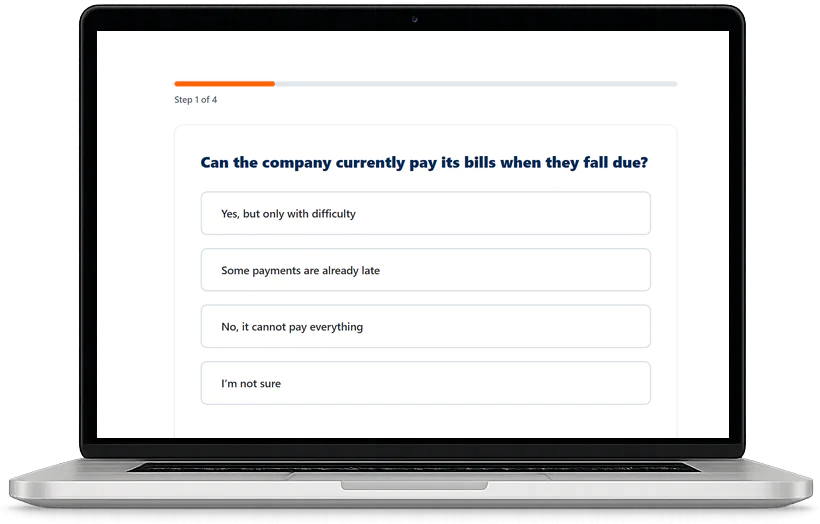
Could Your Company Be Insolvent?
Answer four short questions to see which warning signs apply, how serious the position may be and how soon you may need to act.
See which options may fit your company’s circumstances.
Check my company’s positionSee your result online and receive a copy by email. We only call if you ask.
What Happens When a Company Cannot Pay Its Suppliers
The escalation sequence from unpaid invoice to formal insolvency is short and well-trodden.
- Trade credit withdrawn. The supplier moves to cash on delivery. Other essential suppliers often hear about it through credit-reference agencies or industry gossip within weeks.
- Supply chain disruption. Deliveries halt or require prepayment. The business starts running on depleted stock, which either costs sales or requires expensive alternative sourcing.
- Collection escalation. Persistent internal chasing gives way to third-party debt collection agencies, adding fees and taking a harder tone.
- Statutory demand. For debts over £750, the supplier formally demands payment and gives 21 days to respond.
- Winding-up petition. Unpaid statutory demand at 21+ days supports a petition to the court. Once advertised in The Gazette, the petition freezes company bank accounts and is usually the point at which trading becomes practically impossible.
The timeline from first missed invoice to winding-up petition is usually 90–180 days. Your window for useful action closes sharply around the statutory demand stage, once the petition is filed, your options narrow to defending it, settling it in full, or entering administration.
The Cash-Flow Test and What It Means for Director Duties
Under the Insolvency Act 1986, two tests determine corporate insolvency:
- Cash-flow test, unable to pay debts as they fall due. Directly triggered by persistent supplier arrears.
- Balance-sheet test, total liabilities (including contingent) exceed total assets.
Once either test is failed, your section 172 duty under the Companies Act 2006 pivots from shareholders to creditors as a whole.
From that moment, continuing to trade past the point where insolvent liquidation is unavoidable, without taking every step a reasonably diligent director would take to minimise creditor losses, is wrongful trading under section 214, with personal-contribution consequences for you as director.
Persistent supplier non-payment is, in insolvency terms, the most visible evidence that the cash-flow test has been failed. Acting on that signal quickly protects both your business and your personal position as director.
Practical Steps to Manage Supplier Debt Before It Escalates
The sequence that consistently produces the best outcomes:
- Pre-empt the call. Contact suppliers before their credit control contacts you. A director who leads the conversation with “we have a timing issue, here is what I propose” is in a materially different negotiating position from one responding to a formal demand.
- Propose a specific, dated payment plan. Suppliers accept plans they can put in their own systems, specific dates, specific amounts, specific first payment offered immediately. Vague undertakings are declined.
- Prioritise critical suppliers. Identify which suppliers’ loss would stop operations. Pay those first, negotiate delayed payment with non-critical suppliers. Do this openly with both sides; attempting to hide it rarely works and damages relationships further.
- Use short-term finance cautiously. An overdraft extension or an invoice finance facility can buy time if the underlying business is sound. Borrowing at 10–15% to pay supplier debt on terms that do not include interest is a poor trade if the cash-flow problem is structural rather than one-off.
- Seek professional advice early if the arrears are part of broader distress. The cost of an hour’s conversation with a licensed insolvency practitioner is trivial compared with the cost of finding out three months later that the window for rescue options has closed.
Formal Insolvency Solutions When Supplier Debt Cannot Be Repaid
When informal negotiation is no longer enough, three formal routes are available. The choice depends on whether the underlying business is viable if the historic debt is addressed. Our licensed IPs work through this assessment with directors at the first meeting.
Company Voluntary Arrangement (CVA)
A CVA is a legally binding agreement between the company and its unsecured creditors to repay a percentage of historic debt over 3–5 years while the business continues to trade. It requires approval from creditors holding 75% by value of the debt. Well-suited to businesses with viable ongoing operations but unmanageable legacy debt.
Administration
Administration produces a statutory moratorium against creditor action while the administrator pursues one of three objectives: rescue as a going concern, better outcome for creditors than immediate liquidation, or realising property to distribute to creditors. It removes control from directors, but the moratorium is often the decisive tool when a winding-up petition is imminent.
Creditors’ Voluntary Liquidation (CVL)
A CVL is the orderly wind-down route where the business is not viable. Directors retain control of the process by initiating it rather than waiting for a compulsory liquidation. Where director conduct is clean, a CVL closes the position with minimal personal-liability exposure.
Side-by-side comparison
| Route | Keeps the business trading | Director control | Typical creditor outcome |
|---|---|---|---|
| CVA | Yes, if viable | Retained | Agreed % over 3–5 years |
| Administration | Possible, via rescue or sale | Handed to administrator | Variable, depends on realisation |
| CVL | No, orderly closure | Initiated by directors; IP takes control | Distribution from realised assets |
Director Liability When Supplier Debt Remains Unpaid
Directors of a UK limited company are not automatically personally liable for supplier debt. Limited liability is the default; personal exposure arises through specific routes:
- Personal guarantees given to specific suppliers, typically on larger credit accounts or strategic supply arrangements.
- Wrongful trading under section 214, personal contribution to losses where continued trading after cash-flow insolvency worsened the creditor position.
- Fraudulent trading under section 213, where the business was carried on with intent to defraud creditors, including continuing to take supplier credit knowing the supplier would not be paid.
- Misfeasance under section 212, including preference payments to favoured creditors (often connected parties) while trade suppliers went unpaid.
The preference point catches directors out most often. Continuing to pay a connected-party supplier (a company owned by your spouse, for example) while third-party trade creditors go unpaid is a pattern liquidators reverse routinely. The payment is unwound, the liquidator recovers the sum from the connected party, and your conduct becomes a matter for the conduct report.
Engaging with a licensed IP early is the single most effective defence against these routes. The file of board minutes, IP advice letters, and dated cash-flow reviews that sits in our cabinet for a director who took advice in month one is the same file that later defeats a wrongful-trading claim; directors who only instructed us after the petition landed rarely have that paper trail to draw on.
Your Next Step When Suppliers Are Threatening Recovery
Where your supplier debt is isolated and the rest of your business is healthy, the payment-plan route usually resolves the position within 90 days. Where supplier debt is accompanied by HMRC arrears, rates arrears, or any formal action (statutory demand served, winding-up petition threatened), your conversation needs to move to formal options before the escalation closes them off.
Our licensed insolvency practitioners and business rescue specialists can assess your position in an hour, outline the practical and formal options, and provide the documented advice that protects both your business and your personal position. Call us free on 0800 074 6757 for confidential advice.
Supplier Payment Arrears FAQs
Can my supplier force immediate payment if the business has no funds?
Not without legal action. Suppliers can issue a statutory demand for debts over £750, giving you 21 days to pay. Unpaid demands support a winding-up petition. Each stage takes weeks, which is your window for useful engagement. Ignoring demands closes that window; responding with a credible plan keeps it open.
How soon can a statutory demand lead to a winding-up petition?
As soon as 22 days after the demand is properly served and remains unpaid and undisputed. In practice, suppliers often wait longer to see if payment arrives, but the legal minimum is 21 days. Once the petition is filed and advertised in The Gazette, company bank accounts freeze and trading usually becomes impossible.
Will personal credit be affected if my business cannot pay suppliers?
Generally no, for a limited company. Company supplier debt sits on the company’s credit file, not the director’s. Personal credit is affected only if a personal guarantee is given to the supplier (unusual on trade credit), or if the situation escalates to personal liability findings (wrongful trading, charging orders on personal property, bankruptcy).
Does starting a new company eliminate old supplier debts?
No. Your original company remains liable for its debts until formally wound up. Directors attempting to transfer assets at undervalue to a new company, or using a similar trading name without permission, face specific sanctions.
Those sanctions include transactions at undervalue unwound under section 238, phoenix-name restrictions under section 216, misfeasance claims, and potential disqualification. “Starting fresh” without properly closing the original company is a common and expensive mistake.
What if a supplier has already begun legal action?
The window for informal resolution narrows once formal action is live but does not close entirely. Settlements can still be reached; formal insolvency (administration in particular) produces a statutory moratorium that stops enforcement.
The urgent action is to get licensed-IP advice immediately. What you do next depends on the stage of the supplier’s claim and the condition of the rest of your business.
Methodology & Disclosure
This guide is written by the Company Debt editorial team, reviewed by licensed insolvency practitioners, and reflects UK insolvency and commercial law as at the last-reviewed date. Statutory references are drawn from the Insolvency Act 1986, Companies Act 2006, and the Late Payment of Commercial Debts (Interest) Act 1998.
Company Debt is a licensed UK insolvency practice. We can act as the licensed Insolvency Practitioner for any recommended CVA, Administration, or CVL under separate engagement. The 0800 number is a free confidential consultation.
Not Sure Where Your Company Stands?
Use the two-minute test to check the warning signs and see how soon you may need to act.
Check my company’s positionEstimates are fineWe only call if you ask us to
Sources & References
- Insolvency Act 1986, sections 123, 212, 213, 214, 216, 238, 239 — legislation.gov.uk
- Companies Act 2006, section 172 — legislation.gov.uk
- Late Payment of Commercial Debts (Interest) Act 1998 — legislation.gov.uk