


If you cannot pay your VAT bill, the situation is more common, and more fixable, than it feels right now. We talk to directors in exactly this position every week: the bill sat there for a month, then two, then a penalty notice arrived, and now a firmer letter has landed. What you do in the next few days matters more than how you got here.
Handled early, unpaid VAT can often be dealt with through a payment plan, provided the company is viable and the repayments are affordable. Left alone, it escalates: HMRC may agree a plan if you contact them before they start enforcing, but their willingness to deal narrows sharply once they do. Below, we set out what happens, what it means, and what to do now.
Can’t Pay VAT? Quick Answer
If you cannot pay your VAT, file the return anyway and contact HMRC before enforcement starts. Most viable companies clear VAT arrears through a Time to Pay arrangement, an instalment plan HMRC agrees where the business can sustain the repayments. If the company cannot pay its VAT or its other debts as they fall due, that is an insolvency question, and it is worth taking advice.
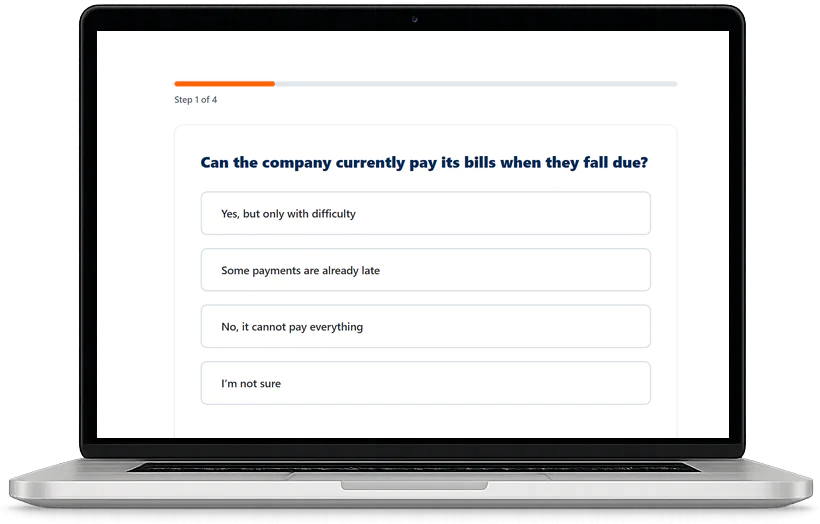
Could Your Company Be Insolvent?
Answer four short questions to see which warning signs apply, how serious the position may be and how soon you may need to act.
See which options may fit your company’s circumstances.
Check my company’s positionSee your result online and receive a copy by email. We only call if you ask.
What Directors Should Do First If You Cannot Pay VAT
A handful of actions in the first few days do most of the work. They cost nothing, and in our experience they are what separate a payment plan from a court petition.
- File the VAT return on time. Late filing and late payment are penalised separately, so a filed return you cannot pay is far better than filing nothing.
- Check the actual amount due. Confirm the figure, and any adjustments or corrections, before you negotiate anything.
- Work out what the company can afford. Set a realistic monthly figure from your cash flow over the next quarter, not just today’s bank balance.
- Contact HMRC before enforcement starts. Phone the Business Payment Support Service on 0300 200 3835. Early contact keeps every option open.
- Keep records of cash flow and decisions. If the company’s solvency is later questioned, notes made at the time protect you.
- Do not promise payments the company cannot make. A broken arrangement is harder to renegotiate than an honest, smaller one.
Can You Get a VAT Time to Pay Arrangement?
A Time to Pay arrangement is HMRC’s formal instalment plan for tax it is owed. In plain terms, you pay the VAT off in monthly chunks instead of one lump. For most directors it is the single most effective tool available, and worth pursuing before any formal insolvency route.
Setting up a plan online. Some companies can set up a VAT payment plan online without calling HMRC.
Eligibility depends on HMRC’s current conditions, which generally require that you have filed your outstanding VAT returns, owe no more than the self-serve limit, are within a set window of the payment deadline, have no other HMRC payment plans or debts, and can clear the balance within the maximum term.
Check the current thresholds on the VAT payment plan service before relying on them, because they change. Above those limits, or once enforcement has started, you arrange Time to Pay by contacting HMRC directly through the Business Payment Support Service on 0300 200 3835.
What HMRC will ask for. Have these ready before you call. HMRC respond far better to a specific, sustainable proposal than to a request for unspecified patience.
- the VAT amount owed;
- why the company cannot pay;
- what the company can afford each month;
- current and forecast cash flow;
- any other tax debts;
- whether future VAT returns can be paid on time.
HMRC also expects you to reduce the debt as far as you reasonably can first, for example by releasing assets such as stock or vehicles, and it may ask directors to put in personal funds or arrange lending before it agrees a plan. Go in expecting that conversation.
Acceptance is far more likely if you are up to date on PAYE, Corporation Tax, and current VAT returns. Behind on everything at once, and a plan is much harder to win.
A specific, affordable offer lands far better with HMRC than a vague request for more time, and putting one together is something we help directors with every week.
One thing we always flag: a plan can wrap up the VAT, penalties and interest together, and it can reduce or remove the penalties, but interest keeps running on the unpaid balance until it clears. Miss a payment and HMRC can cancel the arrangement and charge the penalties as if it had never existed, so only agree to what you can genuinely keep to.
If Time to Pay is refused. HMRC can decline a plan, or agree one and then cancel it if you miss an instalment or fall behind on a current return. If that happens, they may press for faster payment or move to recovery action.
A refusal also reframes the question. The directors we help who get a flat no are usually looking at a solvency problem rather than a timing one. That is the point to take advice, not to make a second offer you cannot keep.
VAT Penalties and Interest If You Pay Late
Late VAT carries two separate charges: a late payment penalty and late payment interest. The penalty is banded by how late you are, and a Time to Pay request made in time can stop it rising or prevent it altogether. Interest runs from the first overdue day regardless.
Up to 15 days late. There is no late payment penalty if you pay the VAT, or agree a Time to Pay arrangement, within 15 days of the due date. Late payment interest still applies from the first day the payment is overdue.
16 to 30 days late. From day 16 a first late payment penalty applies, calculated at 3% of the VAT still owed at day 15. Requesting Time to Pay within this window can stop the penalty rising further.
31 days or more late. If the VAT is still unpaid after day 30, the first penalty rises to 6% in total: 3% of the balance owed at day 15 plus 3% of the balance owed at day 30. From day 31 a second penalty then builds up daily, at an annual rate of 10% on whatever remains outstanding, until the debt is cleared. HMRC enforcement risk becomes serious at this stage.
| How late the VAT is | Penalty position | Interest position | What the director should do |
|---|---|---|---|
| Up to 15 days | No late payment penalty if you pay or agree Time to Pay in this window | Interest accrues from the first overdue day | Pay, or agree Time to Pay now |
| 16 to 30 days | First penalty: 3% of the VAT owed at day 15 | Interest still accruing daily | Request Time to Pay to stop it rising |
| 31 days or more | First penalty 6% total (3% at day 15 plus 3% at day 30), then a second penalty at 10% per year, accruing daily | Interest still accruing daily | Take advice; agree Time to Pay or a formal route |
The exact penalty and interest rates are set by HMRC and change over time. Interest is charged at the Bank of England base rate plus 4% per year. Confirm the current figures on GOV.UK before you rely on them.
A quick example. Say a company owes £20,000 in VAT and pays 40 days late. Nothing is charged for the first 15 days. At day 15 a first penalty of 3% (£600) applies, and as it is still unpaid at day 30 another 3% (£600) is added: £1,200 in penalties.
From day 31 a second penalty starts building daily at 10% a year on what is left, and interest has been running on the £20,000 since day one. We show directors this maths for one reason: paying sooner shrinks all three charges at once.
What Happens If You Still Do Not Pay VAT?
If nothing is in place, HMRC’s response follows a predictable path, and we see the same sequence play out again and again. The table below is what it looks like in practice, and where each stage sits on the risk scale.
| Stage | What it means | Director action | Risk level |
|---|---|---|---|
| VAT payment missed | The debt is live from the day after the deadline; HMRC’s system flags it automatically | Contact HMRC now | Low, but rising |
| Reminder or demand | A penalty notice, then formal demand letters as the tone shifts to enforcement | Respond and propose Time to Pay | Medium |
| Debt management contact | The debt is referred to HMRC’s debt management team, or to a collection agency acting for them | Engage and agree a plan | Medium to high |
| Payment plan discussion | HMRC may still agree Time to Pay if the business is viable | Put forward a realistic offer | Reducible |
| Enforcement or recovery | Enforcement agents under Taking Control of Goods (HMRC can seize company assets), or direct recovery from the company’s bank account | Take advice the same week | High |
| Statutory demand | A formal demand for a debt over £750. If the company does not pay, agree terms, or dispute it within 21 days, the creditor may use this as evidence the company cannot pay its debts | Take advice immediately | High |
| Winding-up petition | HMRC asks the court to shut the company down; HMRC is a frequent petitioning creditor in compulsory liquidation cases | Urgent insolvency advice | Severe |
The trigger for a winding-up petition is rarely the size of the debt. It is HMRC’s read on whether you intend to pay voluntarily. VAT arrears, like PAYE, signal that you may already have crossed that line. If a statutory demand arrives, treat it as a deadline, not a warning, and take advice the same week.
Can Unpaid VAT Lead to Insolvency?
In our experience, unpaid VAT is often the first hard evidence that a company is insolvent, and HMRC treat it that way. The money was never really yours: you collected it from your customers to pass on. Owing it is a different kind of signal from owing a supplier.
If the company cannot pay its debts as they fall due, including VAT, it meets the cash-flow test for insolvency. VAT debt rarely stands alone, and usually sits alongside PAYE, Corporation Tax, supplier arrears or loan arrears.
Since December 2020, VAT is a secondary preferential debt, which means HMRC gets paid ahead of banks holding a floating charge and ahead of ordinary unsecured creditors in the order creditors get paid.
HMRC now recover more from a liquidation than they used to, so they are less patient and quicker to petition. Where there is no realistic route to catch up, that is the point to take formal insolvency advice.
What Directors Risk When VAT Is Unpaid
First, the reassuring part: limited-company VAT is normally a company debt, not a personal one. Director conduct only becomes relevant where the company is insolvent, or close to it, and the exposure then usually comes through wrongful trading rather than a personal VAT bill.
HMRC can issue a personal liability notice for VAT, but that is reserved for deliberate default or evasion, not for a company that simply ran short of cash.
Most of the damage we see was not caused by the original bill. It was caused by what the director did, or failed to do, in the weeks after it.
- Continuing to trade when the company cannot pay its debts. If the VAT debt grows while the company is insolvent, a liquidator can seek a personal contribution under section 214. See what happens to directors in liquidation.
- Paying some creditors while ignoring HMRC. Preferring other creditors once insolvency is likely can be unwound and counted against you.
- Using VAT money to fund ongoing losses. Spending VAT you have collected to prop up a loss-making company deepens both the debt and the exposure.
- Making unrealistic promises to HMRC. A plan you breach is worse than a smaller one you honour, because a broken arrangement is harder to renegotiate.
- Failing to keep proper board or cash-flow records. Without notes made at the time, it is harder to show your decisions were reasonable.
- Taking dividends or repayments when the company is insolvent. Dividends drawn from a company that cannot pay its debts can be reclaimed, and directors’ loans called in.
These matter beyond the debt itself. This is also where director disqualification can start: the Insolvency Service looks at conduct like trading on when the company cannot pay, failing to keep proper records, not paying tax that is owed, or taking company money for personal use. Clean records and early engagement are what keep you on the right side of that line.
Options If the Company Still Cannot Pay VAT
If a standard Time to Pay arrangement is not enough on its own, a few routes remain. Which one fits depends on whether the business is fundamentally viable, and that is the first thing we look at with you.
| Option | When it fits | Main risk | Next step |
|---|---|---|---|
| Renegotiate Time to Pay | The company remains viable and can afford revised payments | HMRC may decline and resume enforcement | Call HMRC before you miss an instalment, not after |
| Short-term VAT funding | The VAT problem is temporary and repayment is realistic | Deepens the hole if the business is not viable | Check the borrowing is serviceable first |
| Company Voluntary Arrangement | A viable company that needs a formal creditor repayment deal | Requires creditor approval and disciplined delivery | Take advice from a licensed insolvency practitioner |
| Creditors’ Voluntary Liquidation | The company cannot recover | Ends the company; director conduct is reviewed | Take advice on an orderly closure |
| Company Administration | There may be a rescue or sale, or serious creditor pressure | Control passes to an administrator | Move quickly; options narrow under petition pressure |
The practitioners we work with deal with HMRC VAT debts every day, and a free, confidential conversation will clarify your position before HMRC forces it. Where a rescue is still possible, the earlier you talk to us, the more options remain open.
Not Sure Where Your Company Stands?
Use the two-minute test to check the warning signs and see how soon you may need to act.
Check my company’s positionEstimates are fineWe only call if you ask us to
Frequently Asked Questions
Can I pay VAT in instalments?
Often, yes, through a Time to Pay arrangement. Call the Business Payment Support Service on 0300 200 3835 with a realistic repayment proposal. Acceptance is more likely if you call before enforcement starts and are current on your other taxes.
Should I file my VAT return if I cannot pay?
Yes, always. Late filing and late payment are penalised separately, so filing on time and paying late is less damaging than doing neither. A filed return also shows HMRC you are engaging rather than hiding.
Will HMRC charge penalties if I cannot pay VAT?
There is no late payment penalty if you pay or agree Time to Pay within 15 days. From day 16 a first penalty of 3% of the VAT owed at day 15 applies; if still unpaid after day 30 that rises to 6% in total, and a second penalty then accrues daily at 10% a year. Interest also runs from the first overdue day.
Can HMRC close my company for unpaid VAT?
Yes. HMRC can ask the court to wind up your company, meaning shut it down, for any debt over £750. They are a frequent petitioning creditor in compulsory liquidation cases, and VAT debts do not need to be large for them to act.
Can directors be personally liable for unpaid VAT?
Normally VAT is a company debt, not a personal one. Personal exposure usually comes through wrongful trading, where you kept trading while insolvent and the VAT debt grew. HMRC can issue a personal liability notice, but only for deliberate default or evasion. VAT group registrations can carry joint and several liability.
What happens if HMRC refuses Time to Pay?
HMRC may press for faster payment or move to recovery action. A refusal usually means the company cannot fund a realistic plan, which is a solvency question rather than a timing one. That is the point to take insolvency advice rather than make a second offer you cannot keep.
Can I get business funding to pay VAT?
Where the business is viable and the shortfall is temporary, short-term funding can clear the VAT and replace an HMRC debt with a commercial one on terms you control. It only makes sense if the underlying business can service the borrowing. Using finance to prop up a company that is not viable usually deepens the hole.
When should I speak to an insolvency practitioner?
When the VAT debt is beyond what a realistic Time to Pay plan can clear, when HMRC has refused or cancelled a plan, or when a statutory demand arrives. The earlier the conversation happens, the more options remain open.