Should I Pay HMRC or Suppliers First?




Payroll is due on Friday, a VAT payment is already late, and the supplier who keeps the production line running has just said everything stops unless they are paid today. A director with limited cash has to decide who is paid first. And whichever choice is made, the others will be unhappy about it.
Under UK insolvency law, your decision is not purely commercial. Once your company is on the edge of insolvency, paying one creditor in preference to another can be unwound later as a “preference” under section 239 of the Insolvency Act 1986.
HMRC has a specific preferential ranking that adds another layer. The wrong choice, made without advice, produces your personal liability as director that the right choice would have avoided.
Below we set out the UK legal framework for who you should pay first when your cash is short, HMRC’s preferential status, when paying a supplier ahead of HMRC is defensible, and where the line sits between your commercial choice and preference risk. In our practice, the director who documents the reasoning at the time is the one who defends it successfully later.
The Quick Answer: Who Should Be Paid First When Cash Is Short
For a solvent company with a temporary cash squeeze, you can prioritise on commercial grounds: the supplier who stops production, the landlord who will forfeit, the employee who will sue. The decision is yours and it is defensible on those grounds alone.
For a company approaching or in insolvency, the rules change. The director’s duty under section 172 of the Companies Act 2006 shifts to creditors as a whole. Paying one ahead of others can be reversed, unless the payment was either:
- Essential to continued trading that will benefit creditors as a whole, and made in the ordinary course of business, or
- Made to a creditor ranking higher in the insolvency waterfall than the creditors being deferred.
The cleanest practical answer in a distressed company: pay HMRC for in-period liabilities (current VAT, PAYE, NICs) as they fall due; pay essential operational suppliers whose loss would stop trading; engage with other creditors on payment plans; and do not pay connected parties (director’s loans, related companies) ahead of third parties.
How Serious Is Your Company’s Position?
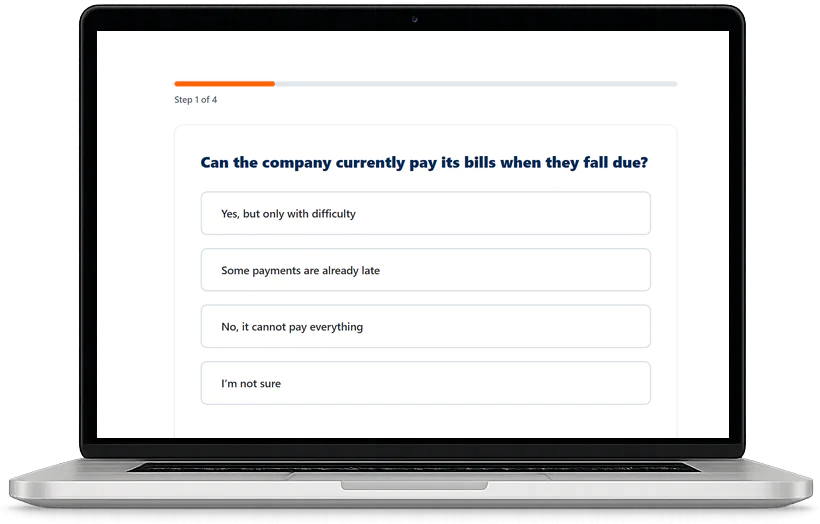
Answer four short questions to see how urgent the situation may be and which options could fit your company’s circumstances.
Check my company’s positionSee your result online and receive a copy by email. We only call if you ask.
Why Payment Decisions Matter for Directors
The legal reasons payment choices matter in distress:
- Preference reversal under section 239, a liquidator can apply to the court to unwind payments made in the 6 months before insolvency (2 years for connected parties) where the payment improved the recipient’s position at the expense of other creditors.
- Transaction at undervalue under section 238, related but distinct, catching payments for less than proper consideration.
- Misfeasance under section 212, breach of director duty, including making unlawful distributions or preferential payments.
- Wrongful trading under section 214, personal contribution for losses caused by continued trading past the point of unavoidable insolvency.
The practical effect: a payment that seemed reasonable at the time, keeping a supplier sweet, keeping payroll running, can be reversed, with the director personally exposed for the recoverable amount plus costs.
When Preferential Payments Can Be Challenged Later
The statutory conditions for a preference claim under section 239:
- The company was insolvent at the time of the payment, or became insolvent as a result of it.
- The payment was made to a creditor (or surety or guarantor of a creditor).
- The payment improved that creditor’s position relative to what it would have been in the company’s insolvency.
- The company was influenced by a desire to prefer the creditor (presumed for connected parties; must be proved for unconnected parties).
- The payment was made in the relevant period before insolvency: 6 months for unconnected creditors, 2 years for connected parties.
The “desire to prefer” element is the one litigated most often. For unconnected payments, the liquidator has to prove that the director actually wanted the creditor to do better than the creditor would otherwise. For connected parties, the desire is presumed, it falls to the director to prove otherwise.
The defence most commonly successful: the payment was made in the ordinary course of trading, for value, and kept the business going. A supplier payment that allowed production to continue, leading to further sales and creditor benefit, is usually defensible. A payment to the director’s spouse’s company, made while trade creditors went unpaid, is usually not.
HMRC’s Preferential Status in UK Insolvency Explained
Since 1 December 2020, HMRC holds a partial secondary preferential status under the Finance Act 2020 for specific taxes:
- Secondary preferential for VAT, PAYE, NIC, and CIS deductions, ranking ahead of floating-charge holders and unsecured creditors in the insolvency waterfall.
- Ordinary unsecured for Corporation Tax and tax-related interest and penalties, ranking alongside trade creditors.
This secondary preferential status matters for two reasons. First, in liquidation the secondary preferential debts are paid out of the asset pool after fixed-charge holders and employee preferential claims but before floating-charge holders, giving HMRC significantly better recovery than pre-2020.
Second, a payment of in-period VAT/PAYE/NIC by your distressed company is rarely preference-vulnerable because HMRC would have received it anyway out of the waterfall. That gives you more room than you might think.
The practical implication: paying HMRC current-period liabilities while the company is approaching insolvency is usually safer than paying unsecured trade creditors, because HMRC’s priority ranking means the payment does not materially prejudice the recoveries other creditors would receive.
When Suppliers May Need Paying First
The scenarios where paying a supplier ahead of HMRC is defensible:
- Essential ongoing supply, where the supplier provides goods or services without which the business cannot continue to trade. Payment made in the ordinary course is defensible as supporting continued trading for all creditors’ benefit.
- Retention of title goods, where the supplier retains title until payment, the supplier is in a priority position anyway; paying to release the goods is usually unproblematic.
- Secured creditor payments, secured creditors rank ahead of HMRC’s secondary preferential claim, so paying them does not prejudice HMRC’s position.
- Documented commercial necessity, contemporaneous board minutes recording the reasoning and the alternatives considered. The paper trail defeats a later “desire to prefer” finding.
The pattern that produces preference claims is very specific: paying an unsecured creditor in full (not essential, not ongoing) while other similarly-ranked creditors go unpaid, where the insolvency happens within 6 months. A distressed director who settles one £20,000 supplier invoice in full while leaving HMRC £200,000 in arrears is in exactly the territory section 239 was written for.
Protecting Yourself From Preference Claims
The practical steps that defend against later preference findings:
- Licensed IP advice before making material choices. Once insolvency is in view, documented contemporaneous advice is the single strongest defence. Take the advice, follow it, keep the records.
- Pay in the ordinary course of business. Regular supplier invoices paid on normal terms are usually defensible. Lump-sum arrears payments to one creditor while others go unpaid are not.
- Never pay connected parties in preference when insolvency is near. The 2-year lookback and the presumption of desire to prefer make connected-party payments the highest-risk category.
- Keep in-period HMRC liabilities paid on time where possible. Current VAT, PAYE, and NIC are what HMRC focuses on; arrears are negotiable through Time to Pay.
- Document every decision contemporaneously. Board minutes recording the reasoning, the alternatives, the commercial necessity, and the advice taken. This is the material that defeats preference claims in litigation.
Your Next Step on Pay HMRC or Suppliers First Decisions
If the company is solidly solvent and the cash squeeze is temporary, commercial judgment prevails. Prioritise as makes business sense; the preference rules do not bite.
If there is any doubt about your solvency (persistent arrears, HMRC pressure mounting, creditor demands formalising), one of our licensed insolvency practitioners needs to see your numbers before your next big payment decision is made. Our practice is to produce a written advice note the same day, so you have the paper to defend the decisions that follow.
Blunt version: the payment that feels most urgent in the moment (the supplier threatening to walk, the landlord on the phone) is almost never the one most dangerous to the director’s personal position. The dangerous payment is the quiet one to a spouse’s company, to your own loan account, or to a friendly creditor you felt you owed. Those are the ones a liquidator finds first.
Our IPs and business rescue specialists can model your insolvency position, provide documented advice on payment priorities, and implement a formal process where one is the right answer. Call us free on 0800 074 6757 for confidential advice, and ask for our payment-priority diagnostic.
Check How Serious the Position May Be
Answer four short questions to see how urgent the situation may be and which broad options could fit.
Check my company’s positionEstimates are fineWe only call if you ask us to
FAQs on Paying HMRC or Suppliers First
Can I prioritise employees over HMRC?
Employees rank as preferential creditors in liquidation for unpaid wages up to £800 per employee under Schedule 6 of the Insolvency Act 1986, alongside HMRC’s secondary preferential claims. Paying employees current wages in the ordinary course of business is defensible; making lump-sum back-pay payments while HMRC goes unpaid is riskier and should be done on documented IP advice.
Does HMRC always rank ahead of suppliers?
For VAT, PAYE, NIC, and CIS deductions, yes, since 1 December 2020, HMRC holds secondary preferential status ahead of unsecured trade creditors. For Corporation Tax and tax-related penalties, no, HMRC ranks as an ordinary unsecured creditor, pari passu with suppliers. The priority difference matters directly in preference analysis.
How long can a preference be challenged after the fact?
Section 239 of the Insolvency Act 1986 applies to preferences made in the 6 months before the onset of insolvency for unconnected creditors, and in the 2 years before for connected parties. The liquidator has broad investigatory powers and can reconstruct payment history from bank statements.
What is a connected party for preference purposes?
Directors, shadow directors, their spouses and civil partners, certain relatives, companies they control or are associated with, business partners, and employees with sufficient influence. Connected-party status extends the lookback to 2 years and reverses the burden of proof, the director must show the payment was not influenced by a desire to prefer.
Is paying HMRC ahead of suppliers ever risky?
Rarely. HMRC’s secondary preferential ranking for VAT/PAYE/NIC means a payment of those taxes would have been made to HMRC out of the waterfall anyway, no prejudice to other creditors. For Corporation Tax (ordinary unsecured), a lump-sum payment ahead of suppliers could theoretically be a preference, but the “desire to prefer” element is difficult to prove where HMRC has been applying pressure.
What if the supplier threatens to stop supplying without payment?
Commercial necessity is a recognised defence against preference claims where the payment was made in the ordinary course to maintain supply for the benefit of all creditors. Document the threat, the commercial reasoning, and the decision contemporaneously. Where the payment pattern is credible, continuing supply in exchange for continuing payment, the defence usually holds.