Hospitality & Restaurant Insolvency in the UK: Causes, Risks & Rescue Options




A restaurant’s last good month is rarely the one that closes it. The closing months arrive later, after the Sky Sports invoice goes unpaid, after the Calor Gas final demand lands on the pass, after the suppliers stop returning calls.
By the time a hospitality director rings for help, the Friday payroll is already in question and the landlord’s solicitor has sent a letter that is not a letter so much as a countdown. If that is where you are now, the options are real but narrowing.
UK insolvency law imposes specific duties on directors the moment financial distress becomes serious. Get those duties wrong and the personal risk follows you out the door. Get them right and you can stabilise, negotiate, and in many cases rescue a business that looks finished but is not.
We have helped hospitality directors through both outcomes, and the difference between them almost always comes down to how early they acted.
Hospitality & Restaurant Insolvency at a Glance
Hospitality and restaurant insolvency runs on a quarterly rent / weekly PAYE / monthly VAT cadence that is unforgiving once cash slips. The sector-specific pressure points are commercial lease forfeiture (peaceable re-entry within 14-21 days of arrears unless the administration moratorium under Schedule B1 IA 1986 catches it), TUPE for high-turnover front-of-house staff, customer deposits and gift cards as unsecured claims, and the alcohol licence transfer under section 47 Licensing Act 2003.
Quick Answer: Hospitality & Restaurant Insolvency
A hospitality business is legally insolvent when it cannot pay its debts as they fall due (cash-flow test, Insolvency Act 1986 s.123(1)(e)) or when its liabilities exceed its assets (balance-sheet test, s.123(2)).
At that point, directors must shift their primary duty from growing the company to minimising creditor losses. Trading through insolvency without that shift is what creates personal liability.
When Hospitality & Restaurant Insolvency Becomes Critical
The inflection point is rarely a single missed bill. It is when you are using this week’s cover revenue to pay last month’s VAT while suppliers are already on seven-day pro-forma terms and rent is two quarters in arrears.
At that level of stacking, the business has crossed from tight cash flow into structural distress. The question is no longer whether to act but which formal tool fits your situation.
Main Director Risk in Hospitality & Restaurant Insolvency
Wrongful trading is the headline risk, but the practical danger that catches most hospitality directors is quieter. Selective payment to a connected supplier while HMRC ages in the background, taking customer deposits for events you cannot honestly say you will deliver, or drawing salary when the company cannot afford it.
Each of those is a documented liability problem in a later liquidation, and each is the kind of pattern our team sees in case files where the director ends up facing a contribution order.
What to Do Next About Hospitality & Restaurant Insolvency
Freeze discretionary spending, build a 13-week cash-flow forecast with every VAT, PAYE, rent and supplier due date visible, and speak to a licensed insolvency practitioner within the week.
Not because the law requires it at that precise moment, but because every week you wait removes one more option from the table. We see the consequences of delayed action regularly; the directors who call in week two have choices the directors who call in week twelve do not.
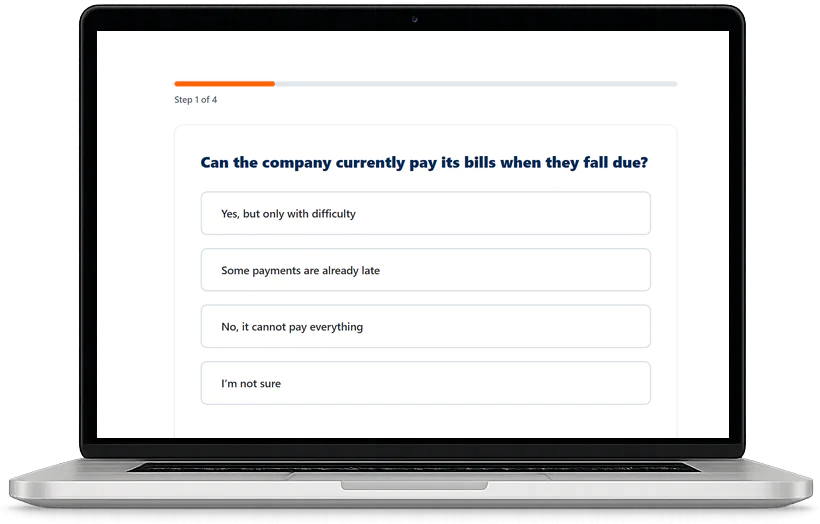
Could Your Company Be Insolvent?
Answer four short questions to see which warning signs apply, how serious the position may be and how soon you may need to act.
See which options may fit your company’s circumstances.
Check my company’s positionSee your result online and receive a copy by email. We only call if you ask.
What Hospitality & Restaurant Insolvency Means in Practice
Hospitality & Restaurant Insolvency: the Legal Tests
The cash-flow test asks whether your company can pay debts as they fall due. In a restaurant context, that means rent day, PAYE day, and the standing order for the linen supplier. Missing one in isolation is not automatically insolvency; missing several in a pattern you cannot reverse is.
The balance-sheet test looks at whether total liabilities, including contingent ones such as customer deposits, accrued holiday pay, and a PAYE liability you have been rolling, outweigh total assets.
A restaurant can pass the cash-flow test on a good Saturday and fail the balance-sheet test every day of the week. If you fail either test, your duty under Companies Act 2006 s.172 tilts toward creditor outcomes, and a court can later scrutinise decisions made from the point at which insolvency was known or knowable.
Difference Between Cash-Flow Pressure and Formal Insolvency in Hospitality
Cash-flow pressure is normal in hospitality: January is brutal, Easter moves, summer can disappoint. Formal insolvency is different. It is characterised by creditor pressure you cannot resolve from trading receipts, obligations you are deferring rather than paying, and a gap between incoming cash and committed costs that widens rather than closes.
The practical test: if you needed to pay every creditor who is currently overdue within the next 30 days, could you? If the honest answer is no, you are probably in insolvency territory and need regulated advice.
When Hospitality & Restaurant Insolvency May Not Be Recoverable
Not every distressed restaurant can be saved. The structural cases where recovery is unlikely involve a lease at above-market rent with no break clause and a landlord who will not negotiate, a concept that was already underperforming before any external shock, and personal guarantees on the lease and finance agreements that leave no room for a clean administration exit.
An HMRC debt compounded to a level a CVA cannot realistically service is also a hard constraint. Recognising this earlier rather than later is what separates a director who exits with their reputation intact from one facing a disqualification investigation.
We are direct about this: some businesses should close sooner than they do, and the director who acts on that clarity pays a lower personal cost than the one who trades on for another quarter hoping the numbers improve.
How to Assess Whether Hospitality & Restaurant Recovery Is Possible
Friday Payroll, Supplier Terms and Working Capital Fragility
The tell in a hospitality business is the gap between when money arrives and when it leaves. Cover revenue lands daily; payroll goes on Friday; rent goes quarterly; VAT goes monthly or quarterly; produce suppliers are on seven or fourteen-day terms; drinks suppliers on thirty.
A single bad month does not simply reduce the bank balance. It compresses the timing so that obligations from three different cycles land in the same fortnight. When that happens, you are effectively choosing which creditor to disappoint, not whether to disappoint one.
We have seen directors hold this together by persuading a drinks distributor to move from 14-day to 30-day terms, releasing enough float to pay PAYE on time. That kind of tactical cash management is legitimate and often overlooked. What it requires is a granular 13-week forecast that shows exactly when each payment falls, not a rough monthly view that hides the weekly cliff edges.
Lease Structure, Forfeiture Risk and Landlord Enforcement in Hospitality Insolvency
A tied pub tenancy under the Pubs Code 2016 (Small Business Enterprise and Employment Act 2015) sits in a different position to a free-trade lease or a short-form licence. Tied tenants have the right to request a Market Rent Only option, which removes the tied beer and product obligations in exchange for a market rent.
In distress, that mechanism can materially reduce operating costs and change the viability calculation. If you are a tied tenant and you have not explored that option, it is worth understanding before you conclude the site is unrescuable.
For all hospitality tenants, the forfeiture risk is real and faster than most directors expect. Under common law, a landlord whose lease contains a forfeiture clause for non-payment of rent can exercise peaceful re-entry once rent is overdue by the period the lease specifies, often as short as 14 or 21 days.
There is no court order required for peaceable re-entry. The landlord can change the locks while you are closed on a Monday morning. We have seen this happen with no prior warning; by the time the director calls us the stock is already inaccessible.
Administration provides a statutory moratorium that prevents a landlord forfeiting by peaceable re-entry without court permission. That protection is one reason a distressed hospitality business with a viable brand sometimes enters administration: not primarily to sell, but to buy time to negotiate a lease surrender or restructuring.
If forfeiture is imminent, that window matters more than any other single factor in our assessment of your options.
Premises Licence, Food Licence and Regulatory Continuity
Under the Licensing Act 2003, a premises licence lapses when the licence-holder company is wound up or enters certain other insolvency events. That sounds technical until you realise what it means in practice. If your company goes into liquidation while still holding the premises licence, the licence does not automatically pass to the buyer of the business or to the insolvency practitioner.
There is a remedy: an interim authority notice under s.47 of the 2003 Act can reinstate a lapsed licence temporarily. But it must be served within seven days of the lapse event and only certain people can serve it. Miss that window and you are seeking a new premises licence from scratch, which takes weeks and means the business cannot serve alcohol in the meantime.
We treat licensing as a day-one priority in our hospitality insolvency planning: the DPS change, the interim notice, the timing of the appointment all need to be coordinated before the formal process starts, not after. Get the sequencing wrong and you hand a buyer a property they cannot trade from on day one of their ownership.
Food Standards Agency registration follows the premises and the operator. If the operator changes because a buyer acquires the business, the new operator needs to register as a food business with the local authority. Environmental Health Officers conduct inspections and their records attach to the premises.
Food compliance is not separate from the insolvency process: it is part of the value preservation story and buyers factor it into their pricing.
Options for Hospitality & Restaurant Insolvency Recovery
Company Voluntary Arrangement for Restaurants and Pubs
A Company Voluntary Arrangement (CVA) is a binding agreement between your company and its unsecured creditors, supervised by a licensed insolvency practitioner. You propose a plan: typically a reduced or deferred repayment of past debts funded by future trading surplus, while current creditors continue to be paid in full.
If 75% by value of the creditors who vote approve the proposal, it binds all unsecured creditors, including those who voted against. For hospitality, the CVA works best where the underlying concept is viable, the site economics improve once historic debt is restructured, and creditors can be persuaded that returns under a CVA exceed what they would recover in liquidation.
Landlords have become more sophisticated and sometimes aggressive in voting against proposals that compromise their arrears. That does not make CVA unavailable; it means the economics must be compelling and the proposal must be credible. The biggest CVA failure mode in hospitality is proposing a plan based on trading projections that are too optimistic.
A CVA that fails two years in leaves you in a worse position than if you had started with a frank appraisal: the professional costs are sunk, creditor goodwill is exhausted, and the formal insolvency that follows is messier than it would have been at the outset.
Our view, based on the hospitality CVAs we have seen succeed and fail, is that the proposal must reflect what the business can actually sustain, not what a recovery scenario might produce.
Administration and Pre-Pack Sale of a Hospitality Business
Administration places your business under the control of a licensed insolvency practitioner who has a statutory duty to act in the interests of creditors as a whole. The administrator can continue trading, pursue a going-concern sale, or facilitate a restructuring.
The moratorium that applies on appointment prevents most creditor enforcement actions, including forfeiture of the lease, without court permission.
A pre-pack administration involves the administrator negotiating the sale of the business before appointment and completing it immediately afterwards. Pre-packs preserve the brand, the trading relationships, and the staff without the disruption of an open trading administration. They are the most common outcome in distressed hospitality sales where the brand has genuine value.
Connected-party pre-packs (where a director buys back the business) are possible but subject to independent scrutiny requirements under the Administration (Restrictions on Disposal etc. to Connected Persons) Regulations 2021.
Staff and TUPE deserve specific attention in a hospitality sale. Agency staff on zero-hours contracts complicate a clean transfer; the legal position on whether they transfer depends on the specific terms and the nature of the arrangement.
Permanent staff in a going-concern sale are more straightforward: TUPE applies, contracts transfer, and dismissals connected to the transfer for economic, technical or organisational reasons are potentially fair with proper consultation. This is a fact-specific analysis that requires employment advice alongside the insolvency advice, and we coordinate both workstreams in our pre-pack process.
Creditors’ Voluntary Liquidation for Restaurants
Where there is no viable rescue and no credible sale, a Creditors’ Voluntary Liquidation (CVL) is the director-initiated closure route. You appoint a licensed insolvency practitioner as liquidator, who takes control of the company, realises the assets, and distributes proceeds to creditors in the statutory order.
The reasons to choose CVL over simply stopping trading and waiting for a creditor petition are stark. A CVL places you in a better position for the conduct investigation that follows: it demonstrates cooperation, allows you to prepare the company’s affairs properly, and reduces the period during which wrongful trading risk accumulates.
For eligible employees, a CVL starts the clock on their ability to claim statutory redundancy pay and notice pay through the Insolvency Service, capped at £751 per week from 6 April 2026 under Schedule 6 of the Insolvency Act 1986.
Customer deposits and prepaid bookings become creditor claims. Gift-card holders rank as unsecured creditors. Neither is a comfortable outcome, but continuing to take bookings you cannot honour creates both a preference risk and a fraud risk that our liquidators will examine.
Director Risks During Hospitality & Restaurant Insolvency
Wrongful Trading Risk From Continued Restaurant Operations
Wrongful trading under Insolvency Act 1986 s.214 applies where a director knew, or ought to have concluded, that there was no reasonable prospect of the company avoiding insolvent liquidation, yet continued to trade without taking every step to minimise loss to creditors.
The standard is objective as well as subjective. Many hospitality operators run on instinct rather than formal management accounts, and that does not protect them from the objective test.
The practical defence is documentation: board minutes or written records showing what the financial position was at each decision point, what options were considered, what professional advice was taken and when, and why the decision to continue trading was consistent with minimising creditor loss.
A director who has a 13-week forecast, a note of the HMRC call, a written proposal from the insolvency practitioner, and a record of the decision to proceed is in a materially better position than one with a hazy recollection of conversations and a Sage file that has not been reconciled since November.
Preference Risk From Supplier and Connected Party Payments
A preference under Insolvency Act 1986 s.239 occurs where a company, in the knowledge that it cannot pay its debts, pays one creditor in a way that puts that creditor in a better position than they would have been in a liquidation. The lookback period is six months for unconnected parties and two years for connected parties (directors, their families, associated companies).
The payment does not need to be fraudulent. It needs to be, in the liquidator’s view, influenced by a desire to prefer.
In hospitality distress, the payments that create preference risk are usually the quieter ones: paying the wine merchant you have a personal relationship with while leaving PAYE unremitted, paying rent to a property company connected to the director, drawing a salary increase in the three months before the company collapses.
None of these are necessarily dishonest. All of them are exactly what our liquidators find in the case files, and the kind that, if challenged, can result in a personal contribution order against you.
Director Record-Keeping and Evidence in Hospitality Insolvency
An insolvency practitioner’s report to creditors, and subsequently to the Insolvency Service where conduct is a concern, is built from the documentary record. If the record shows nothing, the report says little good. If it shows decisions made on the basis of current information, with professional advice, with creditor outcomes in mind, the case for disqualification is much weaker.
What you need is not an elaborate governance structure. You need a dated cash-flow forecast, a record of the HMRC conversations, copies of the professional advice you received, and a brief written note of the reasons for any significant payment decisions.
That is achievable in a few hours per week even in an active restaurant operation. The alternative, reconstructing your decision-making after the event, is not something you want to be doing under questioning from a liquidator.
What Directors Should Do About Hospitality & Restaurant Insolvency
Build a 13-Week Cash-Flow Forecast Before Friday’s Payroll
The 13-week cash-flow forecast is the first thing a licensed insolvency practitioner will ask for and the first thing you should build before any other decision. It does not need to be a financial model: a column per week, each week’s opening balance, each week’s receipts from covers and events, and each week’s payments out.
Start with the non-negotiables (PAYE, VAT due dates, rent, standing orders) and work outward from there.
The point is not precision. The point is visibility. When you can see that the business runs out of cash in week six regardless of trading performance, the conversation with an insolvency practitioner becomes very different from a vague sense that things are difficult.
Our experience is that this clarity, however uncomfortable, is what triggers the decisions that protect you.
Friday payroll is where the crisis often becomes concrete. You can manage a creditor for another week; you cannot tell your kitchen team on Thursday evening that wages will not arrive. Build the forecast with payroll as the first constraint, not the last one. Our team uses the same 13-week structure with every hospitality director we advise, regardless of the size of the operation.
Engage HMRC and Landlords Before Enforcement Escalates
HMRC’s Time to Pay arrangement is available to businesses that engage early, have returns filed, and can propose a realistic repayment plan. Proposals are assessed on current affordability, projected trading, and the credibility of the plan to clear arrears while maintaining current obligations.
A credible proposal, even one that involves paying over 18 months, is almost always preferable to the enforcement ladder that follows non-engagement: late-payment penalties, distraint, and ultimately a statutory demand that gives creditors the platform to present a winding-up petition.
We have helped operators negotiate Time to Pay arrangements covering VAT and PAYE arrears well into six figures; the key is always to engage before enforcement starts, not after.
With landlords, the conversation is harder because the commercial interest is more direct. A landlord with a forfeiture right and an above-market tenant has less incentive to negotiate than HMRC.
What changes the landlord’s calculus is demonstrating that the alternative (a void premises, rates liability during the void, re-letting costs) is worse than a structured payment plan or a negotiated lease surrender with a transitional period.
Take Regulated Insolvency Advice Before Hospitality Options Close
We work with hospitality directors across the full range of situations: from businesses that are tight but recoverable with a CVA and a rent renegotiation, to operations where the premises licence has already lapsed and the only question is how to close without personal liability.
The consistent finding from our advisory work is that directors who act early preserve more options, face less personal scrutiny, and generally close or restructure with less damage to themselves and their staff.
Those who act late, typically after a winding-up petition is filed or after the landlord has already changed the locks, have far fewer choices and face much harder questions from liquidators.
A confidential initial conversation carries no commitment and costs nothing. For the full range of company rescue solutions available before closure becomes the only path, including options specific to hospitality operators with tied leases, suppressed licensing value, or agency-heavy staffing structures, that conversation is where the picture becomes clear.
Company Debt is a trading name of a connected licensed insolvency advisory business. We refer to regulated practitioners and take a fee for those introductions where a formal procedure follows.
Your Next Step
If Friday payroll is the immediate problem, the answer is a 13-week cash-flow forecast and a call to a licensed insolvency practitioner today, not next week. The gap between what you can pay and what is owed either closes from here or widens: there is no steady state in a cash-flow crisis.
If the business has structural margin failure (the site economics were wrong before the crisis hit), the question is not whether to rescue but whether a sale, a pre-pack, or an orderly CVL protects more of what matters: your staff’s redundancy entitlements, your personal position in the conduct investigation that follows, and your ability to operate again if you choose to.
Understanding CVL compared to other closure routes is worth doing before a creditor makes that choice for you.
The single piece of advice that applies to both types of distress: do not take further bookings or deposits you cannot honestly say you will deliver. That decision, more than almost any other, is what separates a director who exits with their reputation intact from one who spends the next two years managing a conduct investigation.
Related Hospitality & Restaurant Insolvency Guides
Company Rescue Solutions for Hospitality Directors
If your business is still trading but the pressure is severe, the company rescue solutions guide covers the full menu of formal and informal options before insolvency becomes the only path.
Company Voluntary Arrangement: How It Works for a Restaurant
For hospitality operators with a viable brand and cooperative creditors, the Company Voluntary Arrangement guide explains the proposal process, the 75% voting threshold, and the conditions under which a CVA fails and what happens next.
Pre-Pack Administration for Hospitality Sales
If a going-concern sale is the most likely outcome, the pre-pack administration guide explains how the process works, what independent scrutiny applies to connected-party deals, and how staff and licensing are handled in the transfer.
Not Sure Where Your Company Stands?
Use the two-minute test to check the warning signs and see how soon you may need to act.
Check my company’s positionEstimates are fineWe only call if you ask us to
Frequently Asked Questions About Hospitality & Restaurant Insolvency
Does a premises licence automatically lapse when a restaurant company enters insolvency?
Under the Licensing Act 2003, a premises licence held by a company can lapse on certain insolvency events, including liquidation. It does not automatically continue. There is a remedy: an interim authority notice under s.47 of the 2003 Act can reinstate the licence temporarily, but it must be served within seven days of the lapse event and only specified persons can serve it.
Miss that window and you are applying for a new licence from scratch, which takes weeks and means the business cannot serve alcohol in the meantime. Any insolvency planning for a hospitality business should treat the licensing position as a day-one priority, not a detail to sort out afterwards.
What happens to customer deposits and gift cards when a restaurant becomes insolvent?
Customers who have paid a deposit for a future booking, or who hold gift cards, are unsecured creditors of the company for the value they paid. In a liquidation, they rank alongside trade creditors and behind preferential creditors (employees) and HMRC, which has Crown preference for VAT, PAYE and NIC from December 2020.
In practice, unsecured creditors in a restaurant liquidation often receive little or nothing. A buyer in a going-concern sale may choose to honour deposits and gift cards as a commercial decision, but they are not legally required to do so.
Taking new deposits when you know you may not trade is money you are effectively borrowing from customers who do not know that is what is happening, and a liquidator will examine that pattern carefully.
Can a tied pub tenant use the Pubs Code to reduce costs before insolvency?
Yes, potentially. The Pubs Code 2016 gives tied pub tenants of large pub-owning businesses the right to request a Market Rent Only (MRO) option assessment. The MRO option, if taken up, removes the obligation to buy tied products from the pub-owning business in exchange for paying a market rent.
For a pub in distress, the arithmetic sometimes changes significantly: if the tied-product margin is material and the market rent is lower than the combined cost of the tie, the MRO route can reduce operating costs and make the site viable. This is specialist territory and the process has conditions, so advice from someone familiar with the Pubs Code is needed before initiating a request.
Does TUPE apply when a restaurant is sold out of administration?
TUPE (Transfer of Undertakings (Protection of Employment) Regulations 2006) can apply to a going-concern sale out of administration, but insolvency modifies the standard TUPE rules. Certain pre-transfer dismissals and agreed variations to terms are permitted in insolvency that would not be allowed in a solvent transfer, provided they are for an economic, technical or organisational reason.
Zero-hours and agency staff add complexity because whether their contracts transfer depends on the specific terms and the nature of the arrangement. A buyer should not assume that either all staff transfer or no staff transfer: the position needs to be assessed per worker category before the deal completes.
How quickly can a landlord forfeit a restaurant lease for rent arrears?
The speed depends on the lease terms. Many commercial leases include a forfeiture clause allowing the landlord to re-enter once rent is overdue by a specified period, commonly 14 or 21 days. Under common law, peaceable re-entry requires no court order.
The tenant’s protection against peaceable re-entry in insolvency comes from the administration moratorium, which prevents a landlord forfeiting by peaceable re-entry without court permission. Once forfeiture has occurred, applying for relief is possible but costly and time-sensitive. If you believe your landlord is considering action, take advice before the forfeiture happens, not after.
Will my staff get their redundancy pay if the restaurant goes into liquidation?
Where an insolvent employer cannot pay, eligible employees can claim statutory redundancy pay, arrears of wages (up to eight weeks), notice pay, and holiday pay through the Insolvency Service’s Redundancy Payments Service. Payments are capped at £751 per week from 6 April 2026 under Schedule 6 of the Insolvency Act 1986.
Employees then become creditors of the company for anything above the statutory cap, ranking as preferential creditors for up to four months of wages. The process requires a formal insolvency event to have occurred, which is why entering a CVL promptly rather than simply ceasing to trade matters for your staff’s ability to access those claims.
Does a CVA wipe out rent arrears for a restaurant?
A CVA can compromise rent arrears as part of the unsecured creditor proposal, but it does not delete them and it does not affect ongoing rent obligations. The arrears become part of the CVA repayment schedule, typically paid at a reduced rate or over a longer period than the creditor would otherwise accept.
Critically, the CVA does not change the lease terms: ongoing rent continues at the contractual rate, and a new default on current rent gives the landlord grounds to forfeit outside the CVA if the lease allows it. Landlords have become more active in negotiating CVA terms since the volume of retail and hospitality CVAs in recent years has made the commercial dynamics more familiar to them.