Alternatives to Company Liquidation: Rescue and Recovery Options for UK Businesses




Liquidation is not the only way to close or rescue an insolvent company. There are at least five formal alternatives under UK law, and each one exists because liquidation is the wrong answer for a specific set of circumstances.
We speak to directors every week who assume liquidation is inevitable because a creditor is pressing or HMRC is escalating. In roughly a third of those conversations, the company does not need to be liquidated.
It needs a different route, one that buys time, restructures the debt, or preserves the trading operation while the balance sheet is repaired. The problem is that most directors do not know these options exist until someone tells them, and by then the window for some of them has already closed.
Quick Answer on the Alternatives to Company Liquidation
The main alternatives are: Company Voluntary Arrangement (CVA), administration, informal creditor negotiation, time-to-pay arrangements with HMRC, and refinancing or asset-based lending. Each has a different entry threshold, cost profile, and level of director control.
The right one depends on whether the business is viable, how severe the creditor pressure is, and how much time you have before enforcement action lands.
If the business model is broken and the debts are structural, none of these alternatives will work. They buy time and restructure obligations, but they do not fix a company that fundamentally costs more to run than it earns.
We are honest about this because we see directors pursue rescue options that delay the inevitable, accumulate more debt, and increase their personal exposure to a wrongful trading claim.
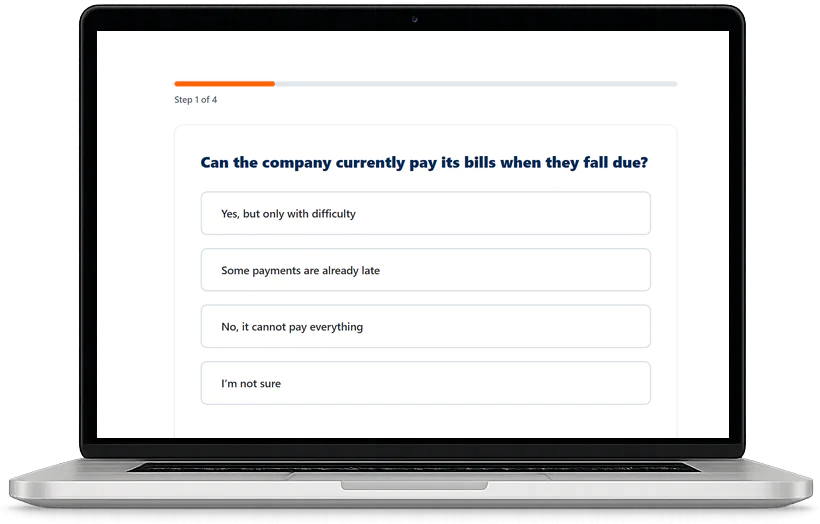
How Serious Is Your Company’s Position?
Answer four short questions to see how urgent the situation may be and which options could fit your company’s circumstances.
Check my company’s positionSee your result online and receive a copy by email. We only call if you ask.
Company Voluntary Arrangement (CVA): A Liquidation Alternative That Restructures Debts
A CVA is a binding agreement between the company and its creditors to repay a proportion of the debt over a fixed period, typically 3 to 5 years. It requires 75% creditor approval by value. The company continues to trade under your control, but a licensed insolvency practitioner supervises compliance with the arrangement.
We find CVAs work well when the business is genuinely viable but has a specific, identifiable debt problem: an HMRC arrears that accumulated during a slow period, a disputed supplier invoice that spiralled, or a lease obligation that became unsustainable.
The CVA freezes creditor action, reduces the total repayment to what the company can realistically afford, and lets you keep trading while the debt is managed down.
The risk is that CVAs fail if the underlying business is not strong enough to meet the monthly payments. We have seen companies enter a CVA, trade for 18 months, miss two consecutive payments, and end up in liquidation anyway with higher total debts than they started with.
A CVA is not a breathing space. It is a repayment commitment, and if you cannot meet it, the consequences are worse than if you had gone straight to liquidation.
Administration: A Liquidation Alternative With Court Protection
Administration places the company under the protection of the court and appoints an administrator (a licensed IP) to manage its affairs. The moment administration begins, an automatic moratorium stops all creditor enforcement: no winding-up petitions, no bailiffs, no legal proceedings without the court’s permission.
Administration serves three possible purposes under the Insolvency Act 1986: rescuing the company as a going concern, achieving a better result for creditors than immediate liquidation, or realising assets to make a distribution to secured or preferential creditors.
In practice, most administrations end in either a company sale or a transition to liquidation. Pure rescue, where the company emerges from administration and continues independently, is less common than directors hope.
Administration is more expensive than a CVA and involves a greater loss of director control. The administrator runs the company, not you. But if creditor pressure is intense and immediate, if a winding-up petition is imminent, or if the business has value that would be destroyed by a rushed compulsory liquidation, administration is the strongest tool available.
Informal Creditor Negotiation: A Liquidation Alternative With Maximum Control
Before you reach formal insolvency, there is usually a window for direct negotiation with creditors. This has no statutory framework, no court involvement, and no public record. You contact each creditor individually, explain the position, and propose revised payment terms.
We advise directors to try this first because it preserves maximum control and costs nothing beyond your time. The catch is that informal arrangements are not binding.
A creditor who agrees to a payment plan on Monday can change their mind on Friday and serve a statutory demand. There is no moratorium, no legal protection, and no enforcement freeze.
Informal negotiation works when creditors are willing and the company’s position is improving. It fails when creditors have lost trust or when one large creditor refuses to cooperate.
We have sat in rooms where a single phone call to HMRC’s payment support team resolved a £40,000 tax debt with a 12-month repayment plan. We have also sat in rooms where the same call came three months too late and HMRC had already instructed solicitors. Timing is everything in informal negotiation. The earlier you call, the more likely the creditor is to engage.
HMRC Time to Pay: The Most Common Liquidation Alternative
Time to Pay (TTP) is HMRC’s formal instalment arrangement for businesses that cannot pay their tax debts in full. It is the single most common alternative to liquidation that we see directors use, because HMRC is the single most common creditor that pushes companies toward insolvency.
A TTP arrangement lets you spread your tax debt over an agreed period, typically 6 to 12 months. HMRC will charge interest on the outstanding balance but will suspend enforcement action for the duration of the arrangement.
You must keep up with current tax obligations as well as the repayment plan. If you fall behind on either, HMRC can terminate the arrangement and resume enforcement immediately.
We tell every director: call HMRC before they call you. A director who contacts HMRC’s Business Payment Support Service proactively, with a realistic proposal and evidence that the business can sustain the repayments, has a significantly better chance of being accepted than one who calls after receiving a statutory demand.
We have seen HMRC agree TTP arrangements for six-figure debts when the director engaged early and honestly. We have also seen them refuse £5,000 arrangements when the director waited too long.
Refinancing and Asset-Based Lending: A Liquidation Alternative That Buys Time
If the company’s problem is cash flow rather than profitability, injecting new capital can bridge the gap. Invoice finance (borrowing against outstanding invoices), asset-based lending (borrowing against equipment, property, or stock), and commercial refinancing can all provide the liquidity needed to pay pressing creditors without entering a formal insolvency process.
We see this work when the company has a genuine order book, collectible debts, or unencumbered assets. It does not work when the company’s assets are already charged, when the debtor book is weak, or when the new borrowing simply delays insolvency by adding another creditor to the pile.
Refinancing an insolvent company without addressing the underlying problem is not rescue. It is displacement.
How to Choose the Right Liquidation Alternative for Your Company
- Business is viable, specific debt problem: CVA or informal negotiation.
- Creditor pressure is intense and immediate: Administration.
- HMRC is the main creditor: Time to Pay arrangement.
- Cash-flow gap with strong assets/order book: Refinancing or invoice finance.
- Business model is broken, debts are structural: None of these. Liquidation is the right answer.
If the business is viable but debt-burdened, the route is CVA or HMRC Time to Pay. Both preserve trading and restructure obligations. If creditor enforcement is imminent, administration provides the statutory moratorium.
If the business model is broken, none of the rescue routes will hold and a CVL on your terms is the cleaner exit. The first call establishes which applies.
If you are not sure which category your company falls into, that uncertainty is itself a reason to speak to a licensed insolvency practitioner before choosing. Company Debt’s regulated insolvency practitioners can assess all the options objectively. A conversation this week is worth more than another month of uncertainty.
Check How Serious the Position May Be
Answer four short questions to see how urgent the situation may be and which broad options could fit.
Check my company’s positionEstimates are fineWe only call if you ask us to
FAQs on Alternatives to Company Liquidation
Can I avoid liquidation if my company is already insolvent?
Possibly. A CVA or administration can be entered even when the company is technically insolvent, provided the business has a viable future. The key test is whether the underlying trading operation generates enough cash to service a restructured debt and cover ongoing obligations.
If it does, rescue is realistic. If it does not, liquidation is the appropriate route.
What is the cheapest alternative to liquidation?
Informal creditor negotiation costs nothing beyond your time. HMRC Time to Pay arrangements are also free to set up. CVAs typically cost £5,000 to £10,000 in nominee and supervisor fees. Administration is the most expensive, often £15,000 or more.
The cheapest option is not always the best. It depends on the severity of creditor pressure and whether an informal approach will hold.
Will a CVA stop HMRC from taking enforcement action?
If HMRC votes in favour of the CVA (or does not vote against it), they are bound by its terms and enforcement action is suspended. However, HMRC must approve the CVA proposal, and they can reject it.
Current tax obligations that arise during the CVA period must be paid on time. Falling behind on current taxes during a CVA is one of the most common reasons CVAs fail.
Can I use more than one alternative at the same time?
Yes. For example, you might negotiate informal payment plans with trade creditors while simultaneously applying for a TTP arrangement with HMRC and arranging invoice finance to improve cash flow.
Combining approaches is common and often more effective than relying on a single route. A licensed insolvency practitioner can help you coordinate multiple strategies.
How do I know if my company qualifies for administration?
The company must be or be likely to become unable to pay its debts. The administrator must believe that their appointment is reasonably likely to achieve one of the statutory purposes: rescue, a better result for creditors than immediate liquidation, or realising assets for secured/preferential creditors.
In practice, most companies that are considering liquidation would also qualify for administration. The question is whether administration would achieve a meaningfully better outcome.