


Three routes, one decision, and most directors pick the wrong one for your situation because the internet makes them sound interchangeable. They are not. A CVA keeps the company alive under a binding agreement with creditors. Strike-off dissolves it cheaply but only works if there are no debts. Liquidation winds it up formally through an insolvency practitioner.
The right choice depends on one question you need to answer honestly: is your company solvent or not?
Everything else follows from that. One director we worked with spent four months pursuing a CVA for a company that had been balance-sheet insolvent for two years. The CVA failed at the creditor vote, he lost the professional fees, and ended up in a CVL anyway. That is the cost of choosing the wrong route.
This guide sets out what each route actually does, who qualifies, what it costs, how long it takes, and the director-risk profile for each. It is written from our position as licensed insolvency practitioners at Company Debt, and reflects the first-call conversation we have with directors choosing between these three options every week.
Recovery Path
The Solvency Test Is the Only Reliable Starting Point for This Decision
Strike-off (DS01) requires the company to have no outstanding debts, no ongoing creditor obligations, and no trading in the last three months.
If any of those conditions is not met, strike-off is unavailable and using it anyway creates personal liability. Creditors can restore the company and pursue you personally. A CVA is only viable if creditors holding 75% of the debt by value will vote for the proposal, which requires the business to have genuine forward cashflow.
Liquidation is the correct route for any company that is insolvent and lacks creditor support for a CVA. Starting with the solvency test eliminates two of the three options immediately.
The Quick Answer: Which Route Fits Your Situation?
If the company is solvent (it can pay all its debts in full) and you want to close it, use strike-off if there are no material assets, or an MVL if there are retained profits to extract tax-efficiently. If the company is insolvent but the underlying business is viable and you want to keep trading, a CVA lets you restructure the debts over three to five years with creditor approval.
If the company is insolvent and there is no realistic prospect of trading out, a Creditors’ Voluntary Liquidation is almost always the cleanest exit. Mixing these up is the single most expensive mistake we see on first calls.
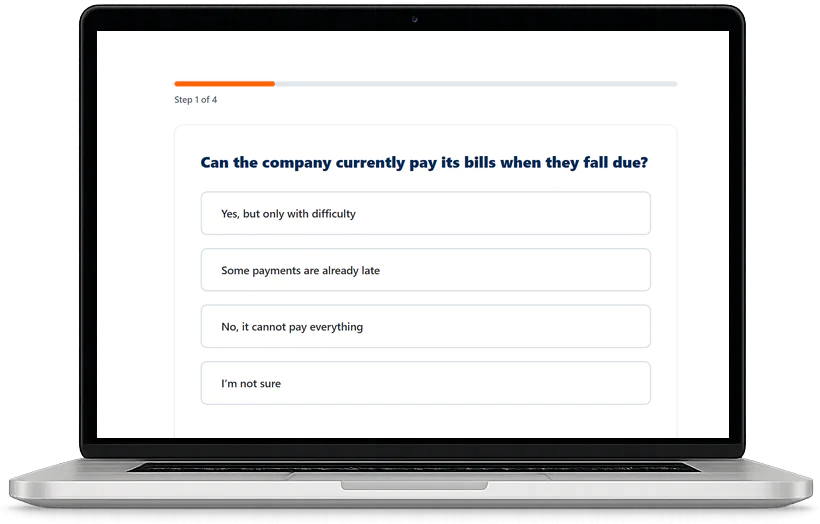
Could Your Company Be Insolvent?
Answer four short questions to see which warning signs apply, how serious the position may be and how soon you may need to act.
See which options may fit your company’s circumstances.
Check my company’s positionSee your result online and receive a copy by email. We only call if you ask.
Comparison at a Glance
Before the detail, here is the decision in compressed form:
- CVA: Company survives. Debts restructured over 3-5 years. Requires 75% creditor approval by value. Costs £5,000-£10,000+ in professional fees. Failure rate 30-40% within two years. Best for viable businesses with a temporary cash problem.
- Strike-off: Company dissolved. Costs £13 to £18. Takes 3 months. Only lawful if the company has no creditors and has not traded for 3 months. Since 2021, the Insolvency Service can investigate dissolved companies directly. Best for solvent dormant shells with no assets.
- CVL: Company wound up formally. Costs £3,500+ from assets or director funding. Takes 2-3 weeks to appointment, 6-18 months to complete. Full investigation of director conduct. Best for insolvent companies with no realistic rescue path.
When a CVA Is the Right Route
A Company Voluntary Arrangement is a formal, legally binding agreement between the company and its creditors to repay a proportion of the debts over a fixed period, usually three to five years, while the company continues to trade. It requires approval from 75% of creditors by value at a decision procedure, and once approved it binds all unsecured creditors, including those who voted against it.
A CVA works when three conditions are met: the underlying business is genuinely viable (it can generate enough cash to service the CVA payments and cover ongoing costs), the debt problem is temporary or structural rather than terminal, and the creditors believe the proposal is better than the alternative (which is usually liquidation with lower recoveries).
We tell directors that a CVA is not a way to avoid paying debts. It is a way to pay them slower, and the creditors will only agree if the numbers work.
The catch is the failure rate. Industry data shows 30-40% of CVAs fail within the first two years, usually because the trading projections were too optimistic or because an unexpected event (losing a key customer, a further HMRC assessment, a supply-chain disruption) tips the company back into crisis.
When a CVA fails, the company almost always ends up in liquidation anyway, having spent the CVA professional fees on top.
One director we advised had paid £8,000 in CVA fees, made 14 months of payments, then lost his biggest contract and watched the whole arrangement collapse. The subsequent CVL cost another £5,000. He would have been £13,000 better off going straight to liquidation. That is the risk you weigh.
Key Takeaway
Choosing the wrong closure route is the most expensive mistake we see on first calls.
A director who uses strike-off on an insolvent company faces the same liability exposure as one who dissolved the company informally. Creditors can restore it, the Insolvency Service can investigate conduct, and personal liability for company debts can follow. The £50 DS01 fee saves nothing if the company had outstanding creditors.
When Strike-Off Is the Right Route
Voluntary strike-off under Section 1003 of the Companies Act 2006 is the cheapest way to close a company: £13 online, £18 by post.
The company must not have traded or changed name in the last three months, must have no outstanding creditors, and must notify all relevant parties (employees, creditors, shareholders, pension trustees, HMRC) before filing the DS01 form. After a two-month notice period in the Gazette, the company is removed from the register.
Strike-off is right for solvent companies with no material assets, no debts, and no unresolved liabilities. The classic use case is a dormant shell the director no longer needs. It is wrong for any company that owes money.
Section 1003(3) prohibits voluntary strike-off where the company has outstanding creditors, and since the Rating (Coronavirus) and Directors Disqualification (Dissolved Companies) Act 2021, the Insolvency Service can investigate a dissolved company and pursue the director personally without needing to restore it first.
Strike-off is no longer an escape from debts. It is an administrative closure for clean companies. See our guide to liquidating a dormant company for the full decision framework.
The bona vacantia risk is the other trap. Any assets left in the company at the point of strike-off (bank balances, intellectual property, uncollected debtor balances, vehicles) vest in the Crown under Section 1012.
Recovering them later requires restoring the company, which is slow, expensive, and not guaranteed. We have seen directors lose five-figure bank balances to bona vacantia because they filed the DS01 before closing the account. The cost of the mistake is always higher than the cost of getting advice first.
When Liquidation Is the Right Route
A Creditors’ Voluntary Liquidation is the formal, supervised process for winding up an insolvent company.
The directors acknowledge the company cannot pay its debts, instruct a licensed IP, prepare a Statement of Affairs, and pass a shareholders’ resolution to wind up. The IP is appointed as liquidator, realises the assets, distributes the proceeds in the statutory priority order, investigates director conduct, and dissolves the company.
Liquidation is right when the company is insolvent and there is no realistic prospect of rescue.
It is also right when a CVA has been considered and rejected (either because the business is not viable or because creditors are unlikely to approve), or when a creditor is threatening a winding-up petition and the director wants to retain control of the process by entering a voluntary liquidation before the petition is filed.
We tell directors that liquidation is not a failure. It is the statutory mechanism for closing an insolvent business in an orderly way. The alternative, drifting, trading while insolvent, or attempting an unlawful strike-off, carries far more personal risk. See our guide on wrongful trading for the director-liability framework.
Cost and Speed: A Side-by-Side
The numbers matter because directors making this decision are almost always short of cash. Here is the realistic range:
- Strike-off: £13 to £18 filing fee. Total cost including back-filings and HMRC deregistration: typically £500-£1,500. Timeline: 3 months from DS01 to dissolution.
- CVA: £5,000-£10,000+ in nominee and supervisor fees. Monthly payments to creditors for 3-5 years on top. Timeline: 4-6 weeks to approval, then the full term of the arrangement.
- CVL: £3,500+ from assets or director funding. Timeline: 2-3 weeks to appointment, then 6-18 months for the liquidator to complete the case.
The grim arithmetic is that a failed CVA plus a subsequent CVL costs more than going straight to liquidation. We run the numbers for every director at the first call so you can see the maths before you commit so the decision is evidence-based, not emotional.
Director Control and Investigation Risk
The three routes carry very different personal-risk profiles for directors:
- CVA: No automatic investigation of director conduct. The company keeps trading and the director stays in post. If the CVA succeeds, no further scrutiny. If it fails, the subsequent liquidation triggers the full investigation.
- Strike-off: No investigation at the time of dissolution. But since the 2021 Act, the Insolvency Service can investigate retrospectively, and HMRC can pursue unpaid tax. Personal guarantees survive. Bona vacantia risk on any remaining assets.
- CVL: Full investigation of director conduct. The liquidator files a confidential report on every director (the D-report) to the Insolvency Service under CDDA s7A. Potential outcomes: no action (most common), disqualification undertaking, or disqualification by court order. Compensation orders are also available since 2015.
Our view is that directors who are straight about their conduct have nothing to fear from a CVL investigation. The ones who get caught are the ones who extracted cash, preferred connected creditors, or traded on when they knew it was over. If your conduct is clean, a CVL is the safest route precisely because it puts everything on the record in a controlled way.
The Verdict: How to Choose
The decision tree is simpler than most articles make it:
- Is the company solvent? If yes, strike-off (no assets) or MVL (assets to distribute).
- Is the company insolvent but the business viable? If yes, consider a CVA, but stress-test the projections honestly.
- Is the company insolvent with no realistic rescue? CVL, on your terms, before a creditor forces a compulsory winding-up.
If you are not sure which applies, that is what the first call is for. We will tell you within twenty minutes which route fits your situation. We will run the numbers, test the viability, and tell you honestly which route fits. The worst outcome is choosing the wrong one and paying twice.
FAQs on CVA vs Strike-Off vs Liquidation
Can I strike off an insolvent company?
No. Section 1003(3) of the Companies Act 2006 prohibits voluntary strike-off where the company has outstanding creditors. Attempting it exposes you to creditor objections, HMRC investigation, and since 2021, direct investigation by the Insolvency Service under the Dissolved Companies Act. If the company has debts, strike-off is not a lawful option.
What happens if my CVA fails?
The company almost always enters liquidation, either a CVL initiated by the directors or a compulsory winding-up forced by a creditor. The CVA fees are lost, and the subsequent liquidation costs are added on top. Industry data shows 30-40% of CVAs fail within two years. We run stress-tested projections before recommending a CVA to reduce this risk.
Is liquidation more expensive than strike-off?
Yes, significantly. Strike-off costs £13 to £18. A CVL costs £3,500+. But strike-off is only lawful for solvent companies with no creditors. If your company has debts, the comparison is not between strike-off and liquidation; it is between doing the right thing (liquidation) and doing the wrong thing (striking off an insolvent company and hoping no one notices). Since 2021, people notice.
Can I switch from a CVA to liquidation if it isn’t working?
Yes. If the CVA is failing or the company’s position has worsened, the supervisor (who is a licensed IP) can terminate the arrangement and the company enters liquidation. The transition is usually managed by the same practitioner. The cost is that you have paid for both processes instead of one.
Do I get investigated in all three routes?
Only automatically in a CVL, where the liquidator files a mandatory D-report on director conduct.
In a CVA, there is no automatic investigation unless the CVA fails and liquidation follows. In a strike-off, there is no investigation at the time, but since the 2021 Act the Insolvency Service can investigate retrospectively. The practical message: if your conduct is clean, the investigation is a formality. If it is not, no route hides it forever.
How do I know if my company is insolvent?
Two tests under Section 123 of the Insolvency Act 1986. Cash-flow: can the company pay its debts as they fall due? Balance-sheet: do the liabilities exceed the assets? If the answer to either is yes, the company is insolvent and strike-off is not available. See our guide on am I solvent? for the full assessment framework.
What is the fastest way to close an insolvent company?
A CVL. From first instruction to confirmed appointment is typically two to three weeks. The liquidation itself then runs for 6-18 months in the background while the liquidator deals with assets, creditors, and investigations. From the director’s perspective, the active involvement is frontloaded into the first few weeks. After that, the liquidator runs the process and you cooperate as needed.
Not Sure Where Your Company Stands?
Use the two-minute test to check the warning signs and see how soon you may need to act.
Check my company’s positionEstimates are fineWe only call if you ask us to
Related Guides
- Company Voluntary Arrangement: repaying creditors over time while you keep trading.
- Strike-Off and Dissolution: the cheapest way to close a company with no debts.
- Creditors’ Voluntary Liquidation: the standard route to liquidate an insolvent company.
- Company Administration: protecting a business that may still be worth saving.
- How Much Does Liquidation Cost?: the fixed CVL fee and what it covers.