


A company with nothing left in it can still be liquidated, and the reason directors ask whether they can simply walk away is usually that they cannot see what liquidation would achieve. There is nothing to sell and nothing to distribute, so the procedure looks like an expense with no purpose.
That reading misses where the risk actually sits. The exposures that follow an insolvent company are personal ones, and they do not shrink because the company’s bank balance did. Wrongful trading, disqualification and an overdrawn loan account all operate against you, not against the empty company.
Walking away does not close any of them. It removes the orderly process that deals with them and replaces it with a creditor petition or an Insolvency Service investigation, usually on someone else’s timetable.
The practical question is therefore not whether to liquidate but how to fund it when the company cannot. There are three answers, and one of them is routinely missed.
Quick Answer
A company with no assets and no bank account can still be liquidated. Three formal routes exist, and they are not interchangeable.
- Creditors’ Voluntary Liquidation, or CVL, under section 84 of the Insolvency Act 1986. You start it, you nominate the liquidator (creditors can choose someone else, and their choice wins), and you fund the work.
- Voluntary strike-off under section 1003 of the Companies Act 2006. Cheap, but only realistic if the company stopped trading at least three months ago and has no debts, because every creditor must be told and HMRC and other creditors routinely object.
- Compulsory liquidation under section 122 of the Insolvency Act 1986. A creditor petitions, so it costs you nothing directly. You also lose the choice of liquidator and face a wider conduct review.
For an insolvent company with nothing in it, a CVL funded by the director is the usual route. Our fee is £3,500 plus VAT for a straightforward case, with £500 to £1,500 of external costs on top.
Many directors can fund that from a redundancy claim against the Redundancy Payments Service rather than from their own pocket. That option is covered below, because it is the one most people have never been told about.
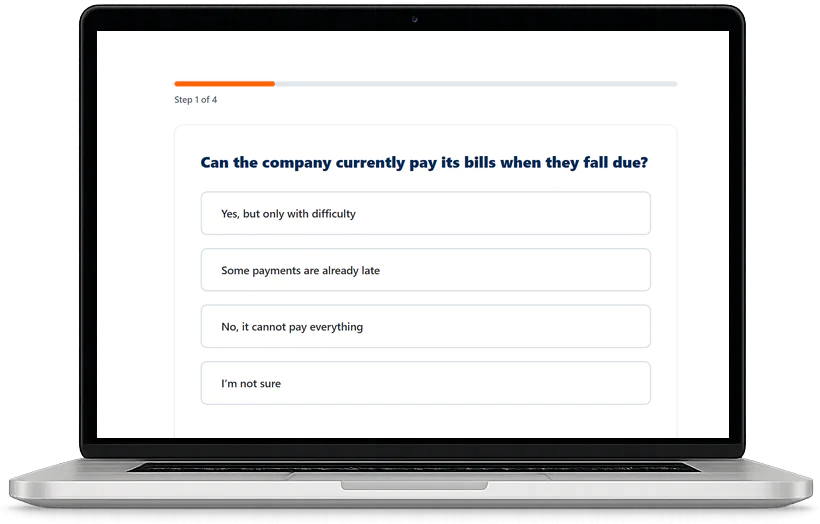
How Serious Is Your Company’s Position?
Answer four short questions to see how urgent the situation may be and which options could fit your company’s circumstances.
Check my company’s positionSee your result online and receive a copy by email. We only call if you ask.
Why Walking Away Costs More Than Liquidating
Three exposures explain why an empty company is not a closed matter. Each operates on your personal assets, which is precisely why the company having none is beside the point.
Wrongful trading, section 214 of the Insolvency Act 1986. If you kept trading or kept incurring liabilities after the point where insolvent liquidation was no longer reasonably avoidable, a liquidator can seek a contribution order against you personally.
Note what that means in practice. The claim is paid from your money, so an empty company is no defence to it. If anything, a long tail of trading on an empty balance sheet is what makes the claim viable.
Disqualification, section 6 of the Company Directors Disqualification Act 1986. Bans run from 2 to 15 years. Schedule 1 of that Act directs the court to weigh matters such as your responsibility for the company’s insolvency and any material breach of legal obligations, which in practice covers trading while unable to pay, failing to keep records and tax arrears.
None of them reference the company’s asset position, because disqualification is about how you behaved rather than what was left.
Investigation after dissolution. The Rating (Coronavirus) and Directors Disqualification (Dissolved Companies) Act 2021 lets the Insolvency Service investigate the directors of a dissolved company without anyone having to restore it to the register first, and apply to disqualify them, normally within three years of dissolution.
Before that Act, striking off a company genuinely did put it beyond easy reach. That is no longer true, and a good deal of the advice still circulating online predates the change.
Can You Just Strike Off the Company?
Strike-off costs £13 online, against several thousand for a liquidation, so the appeal is obvious. The eligibility rules are narrow, and the one that catches people is creditors: every creditor must be told about the application, and any unpaid creditor, HMRC especially, can object and stop it.
- No trading or activity for three months
- No change of company name in three months
- No active legal proceedings
- In practice, no unpaid creditors left to object
- In practice, HMRC settled, with final returns filed and balances paid
If you fail any of those, striking off is not a cheaper route. It is an application that will probably be objected to, because the two-month Gazette window exists for exactly that purpose and HMRC matches strike-off applications against its own debt records as a matter of routine.
We are usually asked about this after the objection has landed rather than before, by which point several months have gone and the debts have carried on accruing.
An outstanding Bounce Back Loan makes it worse again. Covid support scheme abuse now dominates director disqualification. Of the 1,044 directors the Insolvency Service banned in 2025 to 2026 for their conduct at insolvent or dissolved companies, 773 faced at least one allegation about Covid financial support (Insolvency Service enforcement figures).
Attempting to dissolve a company that still owes one of those loans puts your case in front of exactly the team producing those numbers. If the company has debts it cannot pay, strike-off is not the cheap option. It is the expensive one with a delay built in.
How a CVL Works When There Are No Assets
The procedure is the same as any other creditors’ voluntary liquidation. What changes is who pays for it.
- You instruct an insolvency practitioner and the preparation work begins.
- Shareholders pass a winding-up resolution under section 84 of the Insolvency Act 1986.
- You prepare a statement of affairs, the formal schedule of the company’s assets and liabilities, under section 99. It must reach creditors no later than the business day before the decision date, and it is verified by a statement of truth. Leaving material information out of it, or failing to deliver it without good reason, is a criminal offence.
- Creditors take their decision under rule 6.14 of the Insolvency Rules 2016, by virtual meeting or deemed consent. They confirm your nominated liquidator or appoint their own.
- The liquidator takes control and your powers as director cease.
- Investigation, then closure. On a clean no-asset case the active work is often 4 to 12 weeks. Dissolution follows three months after the final account is registered, and that period is fixed by statute.
The one hard constraint is that we cannot take the appointment without funding in place. That is not a commercial preference; the work has to be paid for, and where the company has nothing the money has to come from somewhere else.
Who Pays for Liquidation When There Is No Money?
Three legitimate sources, in the order we usually work through them with a director.
A redundancy claim through the Redundancy Payments Service. Where the company cannot pay statutory entitlements, the state does, and directors often qualify as employees for this purpose under the Employment Rights Act 1996.
Directors frequently assume they are excluded because they own the company. The leading case, Secretary of State for Trade and Industry v Bottrill (1999), decided otherwise: holding more than half the shares does not automatically disqualify you.
The test looks at your contract, your PAYE history, whether you genuinely worked in the business, and whether you have two or more years’ continuous service. It is a question of fact, which is why we ask for the paperwork before giving a view on it.
A claim can cover statutory redundancy, capped at £751 a week with a maximum payment of £22,530, plus up to 8 weeks’ arrears of wages, 6 weeks’ holiday pay and statutory notice. For a director with several years’ service and a contract that reflects reality, the total often covers the liquidation fee with a balance left over.
The paperwork is what decides this, and it decides it long before you call anyone. A director who paid themselves mostly in dividends with a nominal salary and no contract has a weak claim, whatever the commercial reality of the hours they worked.
Funding it personally. Paid before appointment. You do not get it back unless the liquidator recovers more than the cost of the work, which on a genuinely empty company is unlikely.
Third-party funding. A family member, business partner or connected creditor can pay. This is legitimate provided it is documented as a third-party payment rather than money routed out of the company, which would raise a preference question under section 239 of the Insolvency Act 1986.
The Director’s Contribution
Directors often worry that paying for the liquidation themselves is somehow improper, or that the money will be clawed back later as a preference. It is neither.
A preference under section 239 requires the company to have put a creditor in a better position, with a desire to do so. Your contribution runs the other way: it is your own money going in, and you gain no advantage as a creditor from it. The test set out in Re MC Bacon Ltd (1990) has nothing to bite on.
Where the asset position is uncertain at the outset, we can structure the contribution so that any surplus comes back to you if the liquidator recovers more than the cost of the work. That is uncommon on a clean no-asset case, and worth asking about where the picture is unclear.
Funds must be cleared before the appointment can take effect, which is a practical point rather than a formality. It is a common reason an appointment slips by a week.
What the Liquidator Investigates, Even With No Assets
This is where directors are most often caught out. An empty company does not mean a light-touch liquidation, and the conduct side of the work is identical whatever the balance sheet shows.
Section 235 of the Insolvency Act 1986 puts a cooperation duty on you regardless of the company’s finances. Section 236 lets the liquidator apply to examine you privately, under oath, about the company’s affairs.
We report to the Insolvency Service on the conduct of everyone who was a director in the three years before the liquidation, within three months of the company going into liquidation. That happens on all cases, not just the ones with money in them, and it covers the Schedule 1 factors:
- Tax arrears, late returns and failed payment arrangements
- Trading while insolvent
- Failure to keep proper accounting records
- Failure to file accounts at Companies House
- Transactions at undervalue and preferences
- Misfeasance and wrongful trading
- Misuse of Covid support funding
Where that investigation finds evidence of personal liability, the liquidator can pursue you for a contribution or a misfeasance claim, and those claims reach your own assets. The company having nothing is not a shield; on some cases it is the very thing that prompts the question of what happened to what it once had.
Personal Guarantees and Director’s Loan Account Exposure
Two exposures survive the company entirely, and between them they account for most of the personal cost directors of no-asset companies actually face.
Personal guarantees. A guarantee is a separate contract between you and the lender. Liquidating the company does not touch it. Once the company can no longer meet the guaranteed debt, the lender can pursue you, and generally does so once the estate is closed.
Guarantees do not lapse quietly either. Under the Limitation Act 1980 the lender has 6 years to sue on an ordinary guarantee and 12 where it was executed as a deed, and a part-payment or written acknowledgement restarts that clock.
Where a spouse co-signed, the Royal Bank of Scotland v Etridge (No 2) (2001) protections matter. If the lender did not ensure your spouse took independent legal advice, the guarantee against them may be challengeable. It is worth checking before you assume the family home is committed.
An overdrawn director’s loan account. If you drew more than your salary and properly declared dividends covered, the difference is a debt you owe the company, and it becomes an asset the liquidator will normally pursue, unless recovery would cost more than it brings in.
There is a tax consequence too. Section 455 of the Corporation Tax Act 2010 charges the company 35.75% (33.75% on loans made before 6 April 2026) on a loan account still overdrawn nine months after the year end, which sometimes surprises directors who assumed the balance was a private matter between them and their accountant.
Settlement terms depend on what you can evidence and what you can afford, and we negotiate them case by case. What consistently makes it worse is discovery: a balance you disclose is a repayment discussion, and one we find ourselves is a conduct question.
What Happens to the Outstanding Debts
Once the company is dissolved, its debts fall into three groups, and only one of them follows you.
Unsecured company debts can no longer be enforced. Supplier balances, trade credit, overdraft shortfalls and Bounce Back Loan balances all die with the company, unless it is later restored to the register. Creditors write them off and update their records.
Secured creditors enforce against whatever they hold. If the asset is worth less than the debt, the shortfall becomes an unsecured claim against a company that is being dissolved, so in practice it is written off too.
Personal guarantees survive. This is the one that matters, and it is why the guarantee question belongs at the start of the conversation rather than after the liquidation is under way. Where the exposure is beyond what you can manage, an individual voluntary arrangement or bankruptcy are the personal routes, both under the Insolvency Act 1986.
Practical Steps to Liquidate a Company With No Assets
- Confirm the route. Strike-off only if you genuinely have no debts. Compulsory liquidation only if you accept losing the choice of liquidator and a wider conduct review.
- Gather the records before you call anyone. Company records, financial and tax records, employee records, and anything evidencing security or contingent liabilities. How organised these are affects both the cost and how long the case stays open.
- Check your redundancy position early. A contract of employment, PAYE history and two or more years’ continuous service are what the claim turns on. This is worth establishing before you decide you cannot afford to liquidate.
- Verify whoever you instruct. Every insolvency practitioner is licensed and searchable on their regulator’s public register. Check the individual, not just the firm name on the website.
- Prepare the statement of affairs and creditor list carefully. It is a sworn document. Do not sign it blind, do not omit contingent liabilities such as guarantees, and do not guess at valuations.
If you take one thing from this page, make it the second step. The single biggest variable we can see from the outside is not the size of the debt. It is whether the records exist.
FAQs on Liquidating a Company With No Assets
Can a company with no money still be liquidated?
Yes. You can fund it yourself, fund it from a redundancy claim through the Redundancy Payments Service, or have a third party pay. If none of those is possible, a creditor petition into compulsory liquidation is the fallback.
Do I need a company bank account for liquidation?
No. The liquidator runs the estate through their own client account. If your company account still exists but is empty, closing it is part of the normal process.
What happens to outstanding company debts if there is no money?
Unsecured debts, including Bounce Back Loan balances, can no longer be enforced against the company once it is dissolved, unless it is restored to the register. Secured creditors enforce against whatever they hold.
Personal guarantees survive, and an overdrawn loan account is pursued by the liquidator as a company asset. Those two are what reach you personally.
Am I still personally liable if the company has nothing?
You can be. Guarantee enforcement, an overdrawn loan account, a wrongful trading contribution order and misfeasance all operate against your own assets rather than the company’s.
Liability here follows conduct, not the balance sheet. That is the point most often missed by directors who assume an empty company is a finished one.
How long does a no-asset CVL take?
Two answers, because two things are being measured. The liquidator’s active work on a clean no-asset case typically runs 4 to 12 weeks, and longer where there are disputed claims or a loan account to investigate.
Dissolution is later. The company is dissolved three months after the final account is registered, whatever it owned. See how long liquidation takes for the full picture.
Check How Serious the Position May Be
Answer four short questions to see how urgent the situation may be and which broad options could fit.
Check my company’s positionEstimates are fineWe only call if you ask us to