What Happens If I Stop Paying Company Debts?




If you stop paying your company’s debts, the debts do not disappear. They escalate. Interest accrues, creditors move from letters to legal action, and the gap between what the company owes and what it can pay gets wider every week you delay.
We speak to directors who stopped paying creditors months ago and are now dealing with statutory demands, county court judgements, and threats of winding-up petitions. In almost every case, the director tells us they hoped things would improve.
The reality is that stopping payments without a plan is the fastest way to lose control of what happens to your company and to increase your personal exposure as a director.
We have written this page to explain the practical and legal consequences of stopping payment on company debts, what creditors can do at each stage, and what your options are before the situation becomes irreversible.
Quick Answer: What Happens When You Stop Paying Company Debts
When you stop paying, creditors escalate through a predictable sequence: demand letters, then statutory demands, then county court claims, then enforcement (bailiffs, charging orders, bank account freezes), and finally winding-up petitions. Each stage reduces your options.
By the time a petition is gazetted and your bank accounts are frozen, the only question left is who controls the liquidation: you or the creditor.
We also need to be clear about the personal dimension. If your company is insolvent and you continue to trade without paying creditors, you are accumulating wrongful trading exposure under section 214 of the Insolvency Act 1986. The longer the gap between the point where you should have acted and the point where you actually do, the larger your personal liability becomes.
Recovery Path
Stopping Payments Without a Plan Removes Every Structured Option
Directors who enter a formal insolvency process before creditors start enforcement; through a CVA, administration, or CVL; retain control of the route, the timing, and in voluntary liquidation, the choice of practitioner.
Directors who stop paying and wait for creditors to escalate find those options closing sequentially: CVA requires creditor goodwill, administration requires urgency and assets, and compulsory liquidation removes all director control entirely.
The structured routes are open now. They may not be open in three months.
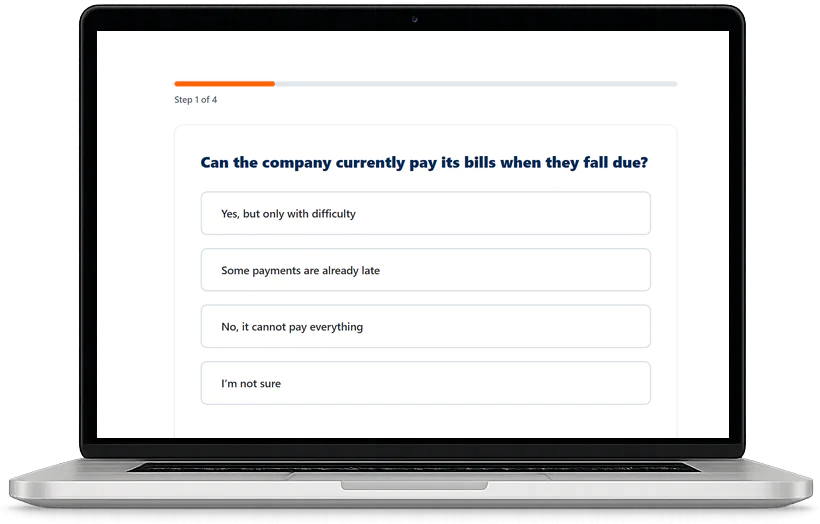
How Serious Is Your Company’s Position?
Answer four short questions to see how urgent the situation may be and which options could fit your company’s circumstances.
Check my company’s positionSee your result online and receive a copy by email. We only call if you ask.
What Creditors Do When You Stop Paying Company Debts
Creditors follow a broadly predictable pattern. Understanding this timeline helps you anticipate what is coming and act before your options narrow.
Weeks 1-4: Demand letters and calls. Most creditors start with reminders, then formal demand letters, then calls from their credit control team. At this stage, negotiation is still easy.
We find that creditors who are engaged early are far more willing to agree payment plans than creditors who have been ignored for months. A phone call from you this week is worth more than a solicitor’s letter from them next month. That is not a platitude; it is the single most consistent pattern we see in every creditor escalation case we handle.
Weeks 4-8: Debt collection agencies. If you do not respond to direct demands, many creditors instruct a debt collection agency. The tone changes. Letters become more formal, calls become more frequent, and the agency may visit your premises. Debt collectors have no special legal powers, but their involvement signals that the creditor has given up on informal resolution.
Weeks 6-12: Statutory demand. A creditor owed more than £750 can serve a statutory demand on the company. This is the formal gateway to a winding-up petition. You have 21 days to pay, agree terms, or apply to set the demand aside.
We see directors who receive a statutory demand and treat it like another letter. It is not. It is the single most important document you will receive before a petition is filed.
Weeks 8-16: County court claim. Some creditors skip the statutory demand and go straight to a county court claim. You have 14 days to acknowledge service and 28 days to file a defence. If you do not respond, the creditor gets a default judgement and can enforce immediately through bailiffs, charging orders, or account freezes.
Weeks 12-24: Winding-up petition. If a statutory demand expires unpaid or a judgement debt remains unsatisfied, the creditor can petition the court to wind up the company. Once the petition is gazetted, your bank freezes the company’s accounts.
From that point, you cannot pay staff, cover rent, or fund trading. The court hearing follows 6 to 10 weeks later, and if the order is granted, your company enters compulsory liquidation.
The Creditor Escalation Timeline
- Missed payment then demand letters (days to weeks)
- Repeated non-payment then statutory demand (£750+ threshold, 21-day clock starts)
- Unsatisfied demand then county court claim or winding-up petition filed
- Petition advertised in London Gazette then bank accounts frozen within hours
- Court hearing then winding-up order, Official Receiver appointed, all director control ends
HMRC Enforcement: What Happens When You Stop Paying Tax Debts
HMRC has enforcement powers that go beyond what ordinary creditors can do. If you stop paying PAYE, VAT, or Corporation Tax, HMRC can:
- Issue a statutory demand without waiting for a court judgement
- Petition to wind up the company directly
- Use its own enforcement agents to seize company assets (Taking Control of Goods)
- Issue personal liability notices to directors for unpaid PAYE and employee NICs
- Apply for a Director Penalty Notice, making you personally liable for the company’s PAYE and NIC debts
We find that HMRC is the most common petitioning creditor in compulsory liquidations. They do not need a large debt to act. We have seen winding-up petitions filed over debts as low as a few thousand pounds. If you are not paying HMRC, they will escalate, and they will escalate faster than most trade creditors.
The one advantage with HMRC is that they offer Time to Pay (TTP) arrangements. If you contact HMRC before enforcement begins and propose a realistic repayment schedule, they will often agree.
We advise every director who is falling behind on tax payments to call HMRC’s payment support service before a statutory demand arrives. Once enforcement has started, TTP becomes much harder to negotiate.
Personal Liability for Directors Who Stop Paying Company Debts
Stopping payment on company debts does not directly create personal liability. The company is a separate legal entity, and its debts are not yours. But stopping payments when the company is insolvent and continuing to trade creates wrongful trading exposure under section 214 of the Insolvency Act 1986.
The test is whether you knew, or should have known, that there was no reasonable prospect of the company avoiding insolvent liquidation, and whether you took every step a reasonably diligent person would take to minimise the potential loss to creditors.
If you stopped paying creditors and continued to trade, accumulating further losses, the liquidator will argue that you should have sought professional advice and placed the company into formal insolvency rather than allowing the position to deteriorate.
We are direct about this: the moment you start choosing which creditors to pay, you have almost certainly crossed the line into insolvency. From that point, every week of continued trading without professional advice increases your personal exposure. The liquidator will look at the timeline, and a shorter gap between the trigger point and the date you acted is always easier to defend.
What to Do Instead of Stopping Company Debt Payments
- Contact your creditors proactively. A phone call explaining the situation and proposing a realistic payment plan is more effective than silence. Creditors who are engaged early are less likely to escalate.
- Contact HMRC for a Time to Pay arrangement if you are behind on tax. Do this before they send a statutory demand.
- Speak to a licensed insolvency practitioner. If the company genuinely cannot pay its debts, our guide on closing vs saving your company helps with that assessment. You need to understand whether rescue is possible or whether a voluntary liquidation is the right step. Acting now gives you the choice of route. Waiting until a creditor petitions means the court chooses for you.
- Do not make selective payments. Paying one creditor ahead of others when the company is insolvent disrupts the statutory creditor priority order. Pay normal trading expenses in the ordinary course, but do not settle favoured creditors, repay your own director’s loan, or pay family members ahead of trade creditors.
- Document your decisions. If you do continue to trade while seeking advice, keep a written record of why you made each payment decision. The liquidator will review these decisions, and contemporaneous documentation is the strongest evidence of good faith.
Company Debt’s licensed insolvency practitioners deal with creditor pressure every day. If you have stopped paying debts and are not sure what happens next, get urgent liquidation advice will clarify your options before a creditor decides for you.
Check How Serious the Position May Be
Answer four short questions to see how urgent the situation may be and which broad options could fit.
Check my company’s positionEstimates are fineWe only call if you ask us to
FAQs on Stopping Company Debt Payments
Can creditors come after me personally for company debts?
Only if you gave a personal guarantee, have an overdrawn director’s loan account, or are subject to a wrongful trading claim or HMRC personal liability notice. The company’s debts are not automatically your debts. But the routes to personal liability are more common than directors expect, particularly personal guarantees given to banks, landlords, and HMRC Director Penalty Notices.
How quickly can a creditor force my company into liquidation?
A statutory demand gives you 21 days. After that, the creditor can petition the court, and the hearing is typically 6 to 10 weeks later. In total, from statutory demand to winding-up order can be as little as 10 to 14 weeks. If a creditor already holds a county court judgement, they can skip the statutory demand and petition immediately.
Will HMRC agree to a payment plan?
HMRC offers Time to Pay (TTP) arrangements for businesses that contact them proactively with a realistic repayment proposal. TTP is much easier to negotiate before enforcement action starts. Once HMRC has served a statutory demand or issued a winding-up petition, they are significantly less likely to agree. Call HMRC’s payment support service as early as possible.
What happens if I just ignore the debts completely?
Creditors escalate: demand letters, statutory demands, county court claims, enforcement, and ultimately a winding-up petition. If you ignore a county court claim, the creditor gets a default judgement. If you ignore a statutory demand, the creditor can petition to wind up the company.
Ignoring debts does not make them go away; it makes them more expensive and removes your ability to influence the outcome.
Is it better to stop paying all creditors or to pay some selectively?
Neither is ideal. Selective payment creates preference risk under section 239 of the Insolvency Act 1986, particularly if you pay connected parties or specific creditors ahead of others.
The right answer is to take professional advice on whether the company should continue trading and, if so, which payments are defensible as ordinary course business expenses. A licensed insolvency practitioner can guide you through this.