Company Rescue Solutions Overview




Week six of the cash flow forecast. The number that looked tight in month one now looks dishonest. The HMRC reminder sits on the desk, the largest supplier is on stop, and the payroll BACS run is on Friday.
You arrived at this page because someone, somewhere, said the company might still be saveable. The honest answer is: maybe. It depends on how late you have left it, what is recoverable underneath the cash gap, and whether you are prepared to act this week rather than next month.
This is the Company Rescue Solutions hub. It maps the full menu of company rescue routes in England and Wales for directors who still want to keep something trading.
Below, you will find the family of formal procedures (CVA, Administration, Pre-Pack), the informal levers (HMRC Time to Pay, creditor negotiation), and the route-of-last-resort closures (CVL, MVL) that sometimes serve directors better than a doomed rescue attempt.
We are direct about the trade-off because the literature is not. The earlier you call, the more options you keep. The later you call, the more options the insolvency practitioner keeps.
This page exists to help you triage which route fits your situation before that window narrows further.
Company Rescue Solutions at a Glance
What This Company Rescue Hub Covers
This hub covers the rescue and recovery options open to a limited company in England and Wales under pressure: from informal HMRC negotiation through to formal Insolvency Act 1986 procedures.
It groups the routes into four families so you can find the one that matches your situation in minutes, not afternoons.
Each cluster below describes the family, names what the route actually solves, and links to the dedicated guide where the mechanics, costs, and risks are set out in full.
The hub is not a substitute for the spoke pages; it is the triage layer above them.
Who This Company Rescue Hub Is For
You are most likely a director of an SME limited company, somewhere between £100k and £5m turnover, currently looking at the Barclays app showing less than a week of payroll cover.
You have probably been told to “take advice” by your accountant. You may have been told to “wait and see” by a friend who is not in this position. This hub is written for the first reader, not the second.
If you are a creditor of a company that has entered a rescue procedure, the spoke pages on CVA and Administration set out your rights. This hub assumes the director’s seat.
How to Use This Company Rescue Hub
Read the cluster summaries first. Each cluster names the family, the trade-off, and the kind of director it suits. Then jump to the spoke article that matches.
If you are unsure which family fits, the “Company Rescue by Situation” section further down splits readers by the actual pressure they are facing (cash flow shock, HMRC, supplier on stop, personal guarantees), which often points faster than picking a procedure first.
Company Debt has triaged thousands of director enquiries through this same decision tree.
Where we audit the case files we handle, the rescues that complete cleanest are the ones where the director rang a licensed insolvency practitioner inside 48 hours of the first serious creditor letter.
Late-arriving cases close cleanly too, but with a narrower menu.
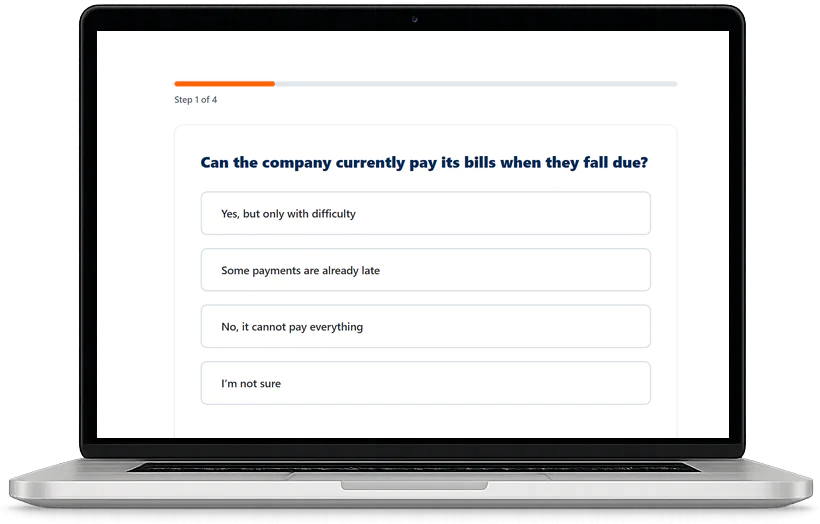
Could Your Company Be Insolvent?
Answer four short questions to see which warning signs apply, how serious the position may be and how soon you may need to act.
See which options may fit your company’s circumstances.
Check my company’s positionSee your result online and receive a copy by email. We only call if you ask.
Key Company Rescue Solutions Guides
Company Voluntary Arrangement Family
A CVA is a statutory composition under sections 1 to 7B of the Insolvency Act 1986. It binds unsecured creditors to a reduced repayment plan, typically over three to five years, while the company keeps trading and the directors stay in control.
It needs approval by 75% by value of the creditors who vote. It also fails if more than half by value of the creditors not connected with the company vote against it.
The CVA family is right for directors with a viable underlying business, an HMRC or trade-creditor cash gap that is large but not catastrophic, and the discipline to honour monthly contributions for several years.
It is wrong for businesses where the trading model itself is broken; rescheduling debt does not fix loss-making operations.
The cost is rigidity: every month the contribution lands or the CVA fails.
For the full mechanics, see our company voluntary arrangement guide, the CVA pros and cons breakdown, the CVA vs liquidation comparison, and what happens when a CVA fails. For partnerships, see partnership voluntary arrangements.
Administration and Pre-Pack Family
Administration is a court-supervised procedure under Schedule B1 of the Insolvency Act 1986. The moment an administrator is appointed, a statutory moratorium halts most creditor action.
Inside that window, the administrator runs the company while restructuring or selling the viable parts.
Pre-pack administration is the variant where the sale is negotiated before the formal appointment and completed on day one. It is faster, cheaper, and preserves more value.
It is also the variant most criticised by creditors, especially when the buyer is connected to the directors, which is why a sale of all or a substantial part of the business to a connected buyer in the first eight weeks of administration now needs either an independent evaluator’s report or creditor approval under the 2021 Pre-Pack Regulations.
The cost is loss of director control: the administrator is in charge from appointment, and the existing director is, at best, a transitional adviser. For the procedure mechanics, see our pre-pack administration guide.
Informal HMRC and Creditor Negotiation Family
Not every cash gap needs a formal procedure.
Where the underlying business is sound and the pressure is concentrated in one or two creditors, a Time to Pay arrangement with HMRC, a payment plan with a key supplier, or a refinance with the existing lender may close the gap without statutory machinery.
The cost of staying informal is exposure: nothing binds the other creditors. One angry creditor with a winding-up petition can collapse an informal plan that the other ten were happy with.
Informal routes work best when the pressure is genuinely narrow.
For HMRC-specific moves, see HMRC tax problems for the full negotiation playbook. For broader creditor pressure, see the winding-up petition guide; once a petition lands, the informal window has typically closed.
Solvent Closure and Last-Resort Routes
Sometimes the best rescue is an honest closure.
If the trading model is broken and rescheduling debt only buys six months of additional losses, a Creditors‘ Voluntary Liquidation under Part IV of the Insolvency Act 1986 may protect the director from wrongful trading exposure under section 214 better than a doomed CVA attempt.
For solvent companies winding up at the end of their natural life, a Members’ Voluntary Liquidation extracts capital tax-efficiently.
Strike-off under section 1003 of the Companies Act 2006 is cheaper still, but only safe for clean dormant shells.
The friction here is psychological more than legal: directors often resist closure as failure when it is the cleaner exit.
For the comparison, see using a CVA to close a company, where the route is sometimes used as a structured wind-down rather than a rescue.
Company Rescue Solutions by Situation
Most directors arrive at this hub from a specific pressure point, not a procedure preference. The four situations below cover most of what we see. Find the one that matches what is actually on your desk this week.
Cash Flow Shock With a Viable Business Underneath
One large invoice has gone bad, a contract has slipped, or seasonal demand has held off longer than the management accounts assumed. The business is fundamentally profitable; the problem is the next 90 days.
CVA, refinance, or an informal HMRC Time to Pay are the realistic candidates here. Administration is usually overkill and Liquidation is usually wrong.
Structural Insolvency: Loss-Making Trading
If you cannot point to the month when trading turns profitable, the issue is not the cash gap; it is the model. A CVA on its own will not save a structurally loss-making business.
Pre-pack administration can sometimes preserve the viable parts and shed the loss-making ones; CVL closes the company cleanly and stops the personal exposure clock under section 214 IA 1986 from running further.
HMRC Pressure as the Dominant Creditor
Crown preference returned on 1 December 2020. HMRC sits ahead of floating-charge holders for VAT, PAYE, employee NIC, CIS, and student loan deductions. That changes the maths on every formal procedure.
A CVA still works because HMRC is a voting creditor and historically engages constructively. Administration also works, but the administrator must respect the preferential status. See HMRC tax problems for the negotiation specifics.
Personal Guarantee Exposure on Director Borrowing
Most director-signed loans, lease guarantees, and overdraft facilities crystallise the moment the company enters a formal procedure.
That changes the calculus: a rescue route that protects the company but triggers a six-figure personal guarantee call is not, from your perspective, a rescue.
See director guarantees in a CVA for how PGs are handled in each route, and how they shape the practical choice between CVA, Administration, and CVL.
Company Rescue Solutions by Risk or Procedure
Each rescue route carries a different formality cost, a different speed, and a different impact on director control. The honest comparison runs informal-to-formal, not “best to worst”.
Picking the lowest-friction route that actually solves the problem is usually right; reaching for the heaviest tool first usually destroys value.
Informal Negotiation Risk Profile
Informal routes are the cheapest and the fastest. They preserve director control fully. But they bind only the creditors who agree to them.
A single dissenting creditor, especially one owed an undisputed debt of more than £750 and willing to pay the £352 court fee and £2,600 deposit for a winding-up petition, can torpedo the plan. Informal works when the pressure is narrow and the creditors are sane.
CVA Risk Profile
Once 75% by value of the creditors who vote approve it, the CVA binds every unsecured creditor who was entitled to vote, including those who voted against and those who did not vote. The director stays in the chair. The cost is the five-year contribution discipline and the public Companies House filing.
Failure rates rise sharply where the contribution was set optimistically; see when a CVA fails.
Administration Risk Profile
Administration carries the heaviest formal cost: the administrator takes control from day one. The benefits are the moratorium, the speed of a pre-pack sale, and the protection from creditor action.
The cost is loss of director command and the public scrutiny of any connected-party sale under the 2021 Regulations.
Liquidation Risk Profile
Liquidation is closure, not rescue, but it earns its place on this hub because choosing it deliberately at the right moment is sometimes the only honest rescue available, the rescue of the director’s exposure rather than the company’s trading.
The wrongful trading clock under section 214 IA 1986 stops running once the company enters liquidation or administration. A CVA, where the company keeps trading, does not stop it.
Wait too long and the personal liability risk grows, regardless of which procedure is eventually chosen.
Your Next Step on Company Rescue
The single most useful action a director under pressure can take this week is a 30-minute call with a licensed insolvency practitioner.
Not because every situation needs a formal procedure, but because the IP can tell you, inside that call, which family of routes is realistic and which are wishful thinking. The ones that need formal machinery get it.
The ones that do not get an informal plan that holds.
Company Debt’s licensed IPs and business rescue specialists handle that triage daily.
We assess the position, run the maths on the cash flow honestly, and either implement a formal process or refer you back to your existing accountant for an informal route, whichever genuinely fits.
Call us free on 0800 074 6757, or use the live chat on this page, for a confidential conversation.
Frequently Asked Questions About Company Rescue Solutions
What is the difference between company rescue and liquidation?
Rescue keeps the company trading, either through informal creditor negotiation or formal procedures like a CVA or Administration under the Insolvency Act 1986. Liquidation closes the company and distributes whatever value remains to creditors in statutory priority order.
Rescue suits viable businesses with a temporary cash gap; liquidation suits businesses where the trading model itself is no longer profitable. The decision turns on whether the underlying business can return to profit within a defined window, not on whether the director wishes it could.
When is a CVA the right company rescue route?
A Company Voluntary Arrangement under sections 1 to 7B of the Insolvency Act 1986 fits where the business is fundamentally profitable, the debt overhang is large but not catastrophic, and the directors can sustain monthly contributions for three to five years.
It needs approval by 75% by value of the creditors who vote, and it fails if more than half by value of the creditors not connected with the company vote against it.
It does not fit where the trading model is loss-making; rescheduling debt does not repair operating losses. The IP nominee will pressure-test the cash flow before recommending a CVA proposal precisely because optimistic forecasts are why CVAs fail.
How quickly can company rescue procedures stop creditor pressure?
Administration imposes a statutory moratorium under Schedule B1 of the Insolvency Act 1986 the moment an administrator is appointed, halting most creditor action immediately.
A CVA gives no protection while the proposal is pending. Once creditors approve it, it binds the creditors entitled to vote. Before that, an eligible company can obtain a standalone moratorium under Part A1 of the Insolvency Act 1986, where a licensed insolvency practitioner acting as monitor confirms that rescue is likely.
Informal arrangements bind only the creditors who agree to them and offer no protection against a winding-up petition from anyone else. The £352 court fee plus £2,600 Official Receiver deposit means a determined creditor can issue a petition cheaply; the procedure speed often matters more than the procedure name.
Are directors personally liable in a company rescue procedure?
Limited liability normally protects directors, but specific routes to personal exposure remain. Personal guarantees on bank lending, leases, and trade credit usually crystallise on insolvency.
Wrongful trading under section 214 of the Insolvency Act 1986 can make directors contribute personally if they carried on trading after they knew, or ought to have concluded, that there was no reasonable prospect of avoiding insolvent liquidation or administration, unless they took every step to minimise creditors’ losses.
Preference claims under section 239 (looking back six months, or two years for connected parties) and undervalue claims under section 238 (two years) can reach a director who benefited, for example by repaying their own loan account or clearing a debt they personally guaranteed. Choosing the right rescue route, at the right moment, materially shapes how those exposures resolve.
How does HMRC’s preferential status affect company rescue options?
Crown preference was reinstated on 1 December 2020 by the Finance Act 2020. HMRC now sits as a secondary preferential creditor for VAT, PAYE, employee NIC, CIS, and student loan deductions, ahead of floating-charge holders and unsecured creditors under Schedule 6 of the Insolvency Act 1986.
In a CVA, HMRC remains a voting creditor and typically engages where the proposal is realistic. In Administration, the administrator must respect the preferential ranking when distributing recoveries. The reinstatement does not change which procedure suits which situation, but it does change how much each creditor class recovers.
What is the cheapest moment to engage with a company rescue specialist?
Before the first winding-up petition. Initial consultations with licensed insolvency practitioners are typically free; rescue procedures get more expensive as the available options narrow. A CVA negotiated before petition is cheaper, faster, and more likely to succeed than one attempted under petition pressure.
Administration costs scale with the complexity of the trading position; a clean pre-pack runs faster and cheaper than a contested administration. Once a petition is advertised, bank accounts freeze, supplier credit collapses, and the timeline compresses, all of which add cost to whichever route is eventually chosen.
Not Sure Where Your Company Stands?
Use the two-minute test to check the warning signs and see how soon you may need to act.
Check my company’s positionEstimates are fineWe only call if you ask us to
Related Guides
- Company Rescue and Recovery: the wider picture, including what recovery looks like after a procedure ends.
- Debt and Creditor Pressure: what to do when the pressure, not the plan, is setting your timetable.
- HMRC Tax Problems: rescue options where HMRC is the dominant creditor.
- Winding-Up Petitions: what happens to the rescue window once a petition is presented.