Construction Insolvency in the UK: Causes, Warning Signs & Rescue Options




Construction insolvencies don’t fail at the build. They fail at the gap between the build finishing and the retention being released.
You can finish the job on time, bring in the subcontractors, pass every inspection, and still find yourself unable to pay a BACS run. The main contractor is holding your £45,000 retention for another fourteen months.
Your CIS deductions are accumulating with HMRC. Your reverse charge VAT return has created a cash gap you weren’t expecting.
What follows covers the financial mechanics specific to UK construction insolvency, the legal tools available before you are forced into them, and the decisions that matter most when your company is under pressure.
Construction Insolvency at a Glance
Quick Answer: Construction Insolvency
Construction insolvency occurs when a UK construction company cannot pay its debts as they fall due (the cashflow test under section 123 of the Insolvency Act 1986) or when its liabilities exceed its assets (the balance sheet test).
In construction, the cashflow test is the more common trigger.
The sector’s combination of reverse charge VAT, CIS deductions, retention payments, and supply chain dependency means a company can be profitable on paper while being cash-insolvent in practice.
We see this pattern repeatedly in construction cases: the numbers look viable until the moment a main contractor defaults on a retention release.
When Construction Insolvency Recovery Is Realistic
Recovery is realistic where the underlying business has forward contracts, a viable margin structure, and an identifiable cause for the current distress.
If the problem is timing, with retentions held, CIS deductions creating a temporary liability, or a single bad contract, then a CVA, administration, or informal creditor arrangement may create breathing room.
If the problem is structural, with margin erosion across the whole book, persistent underbidding, or accumulated HMRC debt that cannot be serviced, then recovery options narrow quickly.
Distinguishing between the two is the first thing our advisers assess in any construction insolvency instruction.
Main Risk in Construction Insolvency
The main director risk is wrongful trading under section 214 of the Insolvency Act 1986.
If you continue taking on contracts or ordering materials after the point when you knew, or ought to have known, that insolvent liquidation was unavoidable, a liquidator can pursue you personally for the increase in the net deficiency.
HMRC’s reinstatement as a preferential creditor in December 2020 means that CIS deductions, PAYE, employee NIC, and VAT now rank above unsecured creditors.
A director who has been drawing salary or paying connected parties ahead of HMRC faces serious preference exposure under section 239 of the Insolvency Act 1986.
What to Do Next About Construction Insolvency
If your company is failing the cashflow test, get licensed insolvency advice within days, not weeks.
The decisions you make in the next fortnight determine whether you are in a rescue procedure or a liquidation, and whether your personal exposure is manageable.
Our advisers can run through your options confidentially before any formal process begins. Call us free on 0800 074 6757 to start that conversation.
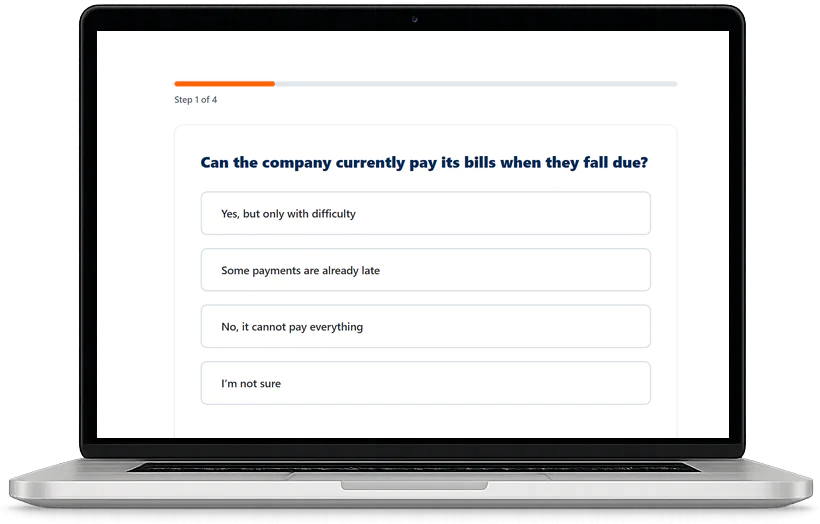
Could Your Company Be Insolvent?
Answer four short questions to see which warning signs apply, how serious the position may be and how soon you may need to act.
See which options may fit your company’s circumstances.
Check my company’s positionSee your result online and receive a copy by email. We only call if you ask.
Why UK Construction Companies Fail: The Financial Mechanics
Reverse Charge VAT and the Cash-Flow Shock for Subcontractors
Since 1 March 2021, subcontractors supplying construction services to VAT-registered main contractors no longer charge VAT on their invoices. The main contractor accounts for it instead.
This is the domestic reverse charge under HMRC’s VAT Notice 735.
The effect on subcontractor cash flow is severe.
Before the change, you charged 20% VAT on top of your invoice, collected it from the main contractor, and used that float between invoice date and the quarterly VAT return deadline. After the change, that float is gone.
You invoice your actual contract rate, receive only that, and your quarterly VAT return often produces a repayment claim rather than a payment liability. The repayment takes time to process.
If you were relying on the VAT float to fund your payroll and materials cycle, the reverse charge removed that buffer overnight.
Construction insolvency rates rose after March 2021 partly because smaller subcontractors who had been using the VAT float as working capital suddenly found themselves short.
If your reverse charge VAT return is generating consistent repayment claims but those repayments are delayed, you have an identifiable cashflow problem.
Our team can help you address it before it becomes a formal insolvency issue.
CIS Deductions and HMRC as Primary Creditor in Construction
Under the Construction Industry Scheme, main contractors deduct either 20% (standard rate) or 30% (higher rate for unverified subcontractors) from labour payments before passing the net amount on.
The deduction is held by HMRC as an advance payment against the subcontractor’s tax liability for the year.
The problem is timing. If you are a subcontractor with gross payment status, you receive your full invoice amount and handle your own tax.
If you have net payment status, you receive 80p in the pound and wait until your annual self-assessment to recover the balance.
For a company with a thin operating margin, operating on net payment status while carrying fixed overheads creates a structural cash deficit throughout the year.
The deduction certificate your accountant shows HMRC at year-end may demonstrate you are owed a refund, but that doesn’t pay October’s wages.
We see construction directors dealing with this mismatch repeatedly: the deduction certificate is real, but the refund arrives months after the payroll crisis. Where HMRC’s role becomes critical is in insolvency.
Since 1 December 2020, under the Finance Act 2020, HMRC has been reinstated as a preferential creditor for CIS deductions held by the company, along with VAT, PAYE, and employee NIC.
That means if your company goes into liquidation, HMRC jumps ahead of trade creditors and other unsecured parties in the payment queue.
In many construction insolvencies, HMRC is the largest single creditor in value terms.
Understanding that before you approach a CVA or administration is critical: any proposal has to work for HMRC, not just for your trade suppliers.
Retention Payments and the 18-Month Gap
Retentions are the most misunderstood cash-flow item in construction.
The standard construction contract retains 5% of each payment application, typically split: half released at practical completion, half released at the end of the defects liability period.
That defects period is commonly twelve months, sometimes longer. In practice, the second half of the retention is often held for eighteen months to three years after the work is finished.
Consider what that means for a subcontractor on a £900,000 contract. The main contractor holds back £45,000 while you have already paid out labour, materials, and plant to complete the work.
If the main contractor enters administration before releasing the retention, that £45,000 becomes an unsecured claim in the insolvency.
The defects liability period is irrelevant. Your statutory right to the money does not help you when the party holding it no longer has the money.
This is the supply chain domino effect in practice. A Tier 1 main contractor fails, and every subcontractor holding unrecovered retentions faces a simultaneous cash shortfall that may exceed their current bank balance.
The Housing Grants, Construction and Regeneration Act 1996, as amended by the Local Democracy, Economic Development and Construction Act 2009, gives you payment rights and adjudication rights.
But those rights are only useful while the main contractor is a going concern.
How to Assess Whether Construction Insolvency Recovery Is Possible
Supply Chain Dominoes and Mapping Your Retention Exposure
Before you can assess whether your company can recover, you need a clear picture of what you are owed and by whom.
List every open retention: the contract value, the retention percentage, the expected release date, and whether the employer or main contractor shows any signs of financial difficulty.
If a single retention is material to your working capital position, your business is exposed to that counterparty’s solvency in a way that is rarely visible until the crisis arrives.
If you are a main contractor, your obligation runs the other way. You are holding retentions owed to subcontractors. Those are liabilities, not assets, and in insolvency they are treated as unsecured claims.
The subcontractors won’t recover them in full.
This creates reputational and operational pressure long before the formal insolvency process starts. Subcontractors will stop performing and start serving payment notices the moment they suspect you are in trouble.
We have seen construction businesses lose their entire supply chain within days of a rumour circulating about financial difficulty.
Adjudication Rights Under the HGCRA and What Insolvency Does to Them
The Housing Grants, Construction and Regeneration Act 1996 gives any party to a qualifying construction contract the right to refer a payment dispute to adjudication at any time.
The adjudicator has 28 days to reach a decision, extendable to 42 days with the referring party’s consent.
The decision is temporarily binding and enforceable in the Technology and Construction Court without the need for a full trial.
This is one of the most powerful short-term tools available to a construction company facing a payment dispute.
If a main contractor has served a payless notice that you believe is incorrect, or has simply withheld payment without a valid basis, an adjudication referral can produce an enforceable decision within four weeks.
The critical point is timing. Once a party enters a formal insolvency process, the ability to enforce an adjudication award against it becomes complicated. An administration moratorium pauses enforcement action.
A liquidation makes the adjudication award a claim in the insolvency, to be paid at whatever pence in the pound the estate produces.
The 28-day clock is only worth running while the paying party is solvent and trading.
If you have a legitimate payment claim and the main contractor is under financial pressure, refer it to adjudication now, not after you hear they have appointed an administrator.
We have worked with construction clients who lost enforceable claims by waiting three weeks too long.
Performance Bonds, Parent Company Guarantees and Collateral Warranties
Many construction contracts include performance bonds, parent company guarantees, or collateral warranties.
These instruments are often ignored until insolvency happens, at which point they become the most valuable documents in the file.
A performance bond is typically issued by a surety or bank at the outset of the contract, guaranteeing that if the contractor fails to perform, the bond will pay out up to the bond value, usually 10% of contract value, to the employer.
If you are an employer dealing with a contractor in financial distress, check whether a performance bond is in place and review the trigger conditions carefully.
If you are the contractor, understand that calling a bond is often a precursor to the employer terminating the contract.
Parent company guarantees operate differently: if a subsidiary fails, the parent company is directly liable for the subsidiary’s obligations.
Collateral warranties give third parties, typically funders or future purchasers, direct contractual rights against the contractor, subcontractor, or professional team.
In insolvency, these warranties become claims against the estate. Review them before the formal process starts.
We regularly see construction businesses discover significant bond or guarantee claims only after an insolvency has already begun.
Options for Dealing With Construction Insolvency
CVA for Construction Businesses: Retaining Contracts While Restructuring Debt
A Company Voluntary Arrangement allows a construction company to repay debt over an agreed period, typically three to five years, under the supervision of an insolvency practitioner.
You remain in control of the business. Contracts continue. Staff stay employed. The CVA binds all unsecured creditors if 75% by value of those voting approve it.
For construction businesses, the CVA’s attraction is that it preserves the company’s ability to tender for new work.
Entering administration or liquidation will almost certainly disqualify you from public sector contracts and from the approved supplier lists of major clients.
A CVA keeps the company alive as a legal entity while restructuring what it owes.
The challenge in construction CVAs is HMRC. With HMRC reinstated as a preferential creditor, the CVA has to satisfy HMRC’s preferential debt in full, or at least more favourably than other unsecured creditors.
HMRC has a process for assessing CVA proposals and will reject ones that do not demonstrate a realistic repayment trajectory.
Our insolvency practitioners model HMRC’s position explicitly when preparing construction CVA proposals, because a proposal that ignores the preferential queue will not get past the creditor vote.
Administration and Pre-Pack Administration for Site Continuity
Administration places the company under the control of a licensed insolvency practitioner who becomes the administrator.
The administrator’s primary objective under the Insolvency Act 1986 is to rescue the company as a going concern where possible, or to achieve a better result for creditors than liquidation would produce.
A statutory moratorium protects the company from enforcement action while the administrator works.
For construction companies, administration is often combined with a pre-pack sale: the business and key contracts are sold to a new entity, usually formed by the existing directors, at a value determined by an independent valuer.
The new company starts trading immediately, retaining the existing workforce, equipment, and contracts.
Pre-pack administration in construction raises specific issues because Health and Safety at Work Act 1974 obligations and the Construction (Design and Management) Regulations 2015 continue on site regardless of what is happening to the corporate entity.
The principal designer and principal contractor duties do not pause during an insolvency process.
The administrator, and any new entity taking over site responsibilities, must ensure CDM compliance continues from day one.
A site that goes dark because of an insolvency dispute creates liability risk that outlasts the insolvency itself.
Creditors’ Voluntary Liquidation When Construction Recovery Is Not Viable
If the business cannot be rescued, a Creditors’ Voluntary Liquidation is the directors’ formal mechanism for closing the company in an orderly way.
You convene a meeting of shareholders who pass a resolution to wind up the company, and creditors appoint a liquidator.
The liquidator realises the assets, distributes the proceeds in the statutory order, and dissolves the company.
The advantage of a CVL over compulsory liquidation is control and timing.
You initiate it, you can influence the appointment of the liquidator, and you avoid the reputational damage of a creditor petitioning the court to wind you up.
You also demonstrate to the liquidator, who will investigate your conduct, that you acted responsibly and sought to minimise creditor losses.
For construction directors, the liquidation investigation will focus on retention monies received but not paid out and CIS deductions handled correctly or incorrectly.
It will also look at preferential payments to directors or connected parties, and whether the company continued taking deposits or advance payments after insolvency was certain.
Get advice before the process starts, not after it is under way.
We also cover the full range of company rescue options if you are not yet at the point of closure.
Director Risks Specific to Construction Insolvency
Wrongful Trading and the Construction Loss Increase Problem
Section 214 of the Insolvency Act 1986 allows a liquidator to apply to court for an order that a director contribute to the company’s assets.
The test is whether the director knew, or ought to have concluded, that there was no reasonable prospect of avoiding insolvent liquidation, and failed to take every step to minimise the potential loss to creditors.
In construction, the moment of no reasonable prospect can be hard to identify precisely.
A director who has forward contracts worth £2 million on the books at the point of distress may genuinely believe the company can trade through.
The difficulty is that construction contracts are conditional on performance.
If you cannot fund materials or labour on the next project, you will breach that contract, crystallise liquidated damages, and worsen the position.
Taking on a new contract when you cannot fund it to completion is the wrongful trading risk in construction.
We advise directors in this position to document every decision, seek written advice on their options, and stop taking new instructions if there is no realistic funding path to completion.
CDM 2015 and Health and Safety Continuity Obligations on Insolvency
The Construction (Design and Management) Regulations 2015 impose specific duties on the principal contractor during the construction phase of a project.
Those duties include maintaining the construction phase plan, ensuring safe working conditions, coordinating the work of contractors, and ensuring that sites under your control comply with Part 4 of the CDM Regulations throughout.
These duties do not transfer automatically when a company enters insolvency.
Where a company enters administration or liquidation mid-project, there is a real risk of a gap in CDM compliance. The Health and Safety Executive takes an active interest in these situations.
A director who abandoned site responsibilities during an insolvency process without ensuring continuity faces a risk outside the insolvency framework.
The same applies if they failed to notify the HSE of changes in principal contractor status. That can create potential personal liability under the Health and Safety at Work Act 1974.
CIS and HMRC Crown Preference Risk for Construction Directors
As a main contractor operating the Construction Industry Scheme, you collect CIS deductions from subcontractors’ payments and remit them to HMRC monthly.
If you have been deducting the correct amounts but the remittances to HMRC are delayed, you have accumulated a priority debt that cannot be restructured away.
CIS deductions held by the company at the point of insolvency are preferential under the Finance Act 2020 reinstatement.
Where a director has been aware that CIS remittances are in arrears and has continued to use company funds for other purposes, HMRC may seek a Personal Liability Notice under section 69 of the Finance Act 2020, attaching personal liability to the director for the unpaid CIS deductions.
This is not an automatic consequence, but it is a live risk where there is evidence of deliberate non-remittance.
Our case experience suggests HMRC pursues this route more actively in construction than in other sectors, because the CIS deduction trail is well-documented from the outset.
What Construction Directors Should Do About Insolvency Now
Act on Retention Cash-Flow Timing Before the Main Contractor Fails
Map your retention position now. For every contract where you have an unreleased retention, identify the release date, the amount, and the financial condition of the party holding it.
If any retention is material and the holding party is showing signs of stress, with late payments, missed calls from their credit controller, or rumours in the supply chain, take action before the formal process starts.
You can refer the dispute to adjudication under the Housing Grants, Construction and Regeneration Act 1996.
What you cannot easily do is recover an unsecured retention once the main contractor has appointed an administrator.
The statutory framework gives you rights, but those rights are only enforceable against a solvent party.
We help construction businesses assess their retention exposure and decide whether adjudication is the right response before the window closes.
Use Adjudication Before the HGCRA Clock Stops Mattering
If you have a payment dispute under a qualifying construction contract, the 28-day adjudication right is one of the most cost-effective enforcement tools available to a UK business.
You refer the dispute, the adjudicator decides within 28 days, and the decision is enforceable immediately in court without the need for a full trial on the merits.
The paying party can challenge it, but the challenge does not suspend the obligation to pay.
Use this tool while the paying party is solvent. Once they enter administration, enforcement becomes significantly harder.
Most subcontractors do not use adjudication because they are afraid of damaging the relationship with the main contractor.
In the period before that main contractor enters insolvency, that reluctance is costing them recoverable cash.
Our view is straightforward: a relationship with a company heading into insolvency is not worth protecting at the cost of an enforceable debt.
Get Construction-Specific Insolvency Advice Early
General business insolvency advice is not sufficient for construction companies.
You need an adviser who understands CIS deduction mechanics, reverse charge VAT implications, the interaction between retention claims and the insolvency priority rules, and the CDM obligations that persist through site closures.
The decisions made in the first two weeks of a construction insolvency tend to determine the outcome for both the company and the directors personally.
Acting early keeps more options open. A CVA requires a viable underlying business and creditor support. Administration requires assets worth selling or contracts worth preserving.
Both become harder to execute the longer the company delays, because creditor trust erodes and assets diminish.
In our experience with construction insolvency, the cases that end cleanest are the ones where the director called within days, not after a payroll crisis had forced their hand.
Your Next Step
The right course of action in construction insolvency depends on why the company is in distress, not just that it is. If your problem is timing, a CVA or informal creditor arrangement may create enough breathing room for a viable company to recover.
That is more realistic where the pressure comes from a large retention held for another eighteen months, CIS deductions creating a year-end liability, or a single bad contract absorbing cash from the rest of the book.
The key test is whether the underlying margin structure works on new contracts. If it does, talk to a licensed insolvency practitioner about a CVA proposal immediately.
HMRC’s position as a preferential creditor means you need a specialist who has prepared construction CVA proposals with HMRC before.
If your problem is structural, with persistent underbidding, labour cost erosion across the whole book, or accumulated HMRC debt that no realistic repayment plan can service, then a CVL is the responsible route.
It ends the company’s trading liability cleanly, protects you from wrongful trading exposure, and allows the liquidator to close the case without the damage caused by a compulsory winding-up petition.
If you are mid-project and a main contractor above you in the supply chain has entered insolvency, act on your retention claims now. The 28-day adjudication clock is only useful while someone can pay at the end of it.
We speak to construction directors every week who delayed because they thought the next contract would fix the cashflow. It rarely does. The earlier you understand your options, the more of them remain available.
Not Sure Where Your Company Stands?
Use the two-minute test to check the warning signs and see how soon you may need to act.
Check my company’s positionEstimates are fineWe only call if you ask us to
Frequently Asked Questions About Construction Insolvency
What is the reverse charge VAT and how does it affect construction insolvency?
Since 1 March 2021, under HMRC’s VAT Notice 735, subcontractors supplying construction services to VAT-registered main contractors no longer charge VAT on their invoices. The main contractor accounts for the VAT instead.
For subcontractors who relied on the VAT float between invoice date and quarterly return deadline as working capital, this removed a significant cash buffer. If your reverse charge VAT returns consistently show a repayment position, you are facing a structural cashflow issue that needs addressing before it becomes a crisis.
What happens to my retention payments if the main contractor enters insolvency?
If the main contractor enters administration or liquidation while still holding your retention, your retention becomes an unsecured claim in the insolvency. You will receive a proportion of it only, often far less than the full amount, depending on what the estate produces after preferential creditors including HMRC are paid.
The defects liability period timing is irrelevant in this situation. The best protection is to refer payment disputes to adjudication under the Housing Grants, Construction and Regeneration Act 1996 before the main contractor enters a formal insolvency process.
Can I use adjudication to recover a debt from a main contractor in financial difficulty?
Yes, while the main contractor remains solvent and trading. The Housing Grants, Construction and Regeneration Act 1996 gives any party to a qualifying construction contract the right to refer a payment dispute to adjudication at any time. The adjudicator has 28 days to reach a decision, which is immediately enforceable in court.
Once the main contractor enters administration, enforcement against that party becomes significantly more difficult. Refer the dispute to adjudication now, not after you hear they have appointed an insolvency practitioner.
What is HMRC’s role as a preferential creditor in construction insolvency?
Since 1 December 2020, under the Finance Act 2020, HMRC regained preferential creditor status for VAT, PAYE, employee NIC, CIS deductions, and student loan deductions. In construction insolvency, where CIS deductions and VAT arrears are common, HMRC is frequently the largest single creditor by value.
Preferential status means HMRC is paid ahead of ordinary unsecured creditors. Any CVA or administration proposal must address HMRC’s preferential position explicitly. A proposal that treats HMRC as a standard unsecured creditor will be rejected.
What CDM obligations continue when a construction company enters insolvency?
The Construction (Design and Management) Regulations 2015 impose continuing obligations on the principal contractor throughout the construction phase. Insolvency does not automatically discharge those duties.
If a company enters administration or liquidation mid-project, CDM compliance responsibilities must be formally transferred to a replacement principal contractor or managed by the administrator. A site that goes dark creates HSE liability risk.
Directors who abandoned site safety responsibilities without ensuring a compliant handover can face personal liability under the Health and Safety at Work Act 1974 independently of the insolvency process.
Can a construction company in financial difficulty use a CVA to keep its contracts?
A CVA allows a company to restructure its debts while continuing to trade. Contracts continue under the existing company name. For construction companies, this is significant because it avoids the public-sector and approved-supplier disqualification that administration or liquidation typically triggers.
The CVA requires 75% creditor approval by value of those voting. Given HMRC’s preferential status for CIS and VAT arrears, any CVA in the construction sector needs to handle HMRC’s position carefully. An insolvency practitioner with construction sector CVA experience is essential.