Energy Provider Insolvency in the UK: Causes, Ofgem’s Role & Options for Directors




Energy retail margins are the difference between two large numbers. Either of those numbers being wrong by a few percent is enough to sink a supplier.
When wholesale gas and electricity prices spiked in 2021 and 2022, dozens of UK energy companies discovered that their hedging positions left them buying energy at spot price and selling at a capped tariff.
The gap between those two figures was not recoverable. Avro Energy, Pure Planet, Utility Point, People’s Energy and Bulb all failed within months of each other.
If you are a director of a licensed energy supplier watching your wholesale cost curve diverge from your retail book, you need to understand what happens next. What will Ofgem do? What do your legal duties require?
Which formal procedures are available to a regulated energy business?
The rules that apply to an ordinary trading company do not translate cleanly to a licensed supplier. The regulatory dimension moves first.
We work with directors across the energy sector and have seen the point at which voluntary action becomes compulsory action close faster than most people expect.
The sections below cover the mechanisms, the risks, and your options before Ofgem’s hand is forced. Our starting point is always the same: act before the regulator does.
Energy Provider Insolvency at a Glance
Quick Answer: Energy Provider Insolvency in the UK
Energy provider insolvency in the UK occurs when a licensed gas or electricity supplier can no longer meet its financial obligations. The typical cause is wholesale energy costs exceeding capped retail income.
When a supplier fails, Ofgem steps in under the Gas Act 1986 and Electricity Act 1989.
It either appoints a Supplier of Last Resort (SoLR) to transfer customers, or triggers a Special Administration Regime (SAR) under the Energy Act 2004 for very large failures.
Directors remain personally exposed to wrongful trading claims under section 214 of the Insolvency Act 1986 if they continue trading after insolvency becomes inevitable.
When Energy Provider Insolvency Becomes Likely
The failure trigger in energy retail is almost always the same: asymmetric wholesale price exposure.
If your company bought energy on short-term contracts or left a significant portion of your book unhedged, a sudden price spike creates a cash deficit that cannot be recovered from tariff income alone.
Ofgem’s price cap limits what you can charge domestic customers. The deficit compounds every day you keep the lights on for customers you are losing money on.
Other pressure points include unrecovered customer credit balances on your balance sheet, Renewable Obligation Certificate (ROC) liabilities falling due to Ofgem, and the cost of maintaining a supply licence under Standard Licence Conditions (SLC).
When your cash reserves can no longer absorb those combined pressures, you have crossed the threshold that section 123 of the Insolvency Act 1986 defines as insolvency.
Main Risk for Directors When an Energy Supplier Fails
The main personal risk is wrongful trading under section 214 of the Insolvency Act 1986.
If a liquidator can show you knew, or should have known, that insolvent liquidation was unavoidable and you continued trading anyway, you can be ordered to contribute personally to the company’s assets.
That contribution goes to creditors, not to you.
There is also risk attached to payments made in the run-up to insolvency.
Paying connected parties, such as related companies or fellow directors, ahead of other creditors can be challenged as a preference under section 239 of the Insolvency Act 1986.
Honouring ROC liabilities to Ofgem while leaving ordinary trade creditors unpaid creates the same exposure. We review these payment patterns with directors before formal proceedings begin, because the ones that cause the most problems are rarely the obvious ones.
What Directors Should Do About Energy Provider Insolvency
Get specialist insolvency advice before Ofgem’s licence officer makes contact. Once Ofgem begins the SoLR process or triggers SAR, the timetable moves on its schedule.
Directors who engage early can shape the outcome: protecting employees, preserving value in parts of the business, and demonstrating to a future liquidator that they acted responsibly once the risk became apparent.
Directors who wait until the regulator acts have already lost most of their options.
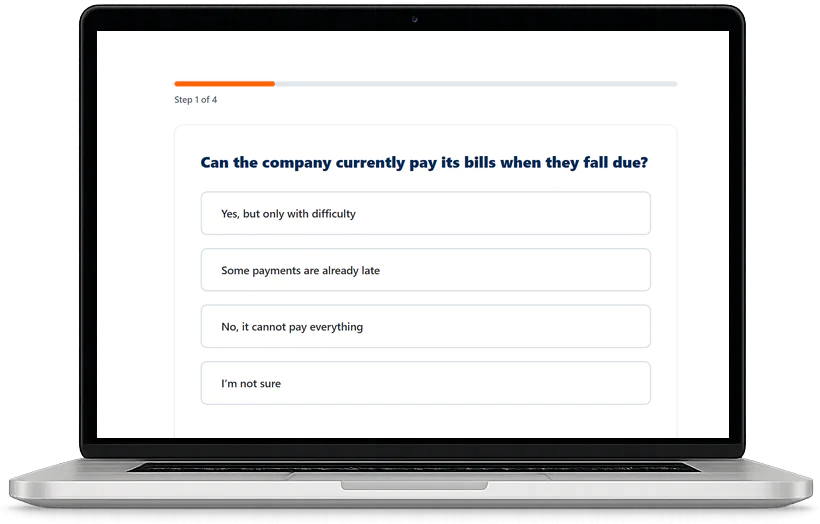
Could Your Company Be Insolvent?
Answer four short questions to see which warning signs apply, how serious the position may be and how soon you may need to act.
See which options may fit your company’s circumstances.
Check my company’s positionSee your result online and receive a copy by email. We only call if you ask.
What Causes Energy Supplier Insolvency in the UK?
Energy Provider Insolvency Meaning
An energy provider is insolvent when it cannot pay its debts as they fall due (cashflow insolvency) or when its liabilities exceed its assets (balance sheet insolvency).
These are the tests set out in section 123 of the Insolvency Act 1986.
For a licensed energy supplier, those debts include wholesale energy purchases, network access charges, Renewables Obligation liabilities, smart metering obligations, and customer credit balances that must be returned if the supplier fails.
What makes energy retail different from most industries is that the revenue side is partially constrained by regulation.
Ofgem’s Default Tariff Cap, introduced under the Domestic Gas and Electricity (Tariff Cap) Act 2018, sets a ceiling on what you can charge residential customers.
When wholesale prices rise faster than the cap adjusts, you are legally prevented from passing the full cost increase on. The margin squeeze is structural, not merely cyclical.
Difference Between Energy Supplier Failure and Ordinary Corporate Insolvency
An ordinary company that cannot pay its debts can apply for administration or enter creditors’ voluntary liquidation under the standard framework of the Insolvency Act 1986.
A licensed energy supplier faces an additional layer.
Ofgem holds the power to revoke your supply licence under the Standard Licence Conditions (SLC), and it will do so if it believes you cannot continue supplying customers safely.
Licence revocation triggers the SoLR process regardless of what your board decides.
The practical effect is that you do not fully control the timing or the form of your own insolvency.
Ofgem can effectively force a transfer of your customer book to a competitor supplier before any formal insolvency proceeding begins.
That matters for your creditors, your employees, and your own liability exposure, because assets and contracts move under the SoLR process and what remains for an insolvency estate can be considerably reduced.
When Energy Provider Insolvency May Not Be Recoverable
The 2021 to 2022 cascade of failures illustrates the point bluntly.
Avro Energy, People’s Energy, Utility Point and Pure Planet all entered the market during a period of low wholesale prices, built customer bases on competitive tariffs, and found themselves unable to hedge adequately when prices rose sharply in the second half of 2021.
None of them survived.
Bulb, which had over 1.7 million customers, was too large for the standard SoLR process and became the first UK energy supplier to enter a Special Administration Regime under the Energy Act 2004.
Recovery is not realistic when your wholesale exposure is structural: when the volume of energy you have committed to buying at market price cannot be covered by the tariff income your regulated customer base will generate.
At that point, the question is not whether to wind down but how to do it in a way that meets your legal duties and limits personal exposure.
How Ofgem Responds to Energy Supplier Insolvency
Ofgem’s Supplier of Last Resort (SoLR) Mechanism Explained
When a licensed energy supplier fails, Ofgem’s primary tool is the Supplier of Last Resort (SoLR) process.
Ofgem identifies a solvent, willing supplier, either a volunteer or a directed licensee, and appoints them to take over the failed supplier’s customer accounts.
The transfer is designed to be seamless from the customer’s perspective.
Supply does not physically interrupt, direct debits are frozen, and customers are told to wait for contact from the new supplier before making any changes.
From the failed supplier’s perspective, the SoLR appointment means its most valuable asset, the customer book, is transferred to a third party under regulatory compulsion.
The SoLR levy mechanism allows the appointed supplier to recover certain costs of the transfer from an industry-wide levy, but this does not benefit the failed supplier’s creditors directly.
Customer credit balances are a particular issue. Ofgem expects the appointed SoLR to honour them for domestic customers, and the costs of doing so are factored into the levy calculation.
Business customers do not have the same protection and rank as unsecured creditors in any subsequent insolvency.
Special Administration Regime Under the Energy Act 2004
The Special Administration Regime (SAR) is a distinct insolvency procedure that exists specifically for energy companies. It was introduced under the Energy Act 2004 and expanded by the Energy Act 2011.
SAR is triggered when a supplier is too large or too complex for the standard SoLR process, specifically where an immediate customer transfer would pose a systemic risk to energy security.
Under SAR, a court appoints a special administrator whose primary objective is not maximising creditor returns.
The special administrator’s duty is to ensure continuity of supply and facilitate the transfer of the business to a new owner or an orderly wind-down. Creditor returns are a secondary objective.
The Bulb Energy special administration ran from November 2021 until Octopus Energy acquired the business in December 2022.
The government provided approximately £1.7 billion in loans to the special administration, much of which was recovered through the Octopus deal.
SAR is not something a director can choose or opt into. It is initiated by the Secretary of State for Energy Security and Net Zero or by Ofgem, not by the company’s board.
Directors of companies entering SAR retain their personal liability exposure under the Insolvency Act 1986 just as they would in ordinary administration.
How Ofgem Appoints a Successor Supplier and Transfers Customers
The SoLR process typically begins the moment Ofgem becomes aware that a supplier is unable to continue trading.
Ofgem contacts potential successor suppliers, usually larger financially stable companies, and invites expressions of interest.
The appointment is made swiftly, often within 24 to 48 hours of the failed supplier’s public announcement.
From that point, the transfer is announced publicly, meter readings are recommended for customers, and the practical handover begins.
If you are a director of the failed supplier at this stage, you will be expected to cooperate with the SoLR, the special administrator if SAR is triggered, and any subsequently appointed insolvency practitioner.
Failing to cooperate, or taking steps that impede the transfer, can constitute misconduct under the Company Directors Disqualification Act 1986.
Options for Energy Supplier Directors Facing Insolvency
Company Voluntary Arrangement as an Energy Sector Rescue Tool
A Company Voluntary Arrangement (CVA) is a formal agreement between a company and its creditors under Part I of the Insolvency Act 1986.
It allows a company to continue trading while repaying creditors over time according to a plan approved by 75% (by value) of creditors.
For an energy supplier, a CVA is only viable if the underlying business remains commercially operable:
a customer base generating positive margin, a supply licence that Ofgem will not immediately revoke, and creditors willing to accept deferred repayment rather than immediate enforcement.
In practice, the window for a CVA in energy retail is narrow. Ofgem will act quickly if it has concerns about your ability to supply customers safely.
A CVA proposal requires a licensed insolvency practitioner to act as nominee and supervisor. It also requires a realistic projection of future cash flows.
If your wholesale exposure is ongoing and unhedged, those projections cannot support the plan.
We assess CVA viability as part of our initial review of distressed energy companies. Most of the time the answer is honest rather than hopeful.
You can read more about how CVAs work in our company voluntary arrangement guide.
Pre-Pack Administration for Energy Companies
A pre-pack administration is an arrangement where the business and assets of a company are sold to a buyer, sometimes the existing management, immediately upon or shortly after the appointment of an administrator.
The sale is negotiated in advance, before the company formally enters administration.
For an energy supplier, a pre-pack can preserve the going-concern value of the business, including the supply licence, operational infrastructure, and staff, in a way that ordinary liquidation cannot.
Pre-pack administration in the energy sector requires Ofgem’s involvement, because any sale of a licensed energy business effectively involves a transfer of the supply licence or an application for a new one.
Ofgem has the power to approve or reject licence transfers. A pre-pack that Ofgem does not support cannot proceed in its intended form.
Detailed guidance on when pre-pack administration is appropriate for directors is available in our pre-pack administration guide.
Creditors’ Voluntary Liquidation vs Compulsory Winding Up
If rescue or restructuring is not viable, the choice is usually between a Creditors’ Voluntary Liquidation (CVL), initiated by the directors, and a compulsory winding-up petition brought by a creditor or by Ofgem.
A CVL under the Insolvency Act 1986 allows directors to take the initiative, appoint a liquidator of their choice, and demonstrate to the Insolvency Service that they acted responsibly when insolvency became clear.
That matters when a liquidator later investigates your conduct. Compulsory liquidation begins with a petition to the court, typically supported by an unpaid debt of at least £750 under section 123 of the Insolvency Act 1986.
Once a petition is presented and advertised, your company’s bank accounts may be frozen. Transactions made after the petition date can be voided under section 127 of the Act. You lose control of the process.
The difference between entering CVL voluntarily and being wound up compulsorily shapes how your conduct is reviewed and how much personal liability you carry out of the process.
Our guide to company rescue solutions covers the landscape of options in more detail.
Director Risks During Energy Provider Insolvency
Wrongful Trading Under Section 214 of the Insolvency Act 1986
Section 214 of the Insolvency Act 1986 creates personal liability for directors who allow a company to continue trading after the point at which they knew, or ought to have known, that insolvent liquidation was unavoidable.
The test is objective: what would a reasonably diligent person with your general knowledge and experience have concluded?
It is not a defence to say you hoped things would improve, or that you had not yet seen the management accounts. If the information was available and you did not look, the standard still applies.
In an energy supplier context, the point of no return can arrive without much warning.
A wholesale price move that destroys your margin for the next quarter may make insolvency inevitable even though you still have cash in the bank today.
The management accounts showing the forward position, specifically the hedging book and the contracted purchase obligations versus capped retail income, are the documents that will define your liability exposure when the liquidator reviews your conduct.
Preference Payment Risk When Honouring Energy Contracts
A preference under section 239 of the Insolvency Act 1986 occurs when a company, in the period before insolvency, gives a creditor a benefit that puts them in a better position than they would be in an insolvent liquidation.
The relevant lookback period is six months for unconnected creditors and two years for connected parties such as directors or related companies.
For energy supplier directors, the preference risk is immediate.
You may face pressure from counterparties to pay outstanding wholesale energy invoices, or from Ofgem to settle Renewables Obligation (ROC) liabilities, while ordinary trade creditors and employees remain unpaid.
Paying those invoices, particularly to connected parties or under explicit pressure from specific creditors, can be challenged by a liquidator.
A decision to pay one creditor while telling others to wait should never happen without documented board-level reasoning.
Board Evidence and Documented Decision-Making
The board minutes you write in the months before insolvency become evidence in any subsequent investigation.
A liquidator reviewing your conduct will look for two things: what the board knew about the company’s financial position, and what the board decided to do about it.
A set of minutes that discusses the wholesale price crisis in general terms but records no specific decisions, no steps taken, no advice sought, reads as passive management in the face of a known crisis.
That is not a defence against wrongful trading.
Board minutes that demonstrate you sought legal and financial advice, reviewed the forward hedging position, and documented why you believed trading could continue are the ones that give a liquidator far less to work with.
The minutes do not need to be lengthy. They need to be honest, specific, and contemporaneous. Writing them retrospectively is worse than not writing them at all.
What Energy Supplier Directors Should Do Right Now
Assessing the Wholesale Price Exposure and Hedging Position
The first thing we ask any distressed energy supplier director to pull is the hedging book: what volume of energy has been purchased forward, at what price, and how much of the customer book is covered by those contracts.
If you are buying a significant portion of your supply on spot or short-term contracts in a market where prices are elevated, and selling at a capped tariff, the forward cashflow model is the starting point for everything else.
The gap between your purchase obligation and recoverable retail income is the number your insolvency practitioner needs.
It tells them whether any rescue option is viable, or whether the honest conversation is about how to manage the wind-down with minimum personal liability.
We have seen directors who avoided this calculation for weeks because they did not want to see the answer. The answer does not change by being avoided.
But the legal position gets worse the longer trading continues without a documented review.
Reviewing Customer Credit Balance Liabilities
Customer credit balances are a liability on your balance sheet. When customers pay by direct debit in advance of usage, that money belongs to the customer: it is not yet revenue.
If your company enters insolvency, those balances are owed back to customers.
For domestic customers, Ofgem expects the SoLR to honour those balances and the SoLR levy mechanism may recover the cost from the industry.
For business customers, the position is materially worse. Business customers whose supplier becomes insolvent rank as unsecured creditors in the insolvency estate and recover whatever the general creditor pool allows.
In most energy supplier insolvencies with significant wholesale liabilities, that is a fraction of the balance owed or nothing at all.
Understanding the precise size of your customer credit balance liability matters because it directly affects what your creditors will recover, and it affects the SoLR’s willingness to take on your customer book.
Getting Specialist Insolvency Advice Before Ofgem Acts
The regulatory clock runs independently of the legal one. Ofgem does not wait for a winding-up petition before beginning to prepare for a SoLR appointment.
If your supply licence conditions are at risk of breach, Ofgem can initiate the SoLR process before any formal insolvency proceeding has started.
By the time you read about your own SoLR appointment in a press release, you are no longer managing the process.
Specialist advice from a licensed insolvency practitioner who understands the energy regulatory framework changes what is available to you.
There may be a negotiated outcome with Ofgem, a pre-pack sale, or a CVA that is achievable if approached early. There is very little that is achievable if approached after the regulator has already moved.
We triage directors in this situation regularly. In our experience, the ones who act when they first see the gap in their hedging model have more options than those who wait until a creditor threatens a petition.
Your Next Step
The decision you face depends on where the real problem sits. If your wholesale hedging position has created a structural deficit, the honest question is not whether insolvency is coming but how to manage it responsibly.
That is the position where you are committed to buying energy at prices above what your capped tariff income can recover.
The priority is to get a licensed insolvency practitioner to review the forward cash position, document what the board knows, and cease increasing your exposure.
Engage with Ofgem before the regulator initiates its own process.
A CVL, pre-pack, or negotiated SoLR outcome with advance cooperation is categorically better than compulsory winding up preceded by weeks of trading that a liquidator will later examine in detail.
If the problem is operational rather than structural, the options include creditor negotiation, a time to pay arrangement with HMRC, or a CVA if the trading business is genuinely viable.
That is more likely where the pressure comes from specific creditors, a recoverable ROC liability, or a short-term wholesale spike your hedging can absorb.
Our page on CVA vs liquidation sets out the practical differences between those paths.
If you are a director of a licensed energy supplier and uncertain which of those categories you are in, that uncertainty is itself a signal.
Call us free on 0800 074 6757 for a confidential conversation with a licensed insolvency practitioner who works in the energy sector. We will tell you honestly which options are open and which are not.
Not Sure Where Your Company Stands?
Use the two-minute test to check the warning signs and see how soon you may need to act.
Check my company’s positionEstimates are fineWe only call if you ask us to
Frequently Asked Questions About Energy Provider Insolvency
What is the Supplier of Last Resort (SoLR) mechanism and how does it affect a failed energy company?
The Supplier of Last Resort (SoLR) is Ofgem’s primary mechanism for protecting customers when a licensed energy supplier fails. Ofgem appoints a solvent successor supplier to take over the failed company’s customer accounts and continue supply without interruption.
For the failed supplier’s directors and creditors, the effect is that the most valuable asset, the customer book, is transferred to a third party under regulatory compulsion. The transfer typically completes within a few days of the failure announcement.
The SoLR does not acquire the failed company’s debts or liabilities; it takes the customers. Whatever remains in the insolvency estate, including cash, plant, data systems and contracts, is available to creditors through the subsequent insolvency process.
What is a Special Administration Regime (SAR) and when does Ofgem use it instead of SoLR?
A Special Administration Regime (SAR) under the Energy Act 2004 is used when a failing energy supplier is too large or operationally complex for the standard SoLR transfer. The SAR is initiated by the Secretary of State for Energy Security and Net Zero or by Ofgem, not by the company’s directors.
A court appoints a special administrator whose primary objective is continuity of supply and orderly transfer or wind-down of the business, rather than maximising creditor returns.
The Bulb Energy SAR ran from November 2021 until Octopus Energy acquired the business in December 2022. With over 1.7 million customers, no single solvent SoLR was willing or able to absorb the entire customer book immediately.
The government provided bridging funding to support the administration until a buyer was found. SAR does not remove personal liability for directors under the Insolvency Act 1986.
Can an energy supplier director face personal liability for the company’s debts?
Yes, in specific circumstances. Section 214 of the Insolvency Act 1986 (wrongful trading) creates personal liability where a director continued to trade after the point at which they knew or should have known that insolvent liquidation was unavoidable. A liquidator can apply to court for an order that a director contribute personally to the company’s assets. The contribution is paid to creditors.
The standard is objective: what a reasonably diligent director in your position would have known. It is not a defence to say the position was unclear if the information was available in your management accounts or hedging reports.
Directors can also face personal exposure through preference claims under section 239 if they directed payments to connected parties in the period before insolvency. Prompt, documented action once insolvency risk is identified is the primary defence.
What happens to customer credit balances when an energy supplier becomes insolvent?
Domestic customer credit balances are protected through the SoLR mechanism. When Ofgem appoints a successor supplier, it expects that supplier to honour the credit balances held by transferred domestic customers. The cost of doing so is recoverable through the Ofgem SoLR levy, which is shared across the industry.
Business customer credit balances have no equivalent protection. Business customers whose supplier becomes insolvent rank as unsecured creditors in the insolvency estate and recover whatever the general distribution allows.
In most energy supplier insolvencies with significant wholesale liabilities, that is a fraction of the balance owed or nothing at all. If you are a business customer of a distressed energy supplier, contact the Insolvency Service and the appointed insolvency practitioner promptly to register your claim.
What role do Renewable Obligation Certificates (ROCs) play in energy supplier insolvency?
Renewable Obligation Certificates (ROCs) are a legal obligation on licensed electricity suppliers under the Renewables Obligation scheme. Suppliers must either hold a sufficient number of ROCs to cover the electricity they supply, or pay a buyout price to Ofgem’s Renewables Obligation fund.
Failing to meet the ROC obligation is a licence condition breach and can trigger Ofgem enforcement action before the company enters formal insolvency.
When a supplier enters insolvency, outstanding ROC liabilities rank as a creditor claim against the estate. Paying ROC liabilities to Ofgem in the period immediately before insolvency while leaving other creditors unpaid can be challenged as a preference under section 239 of the Insolvency Act 1986.
Directors should not make decisions about which regulatory obligations to honour and which to defer without specialist legal and insolvency advice.
Is a Company Voluntary Arrangement (CVA) a realistic option for an insolvent energy supplier?
A CVA is theoretically available to a licensed energy supplier but is rarely viable in practice unless the company retains a commercially positive trading base and a supply licence that Ofgem is willing to allow to continue.
A CVA requires creditors holding 75% by value of the debt to approve the proposal, and requires realistic cashflow projections showing the company can meet both the CVA repayments and its ongoing trading costs.
If the fundamental problem is a structural margin deficit driven by wholesale price exposure, those projections cannot be credible and a CVA will not be approved.
Where a CVA is feasible, for example where a supplier has a viable commercial customer book and the residential exposure is the only distressed element, it can provide a structured path to continued trading. We assess this on a case-by-case basis as part of initial director consultations.