How to Save a Struggling Business?




Directors often hold on until a single big invoice has become “the thing that fixes everything.” It rarely does.
Saving a struggling business is what you do in the fortnight before that invoice fails to land, not the morning after.
This page is the pre-formal triage playbook. You haven’t yet appointed an insolvency practitioner. You can still steer.
The earlier you act, the more options you keep, and the less of the cost ends up on you personally rather than on the company.
Most directors who eventually liquidate spent six weeks hoping a single big invoice would land. The cost of those six weeks is usually personal, not corporate.
Saving a Struggling Business at a Glance
Quick Answer: Saving a Struggling Business
Stop the bleeding first, then diagnose. That means a 13-week cash forecast, a creditor stand-still while you triage, and a written board minute recording when you first knew the company was in distress.
After that, you decide: trade through, restructure, sell, or move into a formal rescue. The order matters, because doing it backwards is what creates personal liability.
When Saving a Struggling Business Is Realistic
It’s realistic when the business has a viable core, a definable creditor problem (not a structural one), and at least 14 days of breathing room before a winding-up petition or HMRC enforcement action.
Strip out the loss-making line, the underused warehouse, the salesperson on commission with no pipeline, and you can usually see whether what’s left is a real business or a habit.
Main Risk in Saving a Struggling Business
The main risk we see is that you keep trading while insolvent, take on new credit you can’t repay, and convert a corporate problem into a personal one. Wrongful trading, preferences, and personal guarantee calls all live in this window.
The fix is documented decision-making and a hard date by which you’ll either be solvent or in a formal procedure.
What to Do Next About Saving a Struggling Business
Take our free insolvency test to see where the company actually sits, write down a 14-day stand-still plan, and book an unrecorded conversation with a licensed insolvency practitioner before you take on more credit.
We do those calls for free; the value is in the second opinion, not the eventual procedure.
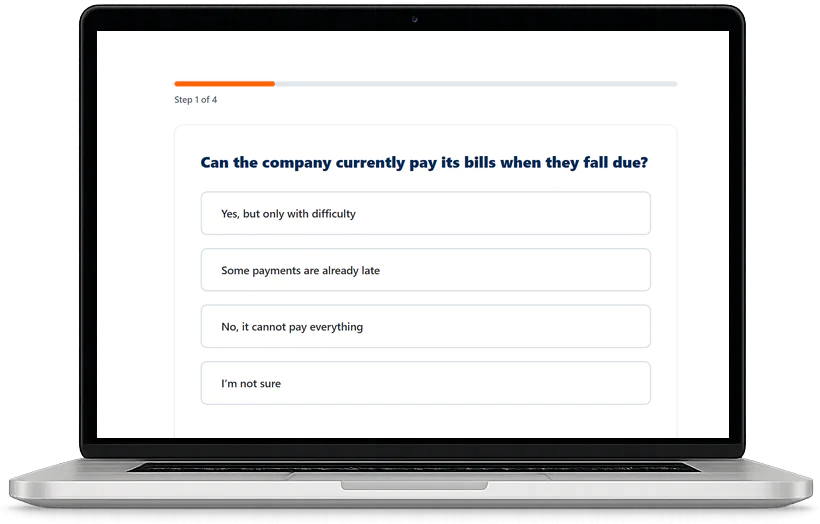
Could Your Company Be Insolvent?
Answer four short questions to see which warning signs apply, how serious the position may be and how soon you may need to act.
See which options may fit your company’s circumstances.
Check my company’s positionSee your result online and receive a copy by email. We only call if you ask.
What Does Saving a Struggling Business Mean?
Saving a Struggling Business Meaning
“Saving” here means keeping a viable trading entity alive in some form. Sometimes that’s the same company, same directors, leaner cost base. Sometimes it’s the same business inside a new corporate wrapper after a sale.
Sometimes it’s a Company Voluntary Arrangement that pays creditors a fraction over five years. What it doesn’t mean is “carry on as we were and hope.”
Difference Between Saving the Business and Rescuing the Company
You can save the business without saving the company. A pre-pack administration sells the trading assets to a new buyer (sometimes the existing directors, in a connected-party sale), and the old company is then usually liquidated or dissolved.
The brand, the staff, the customer contracts can all carry over. The legal entity does not. Many directors find this hard to accept, then accept it, then ask why nobody told them sooner.
When Saving a Struggling Business May Not Be Suitable
If the underlying market has gone (your two biggest customers have moved abroad, your product has been regulated out, your premises lease has 18 years to run with no break clause), then “saving” is the wrong frame.
A solvent or insolvent closure may protect more value, more reputation, and more of your own savings than another six months of pretending. We’d rather tell you that on day one than on day ninety.
How to Assess Whether Saving a Struggling Business Is Possible
Run a Cash-Only Viability Test on the Core Business
Strip out every customer, product line, and overhead that doesn’t earn its keep over a 13-week horizon. Look at gross margin on what’s left, not turnover.
We’ve sat in director’s offices where £4m of revenue was hiding £200k of actual cash generation; once you see the cash number, the decision usually makes itself.
If the stripped-back business covers its own variable costs and overheads, you have something to save.
Build a 13-Week Cashflow with Receipts, Not Invoices
The single most useful document in this fortnight is a weekly cash forecast based on when money will actually clear, not when invoices were raised.
Add the HMRC arrears, the VAT due, the PAYE due, the personal-guarantee-backed lender, and any winding-up petition risk.
If the bottom row goes negative inside six weeks, you have a creditor problem that needs a structured response, not another cost-cutting round.
Compare Outcomes for Creditors With and Without Action
Run the numbers two ways. One: you keep trading, exhaust the bank, and end up in compulsory liquidation in three months.
Two: you stand still on creditors now, sell the warehouse stock at 30% off book, and pay HMRC a Time to Pay arrangement out of the proceeds.
If scenario two leaves creditors better off, that’s the case for action. It’s also close to what a court asks if your decisions are later challenged: whether you took every step to minimise the potential loss to creditors. So write it down on the day you make it.
What Options Are Available for Saving a Struggling Business?
We see directors flatten three different routes into a single “rescue” word and end up choosing on cost. Don’t. There are three honest categories, and the fees scale with the protection they buy.
Informal Agreements with Creditors and HMRC
You phone HMRC and propose a Time to Pay arrangement. You write to your three biggest trade creditors with a one-page cash position and a stand-still proposal. You renegotiate your invoice finance facility before you breach it, not after.
None of this needs a court, an IP, or a fee. Most of it works if you do it before the creditors have started enforcement, and almost none of it works if you do it after.
Rescue or Restructuring Procedures
If the debt is too big to manage informally but the trading business is viable, you move into a formal rescue. The formal rescue procedures are explained on our rescue your business from insolvency page; this article won’t repeat them.
The short version: a CVA reschedules creditor debt over (typically) five years, an Administration buys you a moratorium and a restructure, a Restructuring Plan does similar work for larger or cross-class disputes.
Sale, Closure or Insolvency
If the business has value but the company doesn’t, a sale (sometimes via pre-pack) protects the trading assets while the old company is wound up.
If neither has value, a Creditors’ Voluntary Liquidation closes things cleanly and limits director risk far better than waiting for a compulsory winding-up petition.
A solvent Members’ Voluntary Liquidation is only available if the directors can declare that the company will pay all its debts in full, with statutory interest, within 12 months. Most readers of this page can’t, and that’s fine, but it rules MVL out.
Comparison of Recovery and Insolvency Routes
| Route | Best for | Typical creditor outcome | Director impact |
|---|---|---|---|
| Time to Pay (HMRC) | One-off tax arrears, viable trading | Paid in full over 6–12 months | None if delivered |
| Informal creditor stand-still | Cashflow shock, supportive creditors | Paid in full, slower | None if documented |
| CVA | Multi-creditor debt, viable core | Pence in the pound over ~5 years | Same directors, restricted credit |
| Administration | Going concern under threat | Variable; moratorium protects value | Directors lose day-to-day control |
| Pre-pack sale | Trading assets worth more than the company | Often modest; SIP 16 disclosure required | Possible connected-party purchase, scrutinised |
| CVL | No viable rescue route left | Distribution per priority rules | Investigation by liquidator into conduct |
| Strike-off | Solvent, dormant, no creditor objection | Not appropriate where creditors exist | Improper use can be reversed |
Director Risks During the Rescue Window
The pre-formal window is where directors quietly create personal liability for themselves. Most of it is avoidable with documented decisions and an honest read of the cash position.
The risks below are the ones a liquidator will look at first if things later move into a formal procedure.
| Risk | What triggers it | What protects you |
|---|---|---|
| Wrongful trading (s.214 IA 1986) | Continuing to trade once you knew or ought to have concluded there was no reasonable prospect of avoiding insolvent liquidation or insolvent administration | Dated board minutes, IP advice, a defined stop-date |
| Preferences (s.239 IA 1986) | Paying one creditor (often a connected one) ahead of others while insolvent, with a desire to put them in a better position | Pay in priority order, document any commercial necessity |
| Transactions at undervalue (s.238) | Selling assets for significantly less than their value in the two years before insolvency | Independent valuation before any sale |
| Personal guarantees called | The company defaults on a PG-backed facility | Negotiate before default; a CVA does not normally stop a lender calling a personal guarantee |
| Director disqualification | Conduct found unfit under the CDDA 1986 (e.g. unpaid Crown debts, trading on) | Take advice early; the timing of the call is what gets recorded |
| Misfeasance (s.212 IA 1986) | Breach of fiduciary duty causing loss to creditors | Decisions in writing, on the record, with reasons |
None of these are fatal on their own. They become fatal in combination.
Director conduct investigations exist precisely because this window is so badly handled so often.
What Directors Should Do About Saving a Struggling Business
Call a Stand-Still Board Meeting Within 48 Hours and Minute It
Not a forecast. Not a strategy day.
A stand-still board meeting whose only purpose is to record that the directors have recognised the company is in financial distress, are taking advice, and are not taking on new credit until the position is reassessed by a defined date.
That minute is the single most useful piece of paper you will produce this fortnight; it dates the moment you started behaving correctly.
Build the 14-Day Creditor Triage Map
List every creditor in three columns: enforcement-capable now (HMRC, secured lender, anyone with a CCJ), trade creditors with leverage (key supplier, your landlord), and trade creditors with none.
Phone column one, write to column two, defer column three. Creditor negotiations done in this order keep the business alive longer than any cost-cutting exercise.
Get a Free Second Opinion From a Licensed IP Before Day 14
Not a sales conversation. A diagnostic one, off the record, with someone who has looked at hundreds of these positions. We do them, our competitors do them, and any IP who tries to sell you a procedure on a first call is the wrong IP.
The point of the call is to test your plan against the legal duties, not to commit to anything.
Set a Hard Solvency Review Date and Honour It
Pick a date 14 to 21 days from the stand-still minute. On that date, you re-run the cash forecast, you check the creditor responses, and you decide: solvent and trading on, or moving into a formal procedure.
Drift past that date without a decision and you’ve stopped saving the business and started exposing yourself. The directors who get this right are the ones who treat the date as a duty, not a milestone.
Related Saving a Struggling Business Guides
If you’ve worked through the triage above and want to go deeper on the formal routes or the operational fixes, these companion pages do that work:
- Rescue your business from insolvency: formal procedure routing across CVA, Administration and pre-pack.
- Company cash flow problems: operational fixes for the 13-week cash forecast.
- Company Voluntary Arrangement (CVA): when a five-year creditor reschedule fits.
- Company Administration: moratorium-led restructure or sale.
Not Sure Where Your Company Stands?
Use the two-minute test to check the warning signs and see how soon you may need to act.
Check my company’s positionEstimates are fineWe only call if you ask us to
Frequently Asked Questions About Saving a Struggling Business
How long do I realistically have to save a struggling business?
Usually 14 to 21 days from the moment you privately admit the company is in distress. Long enough to run a 13-week cash forecast, hold a stand-still board meeting, get a second opinion from an IP, and make a documented decision. Past three weeks without a plan, the legal exposure climbs faster than the operational position improves.
If I keep trading while struggling, am I personally liable?
You can be, under section 214 of the Insolvency Act 1986 (wrongful trading), if you carried on trading after you knew or ought to have concluded that there was no reasonable prospect of avoiding insolvent liquidation or insolvent administration.
The defence is showing that you took every step to minimise the potential loss to creditors. Documented decisions and timely advice are how you prove it. A board minute dated today is worth more than any explanation given six months later in a liquidator’s interview.
Is refinancing a sensible move while the business is struggling?
Only if the business has a viable trading core and the new facility extends the runway long enough to fix the underlying cash gap. Stacking another loan onto an unaltered cost base usually buys six weeks and adds a personal guarantee. If you can’t model the new facility being repaid out of operations, the right answer is a creditor restructure, not more debt.
What if no rescue option is viable?
Then the kindest decision, for creditors and for you, is usually a Creditors’ Voluntary Liquidation rather than waiting for a compulsory winding-up petition.
A CVL is started by the directors and approved by a shareholders’ resolution. It is controlled and gives the cleanest line under the matter. Our rescue your business from insolvency page covers the formal routes; the appointment itself is handled by a licensed practitioner.
Can I save the business but not the company?
Yes, and quite often that is the right outcome. A pre-pack administration sells the trading assets, brand and contracts to a new company, and the old company is then usually liquidated or dissolved.
SIP 16 governs the disclosure to creditors. Where directors are connected to the buyer, the sale also needs creditor approval or an independent evaluator’s report, which the buyer obtains. The trading business survives; the legal entity does not.