



If your company has run out of cash and you have been told you need to liquidate but cannot afford the practitioner’s fees, you are not stuck. There are several lawful routes through the insolvency process even when the company has nothing left in the bank, and some of them cost you nothing personally.
We speak to directors in this exact position every week, and the answer is almost always that doing nothing is the worst option.
The decisions you make in the next two weeks usually determine whether you keep control of the wind-down or hand it to a creditor. Below are the four routes that actually work when the company has nothing in the bank, and the realistic ways to fund them.
Who Will Find This Useful
- Directors who have received a liquidation quote but the company has no funds to pay the practitioner’s fees
- Directors sitting on an insolvent, dormant company hoping it will eventually be struck off automatically, without realising the risks of doing nothing
- Directors who qualify for a director redundancy claim but have not yet explored using it to fund the liquidation
Not for: Directors whose company is solvent and can pay its debts. The guidance below addresses insolvency scenarios only.
Why Cannot Afford to Liquidate Is Never a Reason to Do Nothing
We hear it every week: “I’d like to liquidate but the quote was £5,000 and the company has £600 in the bank.” The directors in that position usually assume the only option is to keep the company dormant and hope it gets struck off by Companies House eventually.
That approach carries real risks. While the company sits on the register, the debts remain, creditors can still petition, and HMRC can still investigate.
Worse, continuing to trade while knowingly insolvent is wrongful trading under Section 214 of the Insolvency Act 1986, and it can make you personally liable for the debts you run up during that period.
Our advice to every director facing this is the same: do not drift. Get a free first consultation with a licensed IP. In most cases we can identify a route that works even without cash, and we tell you honestly if one exists or not. Drift is almost always the most expensive option in the end.
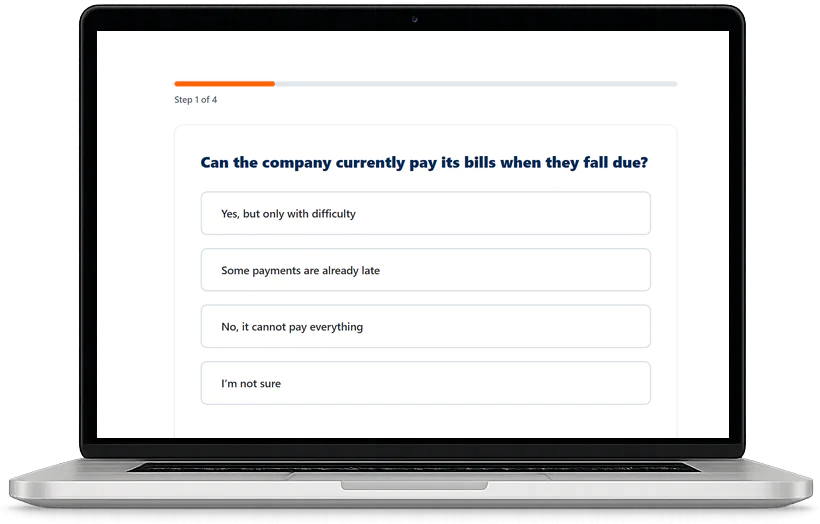
How Serious Is Your Company’s Position?
Answer four short questions to see how urgent the situation may be and which options could fit your company’s circumstances.
Check my company’s positionSee your result online and receive a copy by email. We only call if you ask.
Four Options When You Cannot Afford to Liquidate
- Voluntary strike-off (DS01). Cheap but only lawful for solvent companies with no creditors. Usually not appropriate when you cannot afford liquidation because that implies debts exist.
- Creditors’ Voluntary Liquidation funded by director redundancy or personal funds. A CVL is possible even when the company has no assets, provided a source of funding is identified. Director redundancy claims often bridge the gap.
- Compulsory liquidation by creditor petition. Waiting for a creditor to petition passes the cost to them and to the Insolvency Service, but you lose control of timing, appointment, and investigation.
- Rescue routes (CVA, administration, moratorium). These require some working capital and an underlying viable business, so they are rarely realistic when there is no cash at all.
Recovery Path
No cash for liquidation: the realistic funding routes
For most directors in this position, the choice is between a CVL funded by a director redundancy claim and letting a creditor force compulsory liquidation.
If you qualify for redundancy (employee status, PAYE, two or more years’ service), the claim can cover the CVL fee and keeps you in control of the process. Do not bank on it. The Redundancy Payments Service tests director claims hard and refuses plenty of them where the paperwork does not show a genuine employment relationship. If the claim goes down, the fee is still yours to find. If you do not qualify, the first call identifies any other fundable assets before compulsory liquidation becomes the default.
We walk directors through all four at the first call. The right answer depends on whether the business is viable, whether creditors are already pressing, and whether you qualify for a director redundancy claim.
Voluntary Strike-Off: A Cheap Option Rarely Right for Insolvent Companies
Voluntary strike-off under Section 1003 of the Companies Act 2006 costs £13 online (£18 by paper) and removes the company from the register. It is appealing because it is so cheap.
But Section 1003(3) prohibits strike-off where the company has outstanding creditors, and almost every director asking “can’t afford to liquidate” has creditors. Attempting strike-off despite known debts exposes you to two problems:
- Creditor objections. HMRC and trade creditors routinely object to strike-off notices published in the Gazette. The Registrar will suspend the process until the issue is resolved.
- Personal liability under the 2021 Act. The Rating (Coronavirus) and Directors Disqualification (Dissolved Companies) Act 2021 gave the Insolvency Service power to investigate dissolved companies and pursue directors personally for conduct that would have been actionable in a liquidation. Strike-off is no longer an escape.
Our rule: if the company has debts it cannot pay, strike-off is not your answer. Even if it works in the short term, it can unwind years later.
How to Liquidate Through a CVL When the Company Has No Assets
A Creditors’ Voluntary Liquidation can still be done when the company has no assets, but the liquidator needs to be paid from somewhere. Most CVLs cost £3,500 plus VAT for a straightforward case. When the company cannot cover it, the common funding sources we see are:
- Director personal funds. Directors sometimes pay the fee themselves to regain control of the process and avoid compulsory liquidation.
- Director redundancy claim. If you are an employee of the company as well as a director and meet the qualifying criteria, a redundancy payment from the Insolvency Service (via the National Insurance Fund) can be assigned to the practitioner to cover the liquidation fee.
- Asset realisations the director was not aware of. Book debts, retention-of-title stock, tax refunds, and deposits with suppliers often exist and can be realised by the liquidator to cover fees.
- Family or third-party funding. Some directors borrow from family to cover the fee and avoid the consequences of compulsory liquidation.
Our assessment at the first call usually identifies at least one of these. For a director with real length of service behind them, the redundancy claim alone is frequently enough to cover a straightforward CVL. What it comes to depends on your age, service and weekly pay, and the gov.uk calculator will give you your own figure. More on the process in our guide to creditors’ voluntary liquidation.
Compulsory Liquidation as a Last-Resort Option to Liquidate
If you genuinely cannot fund a CVL and no alternative exists, the company will eventually face compulsory liquidation by creditor petition. HMRC or a trade creditor petitions the court, the court makes a winding-up order, and the Official Receiver is appointed as liquidator.
The cost is met by the petitioning creditor (£352 court fee plus £2,600 petition deposit) and by the Insolvency Service’s own budget. You pay nothing personally.
The downside is loss of control. You cannot choose the liquidator, the Official Receiver investigates director conduct, bank accounts are frozen, trade insurance is withdrawn, and the Gazette advertisement damages your commercial reputation.
Directors who took this route are also more likely to face disqualification proceedings because the Official Receiver’s office is under-resourced for nuanced investigations. Our advice is that compulsory liquidation is a fallback, not a plan.
Rescue Options Beyond Liquidating: CVA, Moratorium, Administration
If the underlying business is viable but cash has run out, there are rescue routes worth considering. A Company Voluntary Arrangement restructures creditor debts over three to five years while the business continues trading.
Administration places the company under court protection with a statutory moratorium that halts creditor action. The Part A1 Moratorium (introduced by CIGA 2020) gives directors a 20-day breathing space to explore restructuring.
The catch is that all three require working capital during the process. A CVA needs cash to fund ongoing trading; administration needs cash for administrator fees; a moratorium needs cash to pay the monitor.
Our experience is that rescue routes work when the business has current income but a historic debt burden. They rarely work when there is nothing coming in at all. We are honest with directors at the first call about which route is realistic for their circumstances.
The Real Cost of Inaction When You Cannot Afford to Liquidate
Directors in financial distress sometimes decide to “just keep going and see what happens.” We understand the temptation, but the consequences of trading while knowingly insolvent are serious.
Under Section 214 of the Insolvency Act 1986, you can be ordered to contribute personally to the company’s assets if you continued trading when you ought to have concluded there was no reasonable prospect of avoiding insolvency.
Under Section 212 (misfeasance), you can be pursued for breach of fiduciary duty. Under the Company Directors Disqualification Act 1986, your conduct can result in a ban of 2 to 15 years.
On top of that, every day you continue trading while insolvent adds to the debt the liquidator will eventually scrutinise. Supplier invoices, HMRC arrears, and rent obligations accumulate. The bigger the pile, the harder your defence becomes. Our rule is: the moment you know insolvency is probable, stop taking on new credit and take advice within days, not weeks.
Director Redundancy: A Funding Option for Directors Who Cannot Afford to Liquidate
Many directors do not realise they may qualify for a statutory redundancy payment when their company enters liquidation.
If you are an employee of the company as well as a director, hold a contract of employment, are paid through PAYE, and have at least two years of continuous service, you can claim redundancy, unpaid wages, holiday pay, and notice pay from the National Insurance Fund via the Insolvency Service.
What the claim comes to depends on your age, length of service and weekly pay, capped at £751 a week from 6 April 2026. Payments usually come through within six to eight weeks of liquidation. Use the gov.uk redundancy calculator for your own figure rather than relying on an average.
This is not a loophole. It is a statutory entitlement created precisely to protect working directors from losing everything when their company fails.
We help directors assess and claim this at the first consultation, and the claim can often be assigned to cover the cost of the CVL itself. For directors who thought they could not afford liquidation, the redundancy claim is frequently the answer. The Insolvency Service publishes clear guidance on the eligibility criteria on gov.uk.
Find out if your director redundancy claim covers the liquidation fee
We assess director redundancy eligibility at the first call and can confirm whether the claim can be assigned to cover the CVL cost, at no upfront charge to you.
Get free adviceQuick Checklist of Options When You Cannot Afford to Liquidate
- Does the company have outstanding creditors? If yes, strike-off is not an option.
- Are you an employee of the company with at least two years of PAYE service? If yes, a director redundancy claim may fund the liquidation.
- Are there assets the liquidator can realise (book debts, stock, tax refunds)? If yes, a CVL is viable.
- Is the underlying business still generating income? If yes, a CVA or administration may be realistic.
- Is a creditor already threatening a petition? If yes, act within the 21-day statutory demand window to keep control.
- Have you stopped taking on new credit from the point you realised insolvency was probable? If not, take advice urgently on wrongful trading exposure.
FAQs on Cannot Afford to Liquidate
How much does a CVL cost if the company has no assets?
A straightforward CVL typically costs £3,500 plus VAT. Without assets, the fee needs to come from another source: director personal funds, a director redundancy claim assigned to the liquidator, family funding, or from asset realisations the liquidator finds during the process (book debts, deposits, tax refunds).
Can I use my director redundancy claim to pay the liquidator?
Yes, and this is one of the most common funding routes. If you qualify (employee status, PAYE, two years continuous service), your redundancy claim can be assigned to the insolvency practitioner to cover the CVL fee. Whether it covers the whole fee depends on your age, service and weekly pay. We calculate it at the first call and handle the claim as part of our CVL work.
What if I just wait for a creditor to petition?
You can, and it costs you nothing directly. But you lose control of the process, the Official Receiver investigates director conduct, your bank accounts freeze, and your commercial reputation suffers from the Gazette advertisement.
Directors who let compulsory liquidation happen are also more likely to face disqualification proceedings. A voluntary CVL on your terms is almost always better than a compulsory liquidation forced by a creditor.
Is striking off the company a cheaper option?
Strike-off is cheap but not lawful when the company has outstanding creditors (Section 1003(3) Companies Act 2006). Since 2021, the Insolvency Service can investigate dissolved companies and pursue directors personally, so strike-off is no longer an escape route from debts. If you attempt strike-off with known creditors, expect objections and potential personal liability.
Can HMRC force me into bankruptcy personally if the company can’t pay?
Not directly, unless you gave a personal guarantee or have been found personally liable via wrongful trading, misfeasance, or a preference claim. The limited company structure protects you in most cases. Personal bankruptcy risk arises only when the corporate veil is pierced or when personal debts have been guaranteed.
What happens to employees if I can’t afford to liquidate?
Employees are entitled to redundancy pay, unpaid wages, holiday pay, and notice pay from the Insolvency Service’s National Insurance Fund once the company enters formal liquidation (CVL or compulsory). These claims are paid directly by the government, not from company assets. Delaying liquidation delays employee claims, which is a real hardship for staff who depend on the money.
How quickly can you start the CVL if I instruct you today?
From first instruction to appointment of liquidator is usually two to three weeks for a straightforward case. We prepare the Statement of Affairs, convene the shareholders’ meeting, and hold the creditors’ decision procedure under Section 100 of the Insolvency Act 1986. More complex cases with disputed debts or asset valuations can take four to six weeks.
Check How Serious the Position May Be
Answer four short questions to see how urgent the situation may be and which broad options could fit.
Check my company’s positionEstimates are fineWe only call if you ask us to
Related Guides
- How Much Does It Cost to Liquidate a Company?: the full cost breakdown by route.
- Creditors’ Voluntary Liquidation: the process, timeline and what to prepare.
- Compulsory Liquidation: what happens if a creditor petitions before you act.
- Company Strike-Off and Dissolution: why the cheap route is not a substitute.