How to Choose the Right Insolvency Procedure: A UK Director’s Decision Guide




You know the company is in trouble. The debts have grown past the point where a good month or a new contract can fix things. Your accountant has mentioned “options,” your solicitor has said something about “duties,” and you have spent the last few nights reading about insolvency procedures that all sound disturbingly similar.
The problem is not that there are no routes out. The problem is there are at least five, they overlap in confusing ways, and picking the wrong one can cost you tens of thousands of pounds or expose you to personal liability. This guide is designed to help you work out which procedure actually fits your situation, not just explain what each one does in theory.
We see directors delay this decision by months, often because they cannot tell which route applies to them. That delay, in our experience, usually makes every option worse. The earlier you understand the landscape, the more routes remain open to you.
On This Page
Quick Answer
If your company cannot pay its debts and has no realistic rescue plan, a Creditors’ Voluntary Liquidation (CVL) is the most common and usually the most appropriate route. If the company is solvent but the goal is tax-efficient closure, consider a Members’ Voluntary Liquidation (MVL).
If the business is viable but needs protection from creditors while it restructures, Administration or a Company Voluntary Arrangement (CVA) may apply. If the company has no assets, no debts, and has not traded for months, strike-off is the cheapest closure route. The rest of this guide helps you confirm which category your company falls into.
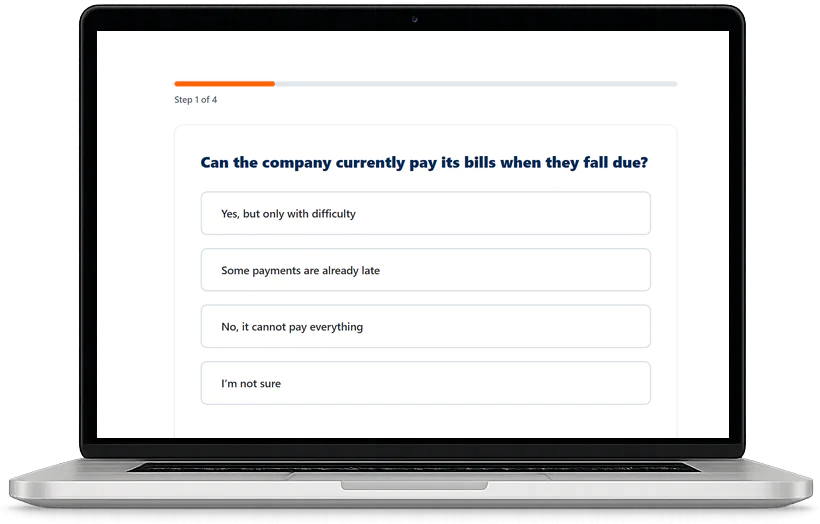
How Serious Is Your Company’s Position?
Answer four short questions to see how urgent the situation may be and which options could fit your company’s circumstances.
Check my company’s positionSee your result online and receive a copy by email. We only call if you ask.
Insolvency Procedures at a Glance: Comparison Table
This table gives you the headline differences. It is deliberately simplified. The sections below explain the conditions and trade-offs that the table cannot capture.
| Procedure | Company solvent? | Company survives? | Director stays in control? | Typical cost | Typical timeline |
|---|---|---|---|---|---|
| CVL | No | No (wound up) | No (IP takes over) | £3,500+ | 3 to 12 months |
| MVL | Yes | No (wound up) | No (IP takes over) | £3,500+ | 6 to 18 months |
| Administration | No | Possibly (rescue aim) | No (administrator runs it) | £10,000 to £50,000+ | 12 months (extendable) |
| CVA | No | Yes (if approved) | Yes (supervised) | £5,000 to £10,000+ setup | 3 to 5 years |
| Strike-off | Yes (no debts) | No (dissolved) | Yes (you apply) | £13 (filing fee) | 3 to 6 months |
IP means insolvency practitioner: a licensed professional who takes legal control of the process. It is not possible to run a CVL, MVL, or administration without one.
Creditors’ Voluntary Liquidation (CVL): When the Company Cannot Pay Its Debts
A creditors’ voluntary liquidation is the procedure most insolvent companies end up using. The company stops trading, an insolvency practitioner is appointed, the assets are sold, and the proceeds go to creditors in a legally defined order. The company is then dissolved.
A CVL is director-initiated. That matters. When you place the company into voluntary liquidation before a creditor forces it, you are demonstrating that you took your legal duties seriously. Directors of insolvent companies have a duty to act in the interests of creditors. Delaying liquidation while racking up more debt is one of the most common triggers for personal liability claims.
The cost is typically £3,500, sometimes more for complex cases. That can feel steep for a company that is already out of money. Some insolvency practitioners will agree to have their fees paid from asset realisations, but this depends on whether the company has assets worth realising. We have a detailed breakdown of how much liquidation costs if you need the specifics.
The process usually takes three to twelve months. During that time, employees are made redundant (the Redundancy Payments Service covers statutory entitlements), and the IP investigates your conduct as a director. That investigation is not optional. It happens in every CVL.
This is for you if: your company owes more than it can pay, has no realistic rescue plan, and you want to close it properly rather than wait for a creditor to force the issue.
Members’ Voluntary Liquidation (MVL): When the Company Is Solvent but You Want to Close It
An MVL is for solvent companies. The directors make a statutory declaration that the company can pay all its debts within 12 months, and then an IP is appointed to wind the company up and distribute the remaining funds to shareholders.
The main reason directors use an MVL rather than just taking the money out as dividends is tax. Distributions in an MVL are treated as capital, which means they qualify for Business Asset Disposal Relief (formerly Entrepreneurs’ Relief). For shareholders with at least £25,000 to extract, the tax saving usually outweighs the liquidation fees comfortably.
The catch, and we raise this with every director considering an MVL: if the declaration of solvency turns out to be wrong, the MVL converts into a creditors’ liquidation and you face scrutiny for making a false statutory declaration.
That is a criminal offence. Do not use an MVL to avoid dealing with debts. We occasionally see accountants recommend an MVL for companies that are borderline solvent. If there is any doubt about whether you can pay every creditor in full within 12 months, this is the wrong procedure.
This is for you if: the company has no outstanding debts it cannot pay, you want to extract retained profits tax-efficiently, and you are certain about the solvency position.
Administration: When the Business Might Be Worth Saving
Administration places the company under the control of an administrator (a licensed IP) who has a legal duty to try to rescue it as a going concern, or, failing that, to achieve a better outcome for creditors than immediate liquidation would.
The moment administration begins, a moratorium kicks in. Creditors cannot issue proceedings, enforce security, or repossess goods without the court’s permission. That breathing space is the entire point. It gives the administrator time to restructure, sell the business, or negotiate with creditors without the whole thing collapsing under legal pressure.
Administration is expensive. From what we see in the market, fees start at around £10,000 for small companies and can run well past £50,000.
The administrator has the power to sell assets, make employees redundant, and override certain contracts. The director loses day-to-day control. Some directors find that difficult to accept, especially when they believe they understand the business better than an outsider. That may be true, but the law requires an independent professional to run it.
Pre-pack administration is a variant where the administrator arranges a sale of the business before or immediately after appointment. We handle pre-pack cases regularly. It is controversial because it can look like directors are dumping debts while keeping the business.
The rules around pre-packs tightened significantly in 2021 with the Administration (Restrictions on Disposal etc. to Connected Persons) Regulations. If directors are buying their own business back out of administration, an independent written evaluation from an evaluator is required from an evaluator.
This is for you if: the business itself is viable (customers, revenue, staff worth keeping) but the debt burden is making it impossible to trade. You need time, protection from creditors, and you can afford the professional fees.
Company Voluntary Arrangement (CVA): Restructuring Debt While You Stay in Control
A company voluntary arrangement is a legally binding agreement between your company and its creditors to repay a proportion of the debt over a fixed period, usually three to five years. An IP supervises the arrangement but you remain in control of the company.
We understand the appeal: you keep trading, keep your staff, keep your contracts.
The trade-off is that 75% of creditors by value must vote in favour. If your largest creditor votes against it, the CVA fails. HMRC is frequently the largest creditor for companies in difficulty, and HMRC’s track record of approving CVA proposals is mixed. They will reject proposals that look unrealistic or where they suspect the directors have been deliberately avoiding their tax obligations.
A CVA also requires consistent monthly payments over the arrangement period. If payments are missed, the supervisor can terminate the CVA, and the company usually goes straight into liquidation. Three to five years of reduced cash flow is a long time for a business that was already struggling.
We see directors sometimes treat a CVA as a way to buy time without fixing the underlying problems. That rarely ends well. We see CVAs fail most often when the business model that created the debt has not actually changed.
This is for you if: the business is profitable enough to sustain regular payments over several years, the debts are manageable once restructured, and you are confident that the problem was temporary rather than structural.
Strike-Off and Dissolution: The Cheapest Exit, With Strict Conditions
Striking a company off the register is the simplest form of closure. You file a DS01 form with Companies House, pay £13, and if nobody objects within two months, the company is dissolved. No insolvency practitioner. No creditors’ meeting.
The conditions are strict. The company must not have traded or sold off stock in the past three months. It must not have changed its name. It must not have any outstanding debts, ongoing legal proceedings, or agreements with creditors. It must not be subject to a CVA or in administration.
This is where directors get into trouble. Striking off a company that still has debts does not make those debts disappear. Creditors can object to the dissolution, and HMRC regularly does. If the company is dissolved with outstanding tax liabilities, HMRC can apply to restore it to the register and then pursue the debts. In some cases, they pursue the directors personally.
We hear this too often. The accountant who tells a director to “just strike it off” when you actually owe money is giving you dangerous advice. It happens more often than it should. Strike-off is not an insolvency procedure. It is a closure mechanism for companies that have nothing left to resolve.
This is for you if: the company has genuinely stopped trading, has no debts, no outstanding tax returns, and no pending claims against it. If any of those conditions are not met, you need a different route.
The Decision Framework: Matching Your Situation to the Right Procedure
Forget the procedure names for a moment. Answer these questions honestly, and the right route will narrow itself.
-
1
Can your company pay all its debts within 12 months?
If yes, you are solvent. Options are MVL (tax-efficient closure) or strike-off (nothing left to distribute). If no, you are insolvent. Continue to step 2..
-
2
Is the underlying business viable?
Can it generate enough revenue to cover costs and service restructured debt? If yes, consider Administration or a CVA. If no, a CVL is almost certainly the right path.
-
3
Is a creditor already threatening legal action or a winding-up petition?
If a petition has been advertised, options collapse fast. Administration may still be possible if you move immediately. A CVA becomes almost impossible. Voluntary liquidation is your most realistic option — do not wait for the court hearing.
-
4
Can you afford professional fees?
Every formal insolvency procedure costs money. Some IPs will take on CVLs where fees can be met from asset realisations. The cheapest-looking option is not the lowest-cost one if it creates personal liability later.
Can your company pay all its debts within 12 months?
If yes, you are solvent. Your options are MVL (if you want to close and extract funds tax-efficiently) or strike-off (if there is nothing left to distribute). If no, you are insolvent, and the remaining questions apply.
Is the underlying business viable?
This is the question that separates rescue from closure.
A business is viable if it can generate enough revenue to cover its costs and make meaningful debt repayments once the existing burden is restructured. If the answer is yes, consider administration (for complex situations requiring creditor protection) or a CVA (for simpler restructuring where you keep control). If no, closure through a CVL is almost certainly the right path.
Is a creditor already threatening legal action or a winding-up petition?
If a winding-up petition has already been advertised, your options collapse fast. Administration may still be possible if you move quickly enough, but a CVA becomes almost impossible because the petition process overrides it. A voluntary liquidation is your most realistic option at this stage. Do not wait for the court hearing.
Can you afford professional fees?
Every formal insolvency procedure costs money. If the company has no assets and no funds for an IP, your options are limited. Some IPs will take on CVLs where fees can be met from asset realisations. Strike-off costs almost nothing but only works if you genuinely owe nothing. The cheapest-looking option is not the lowest-cost one if it leads to personal liability later.
What Happens If You Choose the Wrong Procedure
We see wrong choices more often than most directors expect, and the consequences are not theoretical.
Using strike-off when you should use a CVL: Creditors can object to the dissolution. HMRC regularly restores companies to the register. Directors may face accusations of trying to avoid debts, which can lead to director disqualification proceedings. The debts do not vanish.
Attempting a CVA when the business is not viable: If the CVA fails mid-arrangement, the director has spent several years making payments, paid IP supervision fees, and still end up in liquidation. Your creditors receive less than they would have if you had gone straight to a CVL, and the IP’s report on your conduct will note the delay.
Declaring solvency for an MVL when you are not actually solvent: This is a criminal offence under section 89 of the Insolvency Act 1986 (the provision requiring directors to make a statutory declaration of solvency before an MVL can proceed). The MVL converts to a CVL, and the liquidator investigates why you made a false declaration. Directors have been disqualified and prosecuted for this.
Doing nothing: Arguably the most common wrong choice. The director who sits at the kitchen table at midnight reading insolvency articles, hoping the problem resolves itself. Every month of delay typically increases the deficit, exposes you to wrongful trading claims, and reduces the number of available routes. Inaction is itself a decision, and it is almost always the most expensive one.
Key Takeaway
Wrong procedure choices, in our experience, have real legal consequences: striking off a company with debts does not extinguish them, a false MVL solvency declaration is a criminal offence under s.89 Insolvency Act 1986, and delay is itself a form of wrongful trading exposure. The right procedure, in our caseload, costs less than the wrong one. Always.
FAQs on How to Choose the Right Insolvency Procedure
Can I choose which insolvency procedure to use, or does someone decide for me?
As a director, you can choose a voluntary route (CVL, MVL, CVA, or strike-off) as long as you act before a creditor forces the issue. If a creditor presents a winding-up petition to the court, the court can order compulsory liquidation and the choice is no longer yours. Acting early preserves your ability to select the most appropriate procedure.
What is the difference between insolvency and liquidation?
Insolvency is a financial state: the company cannot pay its debts as they fall due, or its liabilities exceed its assets.
Liquidation is one of several procedures available to deal with insolvency. A company can be insolvent without being in liquidation (for example, if it enters administration or a CVA instead). Not all liquidations involve insolvency either, since an MVL is used to close solvent companies.
Do I need an insolvency practitioner for every procedure?
A licensed IP is required for a CVL, MVL, administration, and CVA.
Strike-off is the only company closure route that does not require an IP. The application goes directly to Companies House. However, strike-off is only suitable if the company has no debts and has not traded recently. If there is any doubt about debts or tax liabilities, taking professional advice before applying for strike-off can prevent costly mistakes.
Will I be investigated as a director if the company goes into liquidation?
Yes. In every CVL and compulsory liquidation, the insolvency practitioner is legally required to investigate the conduct of the directors and submit a report to the Insolvency Service.
This does not mean you have done anything wrong. The investigation is routine. If you have acted honestly, kept reasonable records, and not continued trading when you knew the company could not pay its debts, the process is usually simple.
Can I start a new company after insolvency?
In most cases, yes. Company insolvency does not automatically prevent you from being a director of a new company.
However, if you are disqualified by the Insolvency Service (which can happen if they find evidence of misconduct), a disqualification order bans you from acting as a director for between 2 and 15 years. There are also restrictions under section 216 of the Insolvency Act on reusing a company name that is the same or similar to the liquidated company’s name.
How long does the whole process take from start to finish?
Strike-off takes roughly three to six months.
A CVL typically completes within three to twelve months, depending on asset complexity. An MVL takes six to eighteen months. Administration lasts up to twelve months, though extensions are possible. A CVA runs for three to five years. These are typical ranges. Companies with complex assets, disputed claims, or ongoing litigation can take significantly longer.
Check How Serious the Position May Be
Answer four short questions to see how urgent the situation may be and which broad options could fit.
Check my company’s positionEstimates are fineWe only call if you ask us to
Related Guides
- Company Rescue Solutions: the full range of options before liquidation becomes the only route.
- Company Administration: protecting a viable business while a rescue or sale is arranged.
- Company Voluntary Arrangement: restructuring debt through a creditor-approved repayment plan.
- Creditors’ Voluntary Liquidation: the standard route to close an insolvent company.
- Members’ Voluntary Liquidation: tax-efficient closure for a solvent company with retained profit.
- Strike-Off and Dissolution: the cheapest exit, and when it is not allowed.