How to Prepare for Company Liquidation: A Director’s Step-by-Step Checklist




If you’re reading this, there’s a good chance the company is in serious trouble and the director is trying to work out what to do next.
The word “liquidation” probably arrived in your thinking recently, maybe after a sleepless night or a phone call from a creditor that left your stomach turning. That is a normal reaction to an abnormal situation, and the fact that you’re looking for a checklist rather than ignoring the problem puts you ahead of most directors we speak to.
Liquidation is the formal process of closing a company that cannot pay its debts. An independent licensed insolvency practitioner takes control of the company, sells whatever assets remain, distributes the proceeds to creditors in a legally fixed order, and the company is struck off the register.
It sounds clinical, and in many ways it is. But the weeks before you reach that point are where most of the real decisions happen, and where preparation makes a measurable difference to what you keep, what you owe, and how exposed you are personally.
This guide walks you through the preparation steps we see directors miss most often. We handle this process every week at Company Debt, and the difference between a director who prepares properly and one who doesn’t is stark. Not in the outcome for the company, which is usually the same, but in the outcome for the director.
On This Page
Quick Answer
Preparing for liquidation means gathering your financial records, understanding your personal exposure, notifying employees properly, dealing with HMRC, and choosing the right type of liquidation procedure. The most common route for directors who act voluntarily is a Creditors’ Voluntary Liquidation (CVL), where you appoint a licensed insolvency practitioner to wind up the company.
Preparation typically takes two to four weeks if you start organising records now. The single biggest mistake directors make is waiting too long, because delay can shift a manageable process into one that creates personal liability.
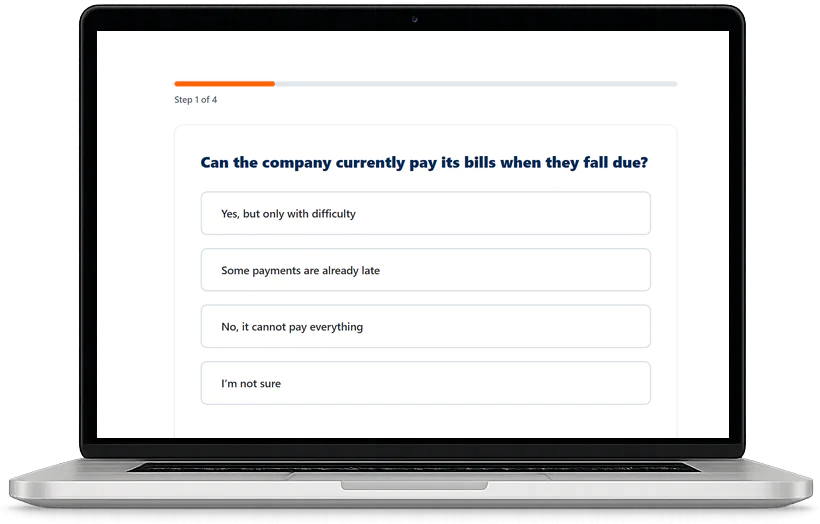
How Serious Is Your Company’s Position?
Answer four short questions to see how urgent the situation may be and which options could fit your company’s circumstances.
Check my company’s positionSee your result online and receive a copy by email. We only call if you ask.
How to Recognise That Liquidation Is the Right Step
A company is insolvent when it cannot pay its debts as they fall due, or when its liabilities exceed its assets. In practice, most directors already know before any formal test. The signs are familiar: suppliers chasing overdue invoices, payroll becoming a monthly crisis, HMRC debt building because it’s the one creditor that doesn’t phone you every day.
But knowing something is wrong and knowing it’s terminal are different things. Liquidation becomes the right step when there is no realistic prospect of the company trading out of its debts. Not a hopeful prospect. Not a best-case scenario. A realistic one, based on the cash you actually have coming in against the obligations you actually owe.
If you’re paying last month’s wages with this month’s receipts, deferring VAT to cover rent, or borrowing from one creditor to settle another, the company is likely past the point where rescue is viable. That does not make the director a failure. It means the business has reached a financial position where continuing to trade puts you, not just the company, at risk.
Your Legal Duties Change the Moment the Company Is Insolvent
This is the part that catches most directors off guard. While your company is solvent, your legal duty runs to the shareholders. The moment the company becomes insolvent, or you ought to know it’s insolvent, that duty shifts to the creditors. The shift is immediate and it changes what you can and cannot do with the company’s money.
In our experience, two legal concepts matter here, and both are worth understanding in plain terms.
Wrongful trading means continuing to run the company and build up more debt when you knew, or should have known, there was no reasonable prospect of avoiding insolvency.
If a court decides you did this, you can be made personally liable for the debts the company racked up after that point. Under the Insolvency Act 1986 (sections 214 and 246ZB, the law that governs company insolvency in England and Wales), directors have a positive obligation to minimise losses to creditors once insolvency is apparent.
Fraudulent trading is more serious: it means you carried on business with intent to defraud creditors. This is rare, but taking on new credit when you know the company cannot repay it can look dangerously close. The distinction between wrongful and fraudulent trading matters because wrongful trading is a civil matter (you pay money), while fraudulent trading can be criminal.
The practical consequence is this: the longer you delay after recognising insolvency, the harder it becomes to show you acted responsibly. Getting proper advice and starting preparation is itself evidence that you took your duties seriously.
Key Takeaway
The moment your company is insolvent, your duty shifts from shareholders to creditors. Continuing to trade and accumulate debt beyond that point can make you personally liable under sections 214 and 246ZB of the Insolvency Act 1986. Taking professional advice promptly is itself evidence of responsible conduct.
Step-by-Step Preparation Checklist
These are the nine preparation steps that make the clearest difference to the outcome for a director. Work through them in order.
-
1
Get a clear picture of what you owe and what you own
List every creditor and every asset. Value assets at realistic auction prices, not purchase cost. This becomes the Statement of Affairs.
-
2
Locate and organise your financial records
Gather management accounts, bank statements (12 months minimum), HMRC correspondence, loan agreements, lease agreements, and employee records.
-
3
Understand your position on the director’s loan account
If the account is overdrawn, you owe money to the company. The liquidator is legally required to recover it. Check the balance now.
-
4
Work out your personal guarantee exposure
Dig out every guarantee you have signed. Check amounts, whether they are limited or unlimited, and which assets they attach to. This determines your real personal risk.
-
5
Deal with employees properly
Employees must be made redundant at or before liquidation. If you have 20 or more staff, collective consultation rules apply. Statutory entitlements are covered by the Redundancy Payments Service.
-
6
Contact HMRC before they contact you
List all HMRC debts — VAT, PAYE, corporation tax, CIS. Since December 2020, HMRC is a preferential creditor for certain taxes. Gather the detail now for the Statement of Affairs.
-
7
Stop doing things that will cause problems later
Do not pay one creditor in preference to others, transfer assets below market value, or take large drawings. The liquidator will review transactions for up to two years back.
-
8
Choose the right liquidation procedure
A CVL (Creditors’ Voluntary Liquidation) is director-initiated and almost always preferable to waiting for a creditor to force compulsory liquidation through the courts.
-
9
Understand what liquidation will cost
A simple CVL typically costs £3,500 plus VAT. Get quotes from more than one licensed IP and ensure the fee breakdown is transparent before you commit.
1. Get a Clear Picture of What You Owe and What You Own
Before anything else, the first step is a full list of the company’s creditors and a realistic valuation of its assets. This will eventually become part of a document called the Statement of Affairs, a formal snapshot of the company’s financial position that the insolvency practitioner will need you to sign and swear is accurate.
Start with creditors. List every person and organisation the company owes money to: HMRC (corporation tax, VAT, PAYE), banks, landlords, suppliers, employees owed wages or holiday pay, and anyone who has lent the company money, including yourself. Include the amount owed to each and whether any of the debts are secured against specific assets.
Then list assets. Bank balances, stock, equipment, vehicles, debtors (money owed to the company by customers), intellectual property, and any property the company owns.
Value these realistically, not at what was paid for them or what they’d fetch in a perfect sale, but at what a buyer would pay quickly in the current market. A van that cost £28,000 three years ago might sell for £9,000 at auction. That is the number the liquidator will work with.
If the company has vehicles, plant, or equipment, check whether any are on hire purchase or finance agreements. Assets that aren’t fully paid for usually belong to the finance company, not your business, and won’t be available for creditors.
2. Locate and Organise Your Financial Records
The insolvency practitioner will need access to the company’s accounting records, bank statements, tax returns, and statutory books. This sounds simple, but we regularly meet directors whose records are scattered across a kitchen table, three email accounts, and an accountant who hasn’t been paid for six months and isn’t returning calls.
Gather the following:
- Management accounts for the last two years (or however far back they go)
- Bank statements for all company accounts, going back at least 12 months
- HMRC correspondence, including any assessments, penalties, or time-to-pay arrangement letters
- Loan agreements and personal guarantee documents
- Lease agreements (premises, vehicles, equipment)
- Employee contracts and records of what they’re owed
- The company’s statutory books (register of members, directors, charges)
- Any legal claims in progress, against the company or by the company
If records are incomplete, that is not a reason to delay. It is a reason to start now, because gaps in records can trigger deeper investigation by the liquidator, and in the worst case can be treated as evidence that the company’s affairs were not managed properly.
3. Understand Your Position on the Director’s Loan Account
If you have a director’s loan account that is overdrawn (meaning money is owed back to the company, not the other way around), this will be a problem. The liquidator has a legal duty to recover that debt. You will be asked to repay it.
Many directors are surprised by this.
Over the years, drawings, dividends, and personal expenses paid through the company can create a substantial loan balance without the director realising quite how large it has grown. Check the latest accounts or ask the accountant for the current balance. If it’s overdrawn, start thinking now about how you’ll address it, because this will come up early in the process.
4. Work Out Your Personal Guarantee Exposure
A personal guarantee is a promise you made, usually to a bank, landlord, or supplier, that if the company can’t pay, you will. Limited liability protects you from the company’s debts generally, but a personal guarantee punches a hole straight through that protection.
Dig out every guarantee directors have signed. Check the amounts, whether they are limited or unlimited, and whether they are joint with other directors. This is the information that will determine what liquidation actually costs you personally, and it shapes the conversation about whether personal insolvency advice is needed alongside the company process.
Directors often underestimate this exposure. The bank loan guarantee you signed five years ago when the business was growing may now represent a personal debt larger than your house’s equity. Knowing that number is uncomfortable but essential.
5. Deal with Employees Properly
This is often the hardest part. Not legally the most complicated, but emotionally the heaviest. Directors hired these people. Some of them trusted the company with their livelihood. Having to tell them the business is closing is a conversation no director wants, and most put it off too long.
From what we see in practice, employees must be made redundant before or at the point of liquidation.
If you have 20 or more employees, collective consultation rules under the Trade Union and Labour Relations (Consolidation) Act 1992 apply, which in plain English means you must consult with employee representatives for a minimum period before making redundancies. Failing to do this can result in protective awards, which are compensation payments ordered by a tribunal.
The good news, and it is genuine good news, is that employees of an insolvent company can claim redundancy pay, unpaid wages, notice pay, and holiday pay from the government’s Redundancy Payments Service.
This doesn’t make the conversation easier, but it does mean your staff won’t be left with nothing. We have a detailed guide on what happens to employees during liquidation that covers the claims process.
6. Contact HMRC Before They Contact You
If your company owes HMRC money, and most insolvent companies do, it is better to be the one who picks up the phone first.
HMRC as a creditor is not uniquely aggressive, but they are uniquely persistent, and since December 2020 they have been a “preferential creditor” for certain tax debts (VAT, PAYE, employee NICs). This means HMRC gets paid before unsecured trade creditors, which in practice means they recover more and have less reason to negotiate.
Gather your HMRC debts into a single list: VAT arrears, PAYE, corporation tax, CIS deductions if applicable. If you’ve had a time-to-pay arrangement that has broken down, note when and why. This information will all be needed for the Statement of Affairs, and having it ready speeds up the process considerably.
7. Stop Doing Things That Will Cause Problems Later
Once you know the company is heading for liquidation, certain actions that might seem sensible to a non-specialist can create serious problems.
We flag these with every director we advise to a non-specialist can create serious problems. We flag these with every director we work with. The liquidator will review the company’s transactions for the period leading up to insolvency, and anything that looks like preferential treatment of one creditor, or asset stripping, will be investigated and potentially reversed.
Do not:
- Pay off one creditor in full while others get nothing (this is a “preference” and can be clawed back)
- Transfer company assets to yourself, family members, or connected parties below market value
- Take large drawings or bonuses from the company
- Use company funds to pay personal debts
- Dispose of stock or equipment at undervalue to generate quick cash
The lookback period for preferences is six months for unconnected parties, and two years for connected parties such as directors and family members. For transactions at an undervalue, the lookback period is two years. These are not grey areas. The liquidator is legally obliged to pursue them.
8. Choose the Right Liquidation Procedure
There are two main types of insolvent liquidation. The difference matters because it affects how much control you have over the process and its timing.
A Creditors’ Voluntary Liquidation (CVL) is initiated by the directors.
You pass a resolution to wind up the company, appoint a licensed insolvency practitioner as liquidator, and the process begins on your terms. This is the route most directors take because it demonstrates cooperation and typically leads to a smoother process. Our guide to creditors’ voluntary liquidation covers the procedure in detail.
A compulsory liquidation happens when a creditor petitions the court to wind up your company. You lose control of the timing, the choice of liquidator, and the process is generally more scrutinising of the directors’ conduct. If a creditor has already issued a winding-up petition, the timetable is no longer yours to set.
In almost every case, if the option exists, a CVL is the better route. It is also the one that signals to the court and to creditors that you acted responsibly once you recognised the position.
9. Understand What Liquidation Will Cost
Liquidation is not free. The insolvency practitioner’s fees, legal costs, and disbursements are paid from the company’s remaining assets.
If there aren’t enough assets to cover the costs, directors may need to contribute personally to fund the process. Liquidation costs vary depending on the complexity of the case, but for a simple CVL with limited assets, expect fees in the range of £3,500 plus VAT as a starting point.
Get quotes from more than one licensed insolvency practitioner. The fees should be transparent, and any firm that can’t give you a clear breakdown before you commit is one to avoid.
What Happens After You Appoint a Liquidator
Once the liquidator is appointed, control of the company passes to them. You no longer have authority to run the business, enter contracts, or deal with company assets. This transition can feel sudden even when you’ve been preparing for it.
The liquidator will:
- Take possession of the company’s assets and arrange their sale
- Write to all creditors notifying them of the liquidation
- Investigate the company’s affairs and the conduct of its directors
- Collect any debts owed to the company, including the director’s loan account if overdrawn
- Distribute proceeds to creditors in the order set out by law
- File a report on the directors’ conduct with the Insolvency Service
Full cooperation is required with the liquidator. That means attending meetings, answering questions, and providing any further documents they request. Cooperation is not optional. Under section 235 of the Insolvency Act 1986 (the provision that requires officers of a company to cooperate with the officeholder), failure to assist the liquidator can result in court action against you.
For most directors who have prepared properly, this phase is more administrative than adversarial. The liquidator is not there to punish you. They are there to realise assets, pay creditors, and close the company down properly. If you’ve been honest and your records are in order, the investigation element is usually simple.
Common Preparation Mistakes We See Directors Make
After our team has handled hundreds of these cases, we see certain patterns repeat. These are the mistakes that create avoidable problems.
Waiting for the “right time.” There is no perfect moment to liquidate a company.
But there is a window where you still have options, and a point after which the options narrow sharply. Directors who wait for next month’s contract to land, for the VAT bill to be sorted, for the situation to stabilise, frequently find that the delay made things worse, not better. A winding-up petition from HMRC arriving on a Tuesday morning removes the choice entirely.
Paying a friendly creditor first. A director whose brother-in-law lent the company £15,000 will naturally feel the pull to make sure family gets paid.
But paying a connected creditor in preference to others during the two years before liquidation is exactly the kind of transaction a liquidator is required to investigate and reverse. The brother-in-law gets the money clawed back, and the director’s conduct comes under closer scrutiny.
Not checking personal guarantees. We regularly sit down with directors who are visibly shocked when they realise the personal guarantee they signed in 2019 means the bank can pursue them for the outstanding balance. The company’s debts are the company’s problem. But a personal guarantee is your problem, and it survives the liquidation.
Stripping assets before the appointment. Removing stock, taking the company van home, or selling equipment cheaply to a friend are all transactions the liquidator will ask about. If assets disappeared or were sold below market value in the lead-up to liquidation, the liquidator can apply to court to reverse those transactions and recover the value.
Ignoring the director’s loan account. If your loan account is overdrawn, the money is owed to the company, and therefore to its creditors. Pretending it doesn’t exist or hoping it will be overlooked is not a strategy. The liquidator will identify it and pursue repayment.
FAQs on How to Prepare for Company Liquidation
How long does it take to prepare for company liquidation?
Most directors can prepare adequately within two to four weeks, provided they start gathering records and taking advice promptly.
The timeline depends largely on how organised the financial records already are and whether there are complications such as outstanding legal claims, disputed debts, or missing accounts. If the accountant is cooperative and your books are reasonably up to date, the process moves faster. If records are patchy or the accountant is no longer engaged, allow additional time.
Can I still pay employees before liquidation?
Paying employees their normal wages for work already done is generally acceptable and expected. What you should not do is pay large bonuses, enhanced redundancy packages, or severance settlements that go beyond what employees are contractually owed.
Employees rank as preferential creditors for certain debts (up to four months of unpaid wages, capped at £800 per employee, plus holiday pay), and they can claim statutory redundancy pay, notice pay, and arrears from the government’s Redundancy Payments Service. Take advice before making any payments outside ordinary payroll.
Will I be personally liable for the company’s debts?
In most cases, limited liability means the company’s debts are not automatically your personal responsibility. However, there are important exceptions. If you signed personal guarantees (commonly for bank loans, commercial leases, or supplier credit), those debts transfer to you personally.
If the liquidator finds evidence of wrongful or fraudulent trading, you could be ordered to contribute personally. And if your director’s loan account is overdrawn, you owe that money back to the company. The majority of directors who prepare properly and act on advice do not face personal liability beyond their guarantees.
What is a Statement of Affairs and do I have to complete one?
A Statement of Affairs is a formal document listing everything the company owns and everything it owes at the date of liquidation. You, as director, must complete it and verify it with a statement of truth.
It includes details of every creditor, every asset, any charges or security held against assets, and details of the company’s recent trading history. The insolvency practitioner will guide you through completing it, but the underlying information has to come from the directors. Getting your records organised before the appointment makes this substantially less painful.
Can I start a new company after liquidation?
Yes, in most cases you can. Liquidation of your company does not automatically ban you from being a director again. However, if the Insolvency Service finds evidence of unfit conduct, you could receive a director disqualification order lasting between 2 and 15 years.
There is also a restriction under section 216 of the Insolvency Act 1986 that prevents you from reusing the same or a similar company name for five years, unless one of three statutory exceptions applies.
Those exceptions are: buying the business from the liquidator and giving proper notice to creditors and in the Gazette, permission from the court, or a company that has already traded under the name for the previous 12 months.
If you plan to start again in the same trade, discuss the name restriction with your insolvency practitioner before choosing a name for the new venture.
What is the difference between a CVL and compulsory liquidation?
A CVL (Creditors’ Voluntary Liquidation) is started by the directors and shareholders of the company. You choose the insolvency practitioner, you control the timing, and the process is generally viewed more favourably by creditors and the Insolvency Service.
Compulsory liquidation is forced on the company by a court order, usually after a creditor has petitioned. The Official Receiver is initially appointed as liquidator, the investigation into the directors’ conduct tends to be more intensive, and you have no say in the timing or choice of practitioner. If you have the option, a CVL is almost always the better route.
Check How Serious the Position May Be
Answer four short questions to see how urgent the situation may be and which broad options could fit.
Check my company’s positionEstimates are fineWe only call if you ask us to
Related Guides
- Creditors’ Voluntary Liquidation: the voluntary route most directors use to close an insolvent company.
- How Much Does Liquidation Cost?: the fixed CVL fee and what it covers.
- Can’t Afford to Liquidate?: funding options when the company has no money left.
- Secured and Unsecured Creditors: the order creditors are paid in once you liquidate.