Insolvency Advice for Directors: Key Considerations




Most directors who call us already have an accountant. That accountant is usually the person who told them the company would “be fine once the next quarter clears.” Tax accountants are often brilliant at corporation tax planning, and they are often wrong about insolvency timing. The two skills are not the same and the regulators do not treat them as the same.
Our subject here is the advice itself. Who is allowed to give it, what regulated insolvency advice covers that an accountant’s monthly call does not, and the moment a director should stop relying on a generalist and bring in a licensed insolvency practitioner alongside.
The cost of the wrong adviser at the wrong moment is not academic. We usually see it surface six months later as a wrongful-trading claim, a personal-guarantee call, or a director’s loan account that should have been frozen the day the cashflow forecast went red.
Insolvency Advice at a Glance
UK insolvency advice for directors is regulated under Part XIII of the Insolvency Act 1986. Only a licensed insolvency practitioner regulated by the IPA, ICAEW, ICAS, or the Insolvency Service can act as your office-holder. Free first-meeting advice is standard, but you should confirm three things before instructing: the practitioner is authorised on the IPA or ICAEW public register, the firm has no conflicting interest in your company or its creditors, and the cost basis (fixed fee versus time-cost) is set out in writing.
Quick Answer: When You Need Insolvency Advice
In our casework, you need insolvency advice the moment you start choosing which creditor to pay this week. That is the practical signal of cash-flow insolvency under section 123 of the Insolvency Act 1986.
Not when HMRC issues a statutory demand. Not when the bank pulls the overdraft. The day you are deciding between PAYE and a key supplier is the day a regulated practitioner needs to be in the conversation.
When Generalist Insolvency Advice Is No Longer Enough
Generalist accountancy advice runs out at the point your duties shift from shareholder interests to creditor interests. Your accountant is unlikely to spot that pivot in time, because their training rewards a forward-looking tax view, not a creditor-protection view.
Once the duty has shifted, only a licensed practitioner can route you through CVA, administration, or CVL without you accidentally doing something a liquidator will later unwind.
Main Director Risk From Late or Wrong Insolvency Advice
The main risk we see is that the wrong adviser keeps you trading three months too long. In that window you take on new credit, you pay a connected creditor first, you draw down a director’s loan, and you sign a fresh personal guarantee.
Each of those is a separate claim a liquidator can bring against you personally. None of them would have happened if a regulated practitioner had drawn the line on day one.
What to Do Next About Insolvency Advice
Take our free insolvency test, then book one diagnostic call with a licensed insolvency practitioner before your next board meeting. Keep your accountant in the loop, because they hold the historic numbers, and we hold the procedural map. You need both, in that order, and not the other way round.
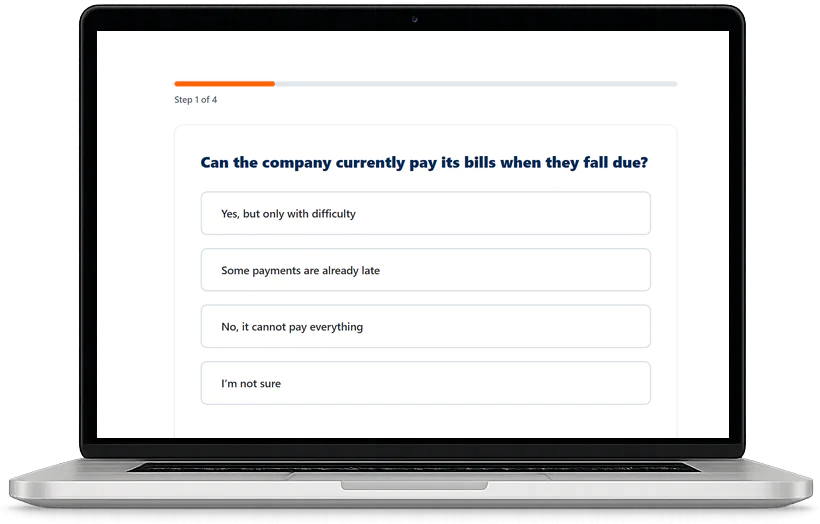
How Serious Is Your Company’s Position?
Answer four short questions to see how urgent the situation may be and which options could fit your company’s circumstances.
Check my company’s positionSee your result online and receive a copy by email. We only call if you ask.
What Counts as Insolvency Advice in UK Law?
Regulated vs Unregulated Insolvency Advice
Only a licensed insolvency practitioner can act as office holder on a formal procedure. That is the line drawn by section 388 of the Insolvency Act 1986. Pre-appointment advice is not similarly fenced, which is why so many unregulated firms sell “rescue plans” that turn out to be a relabelled introducer fee.
If the person giving you advice is not regulated by ICAEW, IPA, ICAS or one of the other recognised bodies, ask why their name will not appear on any future office-holder document. We treat that as the cleanest single test.
Difference Between Tax, Restructuring and Insolvency Advice
Tax advice tells you what HMRC will accept. Restructuring advice tells you how to reshape the balance sheet. Insolvency advice tells you what a liquidator will do with your conduct in eighteen months’ time.
The three overlap at the edges, but only the third one is built around the question that matters once the company is failing: which director acts will look defensible in a section 132 investigation, and which will not.
When Free Insolvency Advice Is Enough
A free initial call with a regulated IP, plus the free guidance from Business Debtline (0800 197 6026), is often enough to confirm you are still on the solvent side of the line and to set a 30-day review point.
It is not enough once a winding-up petition is on the way, once a personal guarantee is in play, or once you are inside a creditor stand-still that needs documented advice. At that point you need paid, named, recorded advice from a licensed practitioner.
Who Provides Insolvency Advice
Licensed Insolvency Practitioners
A licensed IP is an individual, not a firm, who holds an authorisation under section 390 of the Insolvency Act 1986 from a recognised professional body. Their licence number is searchable on the ICAEW, IPA or ICAS register. They carry the regulatory weight on a formal procedure, and they are the only person who can sign the appointment paperwork on a CVL, MVA, administration or CVA.
Solicitors and Specialist Counsel
Insolvency solicitors handle the parts an IP cannot, mainly contested petitions, antecedent transaction disputes, and director-defence work where personal exposure is already in play. Specialist counsel becomes useful when the case is heading for the Companies Court.
For most pre-formal triage, a solicitor is not the first call. The IP is. The solicitor follows once a defensive position has to be taken.
Charities and Free Advice Lines
Business Debtline is the main free service for sole traders, partnerships and small limited companies. It will not represent you in a procedure, but it will help you read your own numbers and keep HMRC’s helpline in scope. For a director with a viable business and a temporary cash gap, that is sometimes the only conversation you need before the position resolves itself.
How to Choose the Right Insolvency Adviser
Verify the IP Licence Number Through the IPA or ICAEW Register
Before you sign anything, check the named individual on the ICAEW or IPA public register. The licence is held by a person, not a firm, and you want to know it is current and not subject to a regulatory order.
If the firm cannot or will not give you the IP’s full name and authorising body in writing, that is the conversation ending. A regulated practitioner will tell you their licence number without being asked twice.
Ask About Time-Cost Schedule Before Engagement
Ask for a written time-cost schedule and an estimate range, in pounds, for the procedure you are likely heading into. SIP 9 requires that schedule to be provided once an appointment is in view.
A firm that quotes you a single round number with no hourly breakdown is either inexperienced or hoping you will not look. You want grade A, B, C and D rates, estimated hours per grade, and a maximum below which fees cannot float without creditor consent.
Test for Conflict of Interest With Existing Lender Relationships
Ask the IP whether they hold a panel relationship with your bank, your invoice financier, or your largest secured creditor. Panel relationships are not automatically disqualifying, but the IP must disclose them under SIP 1 and you must understand whose interests get the early benefit of the doubt. If the IP also acts as receiver for your lender, you want a different IP for the company-side advice.
What Insolvency Advice Should Cover
Solvency Test Documentation Standard Required
The advice must walk you through both statutory tests under section 123: cash-flow (can the company pay debts as they fall due) and balance-sheet (do liabilities exceed assets, including contingent and prospective ones). Either limb being met is enough to put the company in technical insolvency.
The advice must produce a dated written conclusion, not a verbal “you are probably fine for now.” That dated note is what protects you when a liquidator asks when you knew.
Director Personal Liability Triage
Good insolvency advice maps your personal exposure before it maps the corporate route. That means a clear list of every personal guarantee you have signed, the current overdrawn directors’ loan account balance, any preferences in the past two years, and any transactions at undervalue.
Without that triage, the corporate procedure recommendation is half the answer. With it, you can see whether liquidating tomorrow costs you ten thousand pounds or a hundred.
Procedure Routing Memo (CVA, Administration or CVL)
The output of a proper insolvency advice session is a short routing memo that says: which procedure, why this one and not the others, what timetable, what creditor outcome, and what the director needs to do in the next 14 days. If you finish the meeting without that memo, the advice has not landed.
Our pages on rescuing the business from insolvency and saving a struggling business sit alongside the memo, but they do not replace it.
Mistakes Directors Make Around Insolvency Advice
Treating the Accountant’s Reassurance as Insolvency Advice
The single most common mistake is taking “give it another quarter” from a tax accountant as a clean bill of health on insolvency. It is not the same advice and it is not given by a regulated practitioner. The accountant is right about the tax position and almost always silent on the section 214 wrongful-trading window. The reassurance is genuine. It is also not the advice you actually need.
Waiting for a Creditor Petition Before Calling an IP
By the time a winding-up petition lands, the procedural options have collapsed from five to two. Pre-petition you might choose between TTP, CVA, administration, CVL or trading on under tighter controls. Post-petition you are choosing between an urgent rescue or compulsory liquidation.
Directors who wait until the petition arrives are not saving advice fees. They are paying a much larger bill in lost optionality, often dressed up as a personal liability claim that should never have arisen. See our page on dealing with creditor pressure for the decision logic in that window.
Related Insolvency Advice Guides
- How to save a struggling business: pre-formal triage playbook for the fortnight before things break.
- Rescue your business from insolvency: formal procedure routing once rescue is in scope.
- Business recovery services: what a regulated firm actually delivers across the recovery spectrum.
- Find a liquidator near me: how to choose and verify a licensed practitioner in your area.
- Insolvency Act 1986: the underlying statute, section by section, including section 388 on IP licensing.
Check How Serious the Position May Be
Answer four short questions to see how urgent the situation may be and which broad options could fit.
Check my company’s positionEstimates are fineWe only call if you ask us to
Frequently Asked Questions About Insolvency Advice
Is the first call with an insolvency practitioner really free?
Yes, on a diagnostic basis. A regulated IP will give you a free initial conversation that confirms whether the company is solvent, identifies your personal exposure, and sketches the procedural options. Fees only attach once you instruct on a formal procedure. If a firm wants paid engagement before the diagnostic call, that is a signal to call a different IP.
Does seeking insolvency advice automatically lead to liquidation?
No, and a competent IP will tell you when liquidation is not the answer. A meaningful share of diagnostic conversations end with a Time to Pay route, an informal creditor stand-still, or a CVA recommendation rather than a CVL. Liquidation is one outcome among five. The advice is what tells you which one applies.
How does taking insolvency advice protect me from wrongful trading claims?
Section 214(3) of the Insolvency Act 1986 gives directors a defence where they took every step a reasonably diligent person would take to minimise creditor losses once they knew insolvent liquidation was unavoidable.
The dated record of seeking regulated advice, and acting on it, is the strongest single piece of evidence supporting that defence. It goes into the liquidator’s conduct report and influences whether disqualification is pursued.
Should I keep my accountant during insolvency advice?
Yes, and bring them into the IP conversation early. The accountant holds the historic numbers and the tax position. The IP holds the procedural map. The two together produce better advice than either alone. Asking your accountant to lead an insolvency call, however, is asking the wrong specialist for the wrong opinion.
When should I switch insolvency advisers?
Switch if the IP cannot give you their licence number on request, will not produce a SIP 9 time-cost schedule before engagement, or holds a panel relationship with the lender that drove you into difficulty without disclosing it. A second opinion before any formal appointment is normal practice and a regulated practitioner will encourage it.