



If your limited company is under sustained financial pressure, our recovery team can assess whether it can be stabilised, restructured, or should be closed before the position gets worse. We work with directors dealing with HMRC arrears, creditor pressure, cash-flow gaps and the question of whether a formal rescue procedure is now the right move.
The initial assessment is free, and what you tell us is handled confidentially in line with our engagement and privacy obligations. You leave that first conversation with a realistic view of the options and a clear next step for your company, not a pitch for one procedure.
This service is for directors of UK limited companies and, where genuinely appropriate, LLPs. Advice is delivered or reviewed by licensed insolvency practitioners.
Most directors who reach us have been carrying this alone for weeks, often with a personal guarantee sitting behind the debt and a brown HMRC envelope they have stopped opening. If your situation belongs somewhere else, we will say so plainly and point you to the right place.
What Business Recovery Means for a Limited Company
Business recovery, in the sense we use it, is financial and insolvency recovery: stabilising cash, dealing with creditors, and either rescuing the company through the right procedure or closing it in an orderly way. It is not the same as the long-term operational turnaround consulting some larger firms sell, and the difference matters when you are choosing who to call.
| Financial and insolvency recovery | Operational turnaround consulting |
|---|---|
| Cash-flow triage, creditor negotiation, HMRC Time to Pay, refinancing support, CVA, moratorium, administration, restructuring plan, pre-pack and controlled closure | Pricing, product strategy, sales, systems, staffing, supply chain, interim management and long-term performance improvement |
We work in the left-hand column. Where the real problem is a broken operating model that needs months of hands-on management change, we will tell you that is a different kind of engagement and, where it helps, point you to the right specialist. What a restructuring cannot do is repair a business that has simply stopped working.
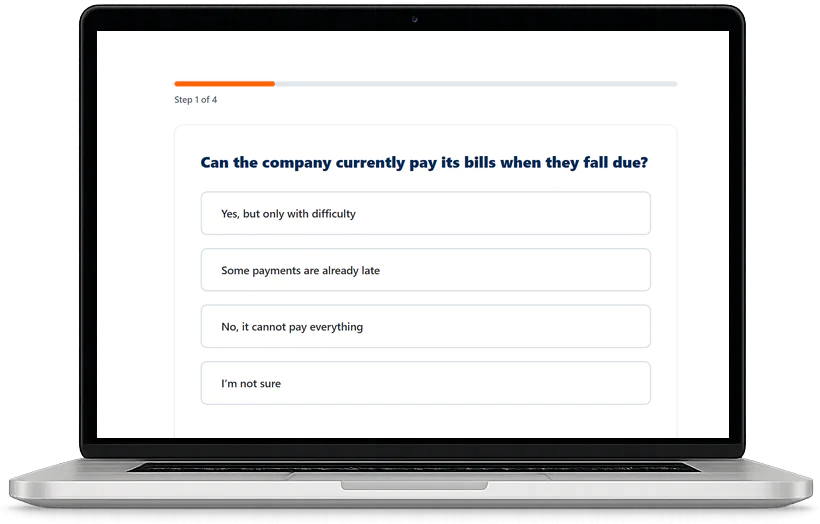
Could Your Company Be Insolvent?
Answer four short questions to see which warning signs apply, how serious the position may be and how soon you may need to act.
See which options may fit your company’s circumstances.
Check my company’s positionSee your result online and receive a copy by email. We only call if you ask.
How Our Business Recovery Services Can Help
The right help depends on how much time you have, how much cash is left, and which creditors are moving. In the cases we handle, most directors need one or two of these four things, not all of them.
Stabilise the immediate position
Cash-flow and creditor triage, urgent legal deadlines, key supplier and payroll pressure, and the short-term moves that stop the position deteriorating while you decide. This is often the first call: work out what has to be paid this week and what can wait.
Negotiate and restructure informally
An HMRC Time to Pay arrangement, a creditor payment plan, refinancing or working-capital options, and cost changes that sit within our actual scope. We test the informal route first because it is cheaper, faster and leaves no public record. If it will not hold, we say so rather than string it out.
Use a formal rescue procedure
Where informal cooperation is not realistic, a Company Voluntary Arrangement, a standalone moratorium, a company administration, a restructuring plan or a pre-pack sale can protect the trade while the debt is dealt with. These are different tools with different effects, set out in the comparison below.
Arrange a controlled exit where rescue is not viable
A creditors’ voluntary liquidation is not recovery, and we will not dress it up as one. But where there is no viable core, ceasing to trade and entering an orderly process can prevent further avoidable losses to creditors. Earlier conduct remains reviewable, so this is a decision to take with advice, not in a panic. Our CVL guide explains how it works.
Is Your Company a Realistic Recovery Candidate?
Recovery works when a viable business is being suffocated by a fixable debt structure. It does not work when the trading model itself has stopped earning. The honest test is simple: can you describe a profitable version of the company after realistic changes, without relying on customers, contracts or funding you do not yet have?
| Recovery is more realistic when | Recovery is less realistic when |
|---|---|
| The underlying trade may be viable after realistic changes | The core trading model stays persistently loss-making |
| The problem is a debt overhang or a short-term cash gap | Any recovery depends on sales or funding that do not yet exist |
| There is enough time to negotiate or run a process | A petition, enforcement step or payroll failure leaves no workable runway |
| Management will change costs, funding or operations | Directors want to postpone closure without changing the business |
| A rescue looks capable of beating the alternative for creditors | The cost and risk of rescue exceed the value it would preserve |
This is a preliminary screen, not a legal determination of solvency. A positive normalised EBITDA is evidence of a potentially viable core, not proof of one: the conclusion still has to account for working capital, finance costs, tax, capital spend, management capability and the cost of the rescue itself. Treat this as our assessment method, not a statutory rule.
What We Assess Before Recommending a Route
Before we recommend anything, we look at four things. This is Company Debt’s initial recovery-assessment method, and it is deliberately practical rather than academic.
| Assessment area | What the team reviews | Why it matters |
|---|---|---|
| Underlying trade | Margins, recurring demand, realistic cost base and management capability | A balance-sheet restructure cannot by itself repair an unviable trading model |
| 13-week cash position | Payroll, tax, critical suppliers, secured debt, legal deadlines and a downside case | Determines urgency and whether informal negotiation is realistic |
| Creditor position | HMRC, secured lenders, trade creditors, guarantees and any current enforcement | Determines which creditors must agree and whether statutory protection is needed |
| Director exposure | Guarantees, drawings, recent payments, asset transfers and decision records | Ensures the company route does not ignore your separate personal risk |
A 13-week rolling cash view, honest about creditor pressure, tells us more in distress than the annual budget or the last set of management accounts. If the company survives the next quarter on realistic assumptions, recovery is on the table.
If the forecast turns negative within a few weeks even after stretching every supplier, you are looking at administration or liquidation, not informal recovery.
Documents worth having ready
- Latest management accounts and an aged creditor list
- HMRC balances by tax (PAYE, NIC, VAT, corporation tax)
- Recent bank statements, or a 13-week cash forecast if you have one
- Secured lending, debentures and any personal guarantees
- Employee and payroll liabilities, and an asset list
- Any current legal action and deadlines, and recent connected-party payments or transfers
Key Takeaway
The route that fits, in our experience, is the one that beats the realistic alternative for creditors while addressing your personal exposure honestly. A rescue that costs more than it preserves is not a rescue, and a closure taken in time usually costs a director far less than one taken too late.
Business Recovery Options We May Consider
These routes have materially different effects. A CVA binds creditors in one way, an administration protects the company in another, and a moratorium does something different again. The table sets out who controls the company, who is bound, and what becomes public, so you can see why the choice is not interchangeable.
| Route | Best fit | Control | Who is bound / protection | Approval & record | Timing |
|---|---|---|---|---|---|
| Informal creditor agreement | Limited creditor pressure, a short-term cash gap | Directors stay in control | No statutory protection; only creditors who agree are bound | Private unless parties agree otherwise | Case-specific |
| HMRC Time to Pay | Viable company that cannot pay tax in full on time | Directors stay in control | No general moratorium; agreed only with HMRC, based on affordability | Agreed with HMRC; not public | Case-specific; no fixed public maximum, terms beyond 12 months are exceptional |
| CVA | Viable company with unsecured debt it can repay in part or over time | Directors keep control under a supervisor | Binds relevant unsecured creditors once approved; secured and preferential rights are not altered without consent | At least 75% by value of voting creditors; formal and filed | Set by the approved proposal; often several years |
| Administration | Urgent protection, restructure or sale | The administrator controls the company | Statutory moratorium halts most creditor enforcement and legal proceedings | Formal appointment, public filing | Ends after one year unless extended or ended sooner |
| Standalone moratorium | A short breathing space while a rescue is put together | Directors stay in control under a monitor | Temporary statutory protection from many creditor actions | Formal process, public filing | Initial 20 business days, with statutory extension routes |
| Restructuring plan | Complex restructuring across creditor or member classes | Depends on the plan | Court-sanctioned; can bind dissenting classes where the tests are met. No automatic moratorium | Class voting and court sanction; public | Case-specific |
| Pre-pack administration | Sale arranged before administration to preserve viable operations or assets | Administrator controls the company; buyer runs the acquired business | Administration protections apply | Formal and public; a substantial connected-party sale in the first 8 weeks needs creditor approval or an evaluator’s report | Sale usually completes shortly after appointment |
| CVL | No realistic rescue; an orderly insolvent closure is needed | The liquidator controls the company | Liquidation applies; earlier conduct stays reviewable | Formal and public | Case-specific |
A members’ voluntary liquidation and voluntary strike-off are not on this table on purpose. They are solvent-closure decisions, not business recovery, and they belong on their own pages. Legal effects here are summarised and depend on the facts. Official sources checked 30 July 2026.
Director Risk While You Trade Through Recovery
One risk to understand early is wrongful trading, under sections 214 and 246ZB of the Insolvency Act 1986. It is not automatic and it does not accrue day by day: liability requires a court order, and the test is whether you knew, or ought to have concluded, that there was no reasonable prospect of avoiding insolvent liquidation or administration.
Taking every reasonable step to minimise potential loss to creditors from that point is what counts. Our wrongful trading guide sets out the detail.
Preferences and transactions at undervalue (sections 238 and 239) are not automatic personal claims either. A court may make an order to restore the position, depending on the transaction and the parties involved, which is exactly why repaying a director loan or a guaranteed lender ahead of others needs advice first.
Personal guarantees are separate contracts: rescuing or restructuring the company does not, on its own, release a guarantee you have signed.
Contemporaneous board minutes, from the day the first serious creditor letter lands, are prudent evidence of how decisions were made. They do not create a safe harbour, but in the cases we see they help a great deal when conduct is later reviewed.
HMRC can also issue a Joint and Several Liability Notice in specified avoidance, evasion or repeated-insolvency situations under Schedule 13 of the Finance Act 2020, not simply because PAYE, NIC or VAT went unpaid.
Where We Can Act
Insolvency law is not uniform across the UK, so where your company is registered changes what applies and who can be appointed. We set out coverage honestly rather than claiming a blanket “full UK” service.
- England and Wales: the core jurisdiction for our advice and appointments, under the Insolvency Act 1986 and the Insolvency (England and Wales) Rules 2016.
- Scotland and Northern Ireland: separate legislation and procedure rules apply. We can give initial advice and, where a formal appointment is needed, introduce an appropriately authorised local practitioner.
- Cross-border companies: where the centre of main interests sits outside the UK, we will tell you at the outset if the matter needs specialist or local handling.
What Happens When You Contact Company Debt
An initial confidential call. We ask for the rough debt total, who the main creditors are, the cash position and payroll timing, any live legal action, whether personal guarantees are in play, and what you want the outcome to be. Your information is handled confidentially in line with our engagement and privacy obligations.
A preliminary recovery assessment. We tell you what can and cannot be concluded from that first conversation, and where the immediate pressure points are. If you are already in court-action territory, we say so and prioritise the procedural protection first.
Written options and costs. Any proposed work, any regulated appointment and the fees for it are set out in writing before you instruct us. You see the basis of the cost before you commit, not after.
Advice, appointment or referral. We explain which entity delivers informal advisory work, which licensed insolvency practitioner would accept any formal appointment under a separate engagement, and when the right answer is to refer you to another specialist instead.
When Company Debt Is Not the Right Firm
We would rather lose the enquiry than take work that does not fit. You should be talking to someone else if:
- You are a sole trader or the problem is personal debt. Recovery in our sense is corporate; personal debt may need separate regulated advice, and a debt-advice charity such as StepChange or Citizens Advice is a good first stop.
- The issue is a simple, single-creditor cash gap. Where one tax bill is the whole story and there are no guarantees in play, your accountant or a direct HMRC arrangement may resolve it without a formal recovery engagement.
- The matter is a regulated-firm wind-down, contentious litigation or a tax dispute needing solicitors or specialist tax advisers, or a long-term operational turnaround outside our service scope. Where these apply, we name a specialist and step out.
Frequently Asked Questions About Business Recovery Services
What is included in the free initial assessment?
A confidential conversation about your company’s debts, creditors, cash position and what you want to happen next. We give you a preliminary view of whether recovery looks realistic, where the urgent deadlines are, and a shortlist of routes worth considering. There is no charge for that first assessment, and no obligation to instruct us afterwards.
Will I speak to a licensed insolvency practitioner?
Your recovery advice is delivered or reviewed by licensed insolvency practitioners. Where a formal insolvency procedure follows, the appointment is accepted and carried out by a named licensed practitioner under a separate written engagement. The regulator and bond details for any appointed practitioner appear on the formal engagement documents.
Can you help if HMRC is the main creditor?
Yes, frequently. Since December 2020, HMRC has ranked as a secondary preferential creditor for PAYE, NIC and VAT, which changes how a rescue is structured. We negotiate a Time to Pay arrangement where the numbers support it, and move to a CVA or administration where they do not.
Is the initial discussion confidential?
Yes. What you tell us is handled confidentially in line with our engagement and privacy obligations. Informal steps such as a TTP, a refinance or a private creditor negotiation leave no public footprint. Formal procedures appear on the public record at Companies House and in the Gazette, and where discretion matters for customers or suppliers we factor that into the route we recommend.
How are fees agreed?
The initial assessment is free. Where formal work follows, the fees and the basis for them are set out in a written engagement letter before you commit. Depending on the procedure, fees may be met from realisations or contributions within the process, or funded separately; the engagement letter explains which applies to your case.
What happens if the company cannot be saved?
We tell you so on the first call and explain why. The usual answer is a creditors’ voluntary liquidation, which closes the company in an orderly way. Ceasing to trade while insolvent and entering a controlled process can prevent further avoidable losses to creditors, though it does not erase earlier conduct, which remains reviewable.
We can help you arrange the CVL or refer you on if you would prefer a second opinion first.
Does a rescue procedure release my personal guarantees?
No. A personal guarantee is a separate contract between you and the lender. Company insolvency or restructuring does not, by itself, release it. Sometimes the right approach is a procedure that protects the company while you negotiate the guarantee separately with the lender. Recovery planning has to map every guarantee at the start, not treat the company fix as if it solves the personal one.
Can you act in Scotland or Northern Ireland?
Scotland and Northern Ireland have their own insolvency legislation and procedure rules. We can give you initial advice on the position, and where a formal appointment is needed we introduce an appropriately authorised local practitioner. We tell you at the outset which parts we handle directly and where a local practitioner takes over.
Not Sure Where Your Company Stands?
Use the two-minute test to check the warning signs and see how soon you may need to act.
Check my company’s positionEstimates are fineWe only call if you ask us to
Related Guides
- How to save a struggling business: early-stage triage before formal routes are on the table
- Rescue your business from insolvency: whether an insolvent company can be rescued, and how
- Company rescue solutions: compare CVA, administration, pre-pack and informal routes in depth
- Company Voluntary Arrangement guide: how a CVA works, what creditors decide, what it costs
- What is wrongful trading?: the statutory test and how director liability actually arises