Can You Rescue a Business from Insolvency?




It is usually a Tuesday afternoon when the realisation lands.
The bank balance is below the wage run, HMRC has stopped accepting promises about the next VAT instalment, and the supplier you have used for nine years has just refused to release the next pallet without payment up front.
You have not collapsed. You have arrived at insolvency.
Once you accept that the company is, in law, insolvent, the question changes.
It is no longer “can we trade through this.” It is “which procedure rescues this business, which procedure ends it, and which one closes the door we cannot afford to close yet.”
This guide is the routing layer. We walk you through how to test whether rescue is realistic, what each formal procedure actually surrenders in exchange for protection, and where the director risks bite hardest while the rescue plays out.
If you are earlier than that, our guide on how to save a struggling business covers pre-formal triage.

Don’t forget, we offer a free confidential directors help line to talk through any serious debt situation. Speak with one of our team right now or, if it’s after hours, leave us a message and we’ll call you back.
Rescuing a Business from Insolvency at a Glance
Quick Answer: Can You Rescue a Business from Insolvency?
Yes, sometimes.
A business that is insolvent on the cash-flow or balance-sheet test (Insolvency Act 1986, section 123) can still be rescued through a Company Voluntary Arrangement, Administration, a Restructuring Plan or, in narrower cases, an informal HMRC Time to Pay deal.
Whether it works depends on whether the underlying business is viable once the debt overhang is restructured. If it is not, rescue procedures buy time, not survival.
When Insolvency Rescue Is Realistic (vs When Liquidation Is Honest)
Rescue is realistic when the trading model still works. If you stripped out the legacy debt, the bounce-back loan, and the historic VAT arrears, would the next twelve weeks of cash flow stand up? If yes, you have a rescue candidate.
If the order book is shrinking, the margin has gone, and customers are leaving for cheaper rivals, the honest answer is that you are choosing between a Creditors’ Voluntary Liquidation now and a forced winding-up later.
Main Director Risk During Insolvency Rescue
The risk that bites hardest is wrongful trading under section 214 of the Insolvency Act 1986: continuing to trade once you knew, or ought to have concluded, there was no reasonable prospect of avoiding insolvent liquidation or insolvent administration.
From the moment of that realisation, every payment you make and every order you accept is a decision a liquidator can later test and unwind.
What to Do Next About Insolvency Rescue
Stop, take the meeting, and get a written opinion from a licensed insolvency practitioner before you sign anything else. Document the board decision. Stop selective payments to connected parties.
Then choose the procedure with the practitioner, not before. If you have already decided you need to instruct someone, our business recovery services page covers what that looks like in practice.
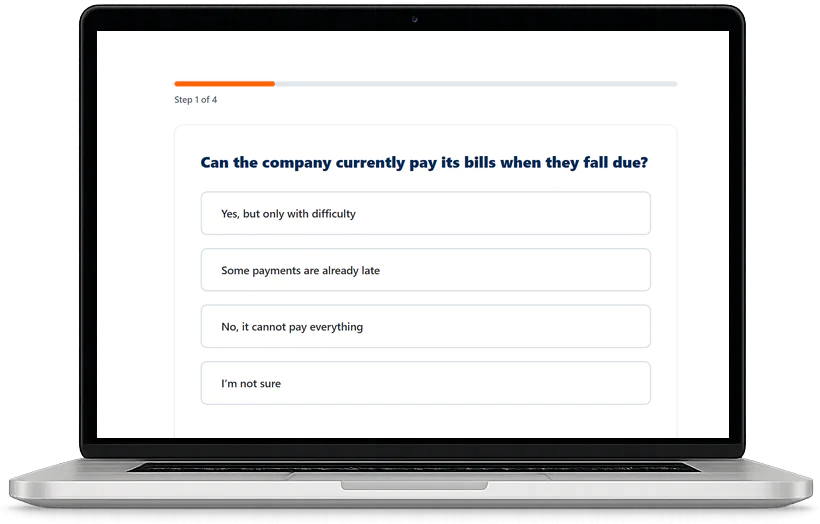
How Serious Is Your Company’s Position?
Answer four short questions to see how urgent the situation may be and which options could fit your company’s circumstances.
Check my company’s positionSee your result online and receive a copy by email. We only call if you ask.
What Does It Mean to Be Insolvent?
Insolvency Meaning (Cash-Flow vs Balance-Sheet Tests)
Section 123 of the Insolvency Act 1986 sets two tests, and a company is insolvent if it fails either. The cash-flow test asks whether the company can pay its debts as they fall due.
The balance-sheet test asks whether liabilities, including contingent and prospective liabilities, exceed assets.
Most directors meet the cash-flow test long before the balance sheet looks ugly. A profitable business with poor working capital can be cash-flow insolvent on a Wednesday and solvent again on a Friday once a debtor pays.
That volatility is exactly the trap: you can be technically insolvent for weeks at a time and not realise the legal clock has started.
Difference Between Insolvency and Recovery
Insolvency is a legal status. Recovery is what some, but not all, insolvent companies achieve.
The two get conflated in director conversations, and that conflation is dangerous: it lets directors carry on trading because “we are not insolvent yet, we are just recovering.” If you fail either section 123 test, you are insolvent, regardless of how the recovery story sounds.
When Rescue From Insolvency May Not Be Suitable
Rescue is not the right call when the core business is structurally loss-making, when the customer base has gone, or when the only thing keeping the company alive is the next director loan or the next bounce-back drawdown.
In those cases, a CVA simply re-papers the same losses over five years, and you spend that period accumulating fresh wrongful-trading exposure on top of the original debts.
How to Assess Whether Insolvency Rescue Is Possible
Viability Test for Insolvency Rescue
The viability test is brutally specific. Strip out the historic debt and the deferred liabilities. Build a thirteen-week cash flow on what the business would do clean.
If, on those numbers, the company generates enough surplus to (a) pay current trading costs, (b) fund a contribution to legacy creditors, and (c) leave a margin for the unexpected, the business is viable.
If it only just covers (a), you have a zombie, not a rescue candidate.
Cashflow, Sale or Funding Evidence Needed
You will need, on paper: a thirteen-week cash flow forecast with named debtor and creditor lines, a creditor schedule split between secured, preferential, HMRC and trade, an aged debtor report, and any signed personal guarantees.
If a sale is on the table, you also need an indicative valuation from someone who is not the buyer.
This is the evidence pack that lets your insolvency practitioner tell you, honestly, whether the company has a future. Without it, anyone advising you is guessing.
Creditor-Outcome Forecast Linked to Rescue
In practice every formal rescue procedure is judged against what creditors would get if the company simply closed. That is not a slogan. A CVA proposal sets out that comparison for creditors before they vote. In Administration the administrator must aim to rescue the company or get creditors a better result than a winding up would.
In a Restructuring Plan the court will only impose the plan on a class that votes against it if that class is no worse off than in the likely alternative. Without that comparison, creditors have no reason to back the procedure.
What Options Are Available for Insolvency Rescue?
Below we group the rescue landscape into three categories, then compare the seven procedures we see most often. The categories matter because they tell you what you are actually surrendering: privacy, control, or the company itself.
Informal Agreement or Repayment Plan
The informal route is direct creditor negotiation, usually with HMRC under a Time to Pay arrangement and with a small number of trade creditors who would rather wait than write the debt off.
Informal deals are private, cheap and quick. They give nothing up except the option of using a formal procedure later if the deal collapses. Their limit: they only work where the debt overhang is contained and the creditors will play ball.
Rescue or Restructuring Procedure
This is the heart of the rescue toolkit. A Company Voluntary Arrangement binds creditors to a fixed-term repayment deal once 75 per cent by value of the creditors who vote approve it, as long as more than half by value of the unconnected creditors do not vote against it, and the company keeps trading.
The Standalone Moratorium under Part A1 of the Insolvency Act 1986 (added by the Corporate Insolvency and Governance Act 2020) gives 20 business days of breathing space, extendable, while the rescue is structured.
The Restructuring Plan under Part 26A of the Companies Act 2006 is the heavyweight option. The court can impose it on a class of creditors that votes against, but only if that class is no worse off than in the likely alternative and another class with a real economic interest has voted for it, and the court still has to consider the plan fair.
Sale, Closure or Insolvency Procedure
When the business cannot continue in its current corporate form, the rescue moves to Administration or a pre-pack.
Administration imposes a statutory moratorium under Schedule B1, paragraph 43 of the Insolvency Act 1986 and hands the company to an administrator whose primary objective is to rescue it as a going concern.
A pre-pack sells the business and assets to a new buyer, often a connected one, immediately after the administrator is appointed. Both surrender director control. Both can save the trade, jobs and goodwill.
Neither saves the original company as a continuing legal entity in most cases.
| Procedure | When It Fits | What It Surrenders | Main Director Risk | Related Guide |
|---|---|---|---|---|
| Time to Pay (HMRC) | HMRC arrears only; underlying business viable | Surcharges if you default; HMRC can withdraw | Personal Liability Notice if HMRC alleges deliberate non-payment | Time to Pay HMRC |
| CVA | Viable trade, broad creditor base willing to accept reduced return | Public record; landlord and supplier scrutiny for 3 to 5 years | Personal guarantees usually crystallise; contribution targets are binding | CVA explained |
| Restructuring Plan | Larger or more complex debt structures, dissenting creditor classes | Court process; legal and adviser cost is significant | Court will scrutinise director conduct in approving the plan | Procedure overview |
| Standalone Moratorium | Need short legal breathing space to structure rescue | Payment holiday for most pre-moratorium debts, but wages, rent for the moratorium period, new supplies and finance debts must still be paid; monitor oversight | Moratorium ends if those debts go unpaid; they take priority if the company enters liquidation or administration soon afterwards | Role of the IP |
| Administration | Urgent creditor protection needed; rescue or sale possible | Director control; the administrator runs the company | Administrator’s investigation into pre-appointment conduct | Administration explained |
| Pre-Pack Administration | Speed matters; goodwill is fragile; a buyer is identified | Original company; some unsecured creditor recovery; reputation | Connected-party scrutiny under SIP 16 and the Pre-Pack Pool | Pre-pack guide |
| CVL (last resort) | No viable rescue route; structured closure is the honest call | The company itself | Liquidator’s report on conduct; potential disqualification | Liquidation overview |
The point of the table is the third column. Every procedure surrenders something. CVA surrenders privacy. Administration surrenders control. Pre-pack surrenders the original company and a chunk of goodwill. CVL surrenders the company itself.
The wrong choice is not the procedure that surrenders most. It is the procedure that surrenders the wrong thing for your situation.
What Risks Should Directors Watch During Insolvency Rescue?
Once a company is insolvent, your duties shift. You must give real weight to the interests of creditors as a whole, a duty that section 172(3) of the Companies Act 2006 keeps in place. Once insolvent liquidation or administration cannot be avoided, their interests come first.
Every risk in the table below flows from that pivot.
| Risk | What Triggers It | Consequence |
|---|---|---|
| Wrongful Trading (IA 1986 s.214) | Trading on after you knew, or ought to have concluded, there was no reasonable prospect of avoiding insolvent liquidation or insolvent administration | Personal contribution order for the increase in creditor losses |
| Preference (IA 1986 s.239) | Paying one creditor (often a connected party or PG-backed lender) ahead of others within 6 months (2 years for connected) while insolvent, wanting to put them in a better position (presumed for connected parties) | Court can reverse the payment; director may be personally liable |
| Transaction at Undervalue (IA 1986 s.238) | Transferring assets at significantly less than their value within 2 years before insolvency, while insolvent or becoming so as a result | Court can reverse the transfer or order compensation, unless it was done in good faith for the business with reasonable grounds to believe it would benefit the company |
| Personal Guarantees | Insolvency event triggers PG clauses on bank, landlord or supplier debt | Personal liability for the underlying company debt |
| Personal Liability Notice (HMRC) | HMRC alleges PAYE/NIC default involved deliberate or fraudulent conduct | Personal liability for company tax debt; PLN guide |
| Director Disqualification | Conduct report to the Insolvency Service under the Company Directors Disqualification Act 1986, leading to a court order or undertaking for unfit conduct | Disqualification 2 to 15 years; cannot act as a director or be involved in managing a company without the court’s permission |
| Misfeasance (IA 1986 s.212) | Breach of fiduciary or other duty causing loss to the company | Court order to repay or contribute to assets |
The risks are linked. A preference often gets discovered during the disqualification investigation. A wrongful-trading allegation often crystallises a personal guarantee because the lender invokes it the moment the company files.
We have seen directors lose more in the six weeks after a CVL than they lost in the eighteen months of trading that led to it, simply because they did not name the risk early enough.
What Directors Should Do When Rescuing a Business from Insolvency
Document Every Trading Decision After the Insolvency Trigger
From the moment you suspect the company is insolvent, your board minutes become the evidence pack a future liquidator will read. Record the question (should we accept this order, take this deposit, pay this supplier). Record the answer.
Record why the decision was in the interests of creditors as a whole.
The directors who survive a section 214 investigation cleanly are the ones who can show the paperwork.
Stop Selective or Connected-Party Payments Immediately
The single fastest way to convert a manageable insolvency into a personal-liability problem is to keep paying the creditors who matter to you (your bank because of the PG, the supplier you need next week, the director loan account) while leaving HMRC and trade creditors waiting.
Section 239 can unwind those payments where the company was influenced by a wish to prefer the creditor, which the law presumes for anyone connected to you. The look-back is two years for connected parties and six months for others. From the trigger date, payments out should follow ordinary-course-of-business rules or stop.
Get a Licensed Insolvency Practitioner’s Written Opinion Before Filing Anything
Get the opinion in writing. Get it before the next board meeting.
Get it from someone licensed by the Insolvency Practitioners Association, ICAEW or one of the other recognised professional bodies, and not from a “rescue adviser” who is unlicensed.
The opinion is your protection if the procedure is later challenged: it shows you took advice and acted on it. Our guide on what an insolvency practitioner does sets out who is qualified to give it.
Tell Your Bank and PG-Backed Lenders Before They Find Out Themselves
If a personal guarantee is in play, your bank will find out the moment a CVA proposal is circulated or an administrator is appointed.
Telling them first, with the rescue plan and the IP’s opinion attached, is the difference between a managed conversation and a default notice on your home loan in the same week.
Mistakes Directors Make When Trying to Rescue an Insolvent Business
Treating a CVA as a Discount Coupon
A CVA is not a way to write off historic debt and carry on as before. It is a five-year contract with creditors, supervised by an IP, with monthly contribution targets the company has to meet.
Directors who pitch a CVA as the easy option, then fail to make the contributions, end up in the very CVL they were trying to avoid, with the added cost of the failed CVA on top.
Drawing the Director Loan Account Down to Zero “Just in Case”
It is a common mistake. The director takes salary, dividends and loan repayments out of the company in the final months because they assume the worst is coming.
Loan repayments to a director in that period are a textbook section 239 preference if the company enters liquidation or administration within the look-back. Dividends paid while the company is insolvent are unlawful and can be clawed back too. The administrator or liquidator will look for these payments and can pursue the director to repay them.
Selling the Best Bits to a Connected Buyer Without a Valuation
A connected-party sale is not unlawful. A connected-party sale at an undervalue is a different matter: if the company later enters administration or liquidation, section 238 of the Insolvency Act 1986 lets the court reverse it. An independent written valuation is your best evidence that the price was fair.
SIP 16 requires the administrator to explain the sale to creditors. Since 2021, a sale to a connected buyer in the first eight weeks of administration also needs creditor approval or an independent evaluator’s report. None of these guard rails save a director who priced the sale on instinct rather than evidence.
Filing an Online Strike-Off to Avoid the Process
Being insolvent does not in itself stop a company applying to be struck off under Companies Act 2006 section 1003. Every creditor must be sent a copy of the application within seven days, and any of them can object.
No application can be made at all while a winding-up petition is pending, or while the company is in administration or a CVA proposal is live. If the company is struck off anyway, creditors can have it restored, and the conduct that led to the strike-off becomes a disqualification matter. The shortcut is not a shortcut.
It is a longer route to the same place, with personal exposure attached.
Related Insolvency Rescue Guides
- How to Save a Struggling Business: pre-formal triage when you have not yet accepted insolvency.
- Business Recovery Services: what instructing a firm actually involves once you have decided.
- Company Voluntary Arrangement (CVA): full procedure and creditor approval mechanics.
- Company Administration: moratorium, administrator’s powers, statutory objectives.
- Pre-Pack Administration: when speed matters and how connected-party sales are scrutinised.
- Wrongful Trading: the central director risk during any rescue attempt.
Frequently Asked Questions About Insolvency Rescue
Will I lose my personal assets if my limited company goes through an insolvency rescue?
Not automatically. The limited company structure separates company debt from your personal assets. The exceptions that bite hardest are personal guarantees (which usually crystallise on insolvency), wrongful trading findings, preference clawback, and HMRC Personal Liability Notices. If none of those apply, your home and personal savings sit outside the rescue.
What happens if creditors reject the rescue plan?
For a CVA, you need 75 per cent by value of voting creditors, and more than half by value of the unconnected creditors must not vote against it. If either test is missed, the proposal fails and the company usually moves to Administration or CVL.
For a Restructuring Plan, the court can override a dissenting class through cross-class cram-down if that class is no worse off than in the relevant alternative, at least one class with a genuine economic interest in that alternative has voted for the plan, and the court considers it fair to sanction it. Either way, rejection is not the end; it narrows the next procedure.
Does Administration always mean I lose control of the company?
Yes. The administrator takes over management of the company under Schedule B1 of the Insolvency Act 1986. Directors stay in office but cannot exercise management powers without the administrator’s consent. The administrator is required to act in the interests of creditors as a whole, which often aligns with rescuing the business but does not always align with what existing directors want.
How can I tell if my company is insolvent without instructing a professional?
Run the two section 123 tests yourself first. Cash-flow test: list every debt due in the next 30 days and ask whether you can pay each one on time.
Balance-sheet test: list all liabilities, including contingent and prospective ones, and compare to assets at realistic, not book, value. Failing either test is insolvency. The professional opinion you still need is not whether you are insolvent. It is which procedure fits.
What if I am already facing a winding-up petition?
The clock has started. Once the petition is advertised in the Gazette, your bank account will usually be frozen, and if a winding-up order is made, any disposition of company property after the petition was presented is void under section 127 unless the court validates it.
You have a window, usually around five to seven weeks between presentation and hearing, to file for Administration, propose a CVA, or pay the petition debt. Take advice within days, not weeks.
Are there government schemes that help rescue an insolvent business?
The Recovery Loan Scheme (and its successors) is administered by the British Business Bank and remains available to viable businesses, but it is not a rescue lender of last resort and lenders apply normal credit criteria. HMRC’s Time to Pay arrangements give breathing space on tax debt where the underlying business is sound. Direct grants for insolvent companies do not generally exist.
How long does an insolvency rescue process take?
A CVA proposal takes roughly four to six weeks to prepare and approve, and the arrangement itself usually runs three to five years. Administration ends automatically after 12 months unless it is extended by the court or, for up to a further year, with creditors’ consent.
The Standalone Moratorium runs an initial 20 business days, extendable. A pre-pack happens almost instantly on appointment of the administrator. Restructuring Plans are court-led and typically take three to four months end-to-end.
Does a CVA require shareholder approval as well as creditor approval?
A CVA needs 75 per cent by value of voting creditors, without more than half by value of the unconnected creditors voting against, and a simple majority of shareholders. In most owner-managed companies the shareholder vote is a formality because the directors and shareholders are the same people. The decisive vote is always the creditor one.
Can directors be held personally liable for trading while insolvent?
Yes, under section 214 of the Insolvency Act 1986. If a court finds that you continued trading after the point at which you knew, or ought to have concluded, that there was no reasonable prospect of avoiding insolvent liquidation or insolvent administration, you can be ordered to contribute personally to the company’s assets.
The defence is that you took every step to minimise loss to creditors that you ought to have taken, judged by what a reasonably diligent director in your role would do, or by your own knowledge and experience if that is greater. That is why documenting decisions matters.
How should I communicate with employees during a rescue process?
Tell employees what you can confirm and nothing you cannot. Premature reassurance (“we are fine”) that turns out to be wrong is a faster route to a tribunal claim than honest uncertainty.
If a TUPE transfer to a buyer is in prospect, the consultation duties under the Transfer of Undertakings (Protection of Employment) Regulations 2006 apply, and the administrator or buyer will usually run that process with you.
If the rescue fails, what happens to me as a director?
If a CVA fails the company usually moves into liquidation, and the liquidator must report to the Insolvency Service on the conduct of everyone who was a director in the three years before insolvency.
Any suspected offences are reported separately under section 218. The Insolvency Service can recommend disqualification of two to fifteen years under the Company Directors Disqualification Act 1986 where unfit conduct is found.
Directors who took written professional advice, documented decisions, and stopped trading at the right moment rarely face that outcome. Those who did not, sometimes do.
Check How Serious the Position May Be
Answer four short questions to see how urgent the situation may be and which broad options could fit.
Check my company’s positionEstimates are fineWe only call if you ask us to
Related Guides
- Company Rescue Solutions: the full set of rescue routes, compared.
- Company Voluntary Arrangement: repaying creditors over time while continuing to trade.
- Company Administration: the moratorium, and when it is the right tool.
- Pre-Pack Administration: selling the business as a going concern.
- HMRC Time to Pay: the informal route, where HMRC is the pressure.
- Creditors’ Voluntary Liquidation: what happens when rescue genuinely is not realistic.