Checklist: What to Do When Insolvency Is Likely




This is our director’s checklist, not a how-to-liquidate guide. We start from the premise that you have looked at the numbers honestly and concluded the company is probably insolvent: meaning either it cannot pay debts as they fall due (s.123(1)(e) IA 1986) or its liabilities exceed its assets including contingent and prospective claims (s.123(2)).
The decisions you make over the next 14-30 days, before a formal procedure starts, will determine how much personal liability you face afterwards.
Our list runs in nine steps, in the order they matter. None of them is optional. Every step produces evidence, the kind of evidence a liquidator’s expert and a Companies House investigator will examine 12-18 months from now. Our aim is not to avoid liquidation.
Our aim is to protect you within liquidation, by demonstrating that you took every reasonable step to minimise creditor loss from the moment you first suspected insolvency.
Quick Answer on the Insolvency Checklist Preparation Steps
Nine-step framework:
- Get a formal solvency assessment. Cash-flow + balance-sheet tests under s.123 IA 1986.
- Organise all company records. Six categories, retained 6 years under s.388 CA 2006.
- Stop incurring new debts. s.214 wrongful-trading clock is ticking.
- Stop making selective creditor payments. s.239 preference exposure is automatic.
- Assess your personal exposure. PGs, DLA, wrongful trading, misfeasance, HMRC PLN.
- Brief your staff honestly. TULRCA 1992 s.188 collective consultation rules apply.
- Check your D&O insurance. Run-off cover + insolvency exclusion in policy wording.
- Document your decision-making. Dated board minutes are the s.1157 CA 2006 defence.
- Consult a licensed insolvency practitioner. Free diagnostic call industry-wide.
The “documented evidence file” rule: every step produces the s.214(3) IA 1986 wrongful-trading defence evidence and the s.1157 CA 2006 court-relief evidence that a future liquidator will examine. Cost-of-delay is real: each missed step adds to the potential s.214 contribution order quantum.
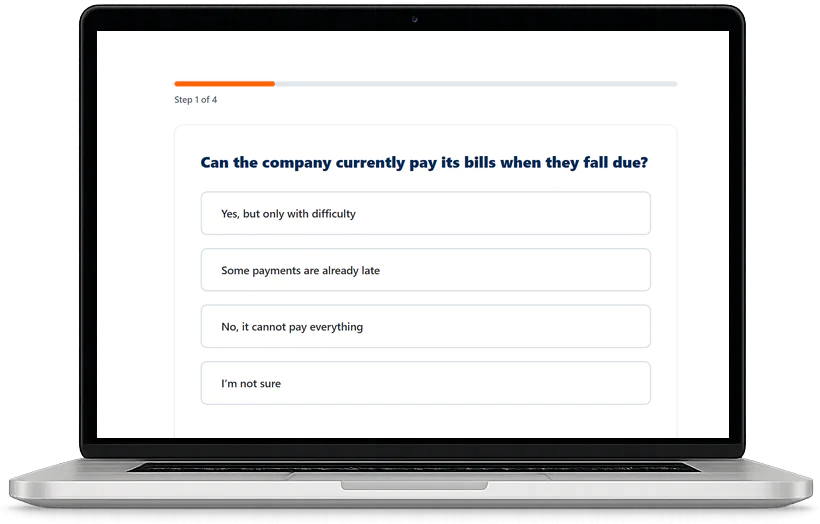
Could Your Company Be Insolvent?
Answer four short questions to see which warning signs apply, how serious the position may be and how soon you may need to act.
See which options may fit your company’s circumstances.
Check my company’s positionSee your result online and receive a copy by email. We only call if you ask.
Insolvency Checklist Step 1: Get a Formal Solvency Assessment
Insolvency in UK law has two tests under section 123 of the Insolvency Act 1986:
- Cash-flow test (s.123(1)(e)); the company cannot pay its debts as they fall due. Practical signal: you are choosing which creditors to pay this week.
- Balance-sheet test (s.123(2)); liabilities exceed assets, including contingent and prospective liabilities. Leading authority: BNY Corporate Trustee Services Ltd v Eurosail-UK [2013] UKSC 28. The Supreme Court framed this as the “point of no return” test.
The 13-week rolling cash-flow forecast is the standard diagnostic tool. Licensed insolvency practitioners require it before recommending any procedure. Build it with brutal honesty: include known contingent liabilities (dilapidations, PG calls, warranty obligations, ongoing litigation), not just current liabilities.
If either test fails, the duty-shift under section 172(3) Companies Act 2006 engages; and BTI 2014 LLC v Sequana SA [2022] UKSC 25 confirms the threshold is “probable” insolvency, which is earlier than most directors think. From that point, every payment, every transaction, every decision is reviewable through a creditors-collectively lens.
Insolvency Checklist Step 2: Organise All Company Records
Section 388 of the Companies Act 2006 requires company accounting records to be kept for at least 6 years. Organise them now, before they need to be produced for a liquidator’s investigation.
The six categories that matter:
| Category | What it includes |
|---|---|
| Company records | Incorporation certificate, articles of association, statutory registers, board minutes, shareholder resolutions |
| Financial records | Statutory accounts (3 years), management accounts (24 months), bank statements (24 months), aged-creditor and aged-debtor reports |
| Tax records | CT600 + supporting computations, VAT returns, PAYE/RTI submissions, P11D filings |
| Employee records | Contracts, payroll, pension scheme details, contractor agreements |
| Security records | Every personal guarantee signed, charges registered under s.859A CA 2006 (MR01 filings), debentures |
| Contingent liabilities | Lease + dilapidation exposure, warranty obligations, litigation, undischarged guarantees |
Section 357 of the Insolvency Act 1986 makes destruction or concealment of company property a criminal offence; up to 7 years’ imprisonment, with automatic disqualification under s.10 of the Company Directors Disqualification Act 1986. The mistake directors make under stress is moving records “out of harm’s way.” That moves them into harm’s way.
Insolvency Checklist Step 3: Stop Incurring New Debts
This is the rule directors break most often, usually because they convince themselves “one more order will fix it.” It will not.
Section 214 of the Insolvency Act 1986; wrongful trading; exposes directors to a contribution order for trading on after they knew, or ought to have concluded, that insolvent liquidation was no longer reasonably avoidable.
The leading case on quantum, Re Produce Marketing Consortium Ltd (No 2) [1989] BCLC 520, calculates the contribution from the “point of no return” to the date of liquidation. Every week of continued trading after that point adds to the figure.
The Sequana decision pushed the threshold earlier still. The Supreme Court held in 2022 that the creditor duty engages when insolvency is “probable”; not when liquidation is unavoidable, not when the bank says no, but when liquidation is the more likely than unlikely outcome.
The “every reasonable step” defence under s.214(3) requires demonstrable cessation of new credit acquisition. Concrete actions:
- Stop accepting new supplier credit. Cash-on-delivery only.
- Stop drawing on overdraft facility (already-drawn is fine; new drawdowns are reviewable).
- Stop taking new customer deposits where you cannot complete the work pre-insolvency.
- Cancel marketing spend that creates new contractual obligations.
Insolvency Checklist Step 4: Stop Making Selective Creditor Payments
The reflex when cash gets tight is to pay the creditor who is shouting loudest. That is exactly what s.239 of the Insolvency Act 1986; preferences; targets.
Section 239 covers payments made in the 6 months before insolvency for arm’s-length creditors, extending to 2 years for connected parties (family, other companies you own, employees who are also relatives).
The test under Re MC Bacon Ltd [1990] BCLC 324 is whether the director had a “desire to prefer”; a positive intention to put the recipient in a better position than they would be in a liquidation.
Section 238 covers transactions at undervalue with a 2-year lookback regardless of connection. Selling assets at below-market value, transferring assets to family, paying for services the company did not receive; all reviewable.
Practical guidance:
- Pay everyone or pay no one. Once cash-flow insolvent, selective payment is preference exposure.
- Director loan repayments are the highest-risk category. Connected-party + 2-year lookback + obvious preference intent.
- Don’t pay HMRC over staff or vice versa. This sounds counter-intuitive but s.239 doesn’t care about your reasoning; it cares about the relative outcome.
- An IP-supervised payment regime removes the director-decision risk. Once the IP runs the payment decisions, you’re no longer making preferences personally.
Insolvency Checklist Step 5: Assess Your Personal Exposure
Six routes lead to personal liability:
- Signed personal guarantees. Separate personal contracts that survive company liquidation. Bank pursues within weeks of company estate closing.
- Overdrawn director loan account. s.455 CTA 2010 charges 33.75% (since 2023-24) at the 9-month mark after year-end. Liquidator pursues the balance as a company asset.
- Wrongful trading (s.214 IA 1986). Contribution order from point-of-no-return.
- Misfeasance (s.212 IA 1986). Breach of fiduciary duty in specific transactions.
- Preferences (s.239 IA 1986). Reviewable selective payments.
- HMRC PLN / JSL. Under FA 2020 Sch 13; transfers company tax debt to director personally for wilful default + phoenix patterns.
For each PG, you need: date, lender, facility, amount, secured/unsecured status, Etridge advice if spouse co-signed. The Royal Bank of Scotland v Etridge (No 2) [2001] UKHL 44 protocol; requiring independent legal advice for spouse co-guarantors; can set aside spouse PGs where breached.
Cross-collateralisation matters: many lenders take PG + legal charge over the director’s home + debenture over the company simultaneously. Default at one level exposes the others.
Insolvency Checklist Step 6: Brief Your Staff Honestly
If you have 20 or more employees at risk of redundancy in a 90-day period, the Trade Union and Labour Relations (Consolidation) Act 1992 mandates collective consultation:
- 20-99 redundancies: 30 days consultation before first dismissal under s.188 TULRCA 1992.
- 100+ redundancies: 45 days consultation.
Section 193 TULRCA 1992 requires Form HR1 to be filed at the Insolvency Service before the first redundancy. This is a strict-liability criminal offence to fail; directors face fines on personal-liability basis.
Section 188 also requires consultation on “ways of avoiding the dismissals”; meaning the consultation must be genuine, not a formality. Protective awards under s.189 TULRCA 1992 can reach 90 days’ pay per affected employee for breach.
The employment-rights side: section 95 of the Employment Rights Act 1996 makes failure to pay wages a fundamental breach of contract. Employees can resign and claim constructive dismissal, with a 3-month tribunal window under s.13 ERA 1996.
Practical brief to staff: confirm what is paid + what may not be paid, refer them to the Redundancy Payments Service (which pays statutory redundancy + arrears + holiday + notice on formal insolvency), point them to FCA-regulated debt advice if their personal finances are at risk.
Insolvency Checklist Step 7: Check Your Directors’ and Officers’ Insurance
D&O insurance; if you have it; typically covers wrongful acts by directors in the role: breach of duty, employment-related claims, regulatory investigations. Run-off cover (the tail after the policy ends) is typically 6 years.
Two things to check before liquidation triggers any coverage event:
- Is “insolvency event” excluded? Some D&O policies explicitly exclude wrongful trading contribution orders under s.214 IA 1986; the most expensive director liability. Read the policy wording. If wrongful trading is excluded, the policy is less useful than the premium suggests.
- Is run-off cover already in place? Most policies require the run-off endorsement to be purchased before the policy ends. Run-off premium is typically 5-10% of the annual premium per year of tail; but it must be agreed before the policy expires, not after.
If the company is heading for liquidation and there is no run-off cover in place, contact the insurer immediately to bind run-off. Coverage for pre-liquidation acts depends on having the tail in place; cancelling the policy without run-off cancels all coverage.
Insolvency Checklist Step 8: Document Your Decision-Making
This step builds the evidence file that protects you in every subsequent investigation.
Dated board minutes are the cornerstone. Each meeting where the financial position is discussed needs to record:
- Financial position at meeting date (cash, available facility, key creditor pressure)
- Alternatives considered (refinance, CVA, administration, CVL, continuing trade)
- Professional advice received (accountant, tax adviser, IP, lawyer; by name and date)
- Decision rationale and supporting reasoning
- Any dissent or qualifications from individual directors
Under s.172 of the Companies Act 2006, directors must consider seven factors. Post-Sequana, an eighth factor; creditor interests; must be explicitly noted once insolvency is probable. Minutes that document the factor-by-factor reasoning underpin both:
- s.1157 CA 2006 court relief: court can excuse a director who acted honestly and “ought fairly to be excused” (Re D’Jan of London Ltd [1994] 1 BCLC 561).
- s.214(3) IA 1986 wrongful-trading defence: every reasonable step to minimise creditor loss.
Contemporaneous documentation is the difference between “negligent” and “took reasonable steps.” The minutes do not need to be elaborate; they need to be dated, factual, and recorded at the time.
Insolvency Checklist Step 9: Consult a Licensed Insolvency Practitioner
Licensed insolvency practitioners are authorised under section 388 of the Insolvency Act 1986 and the Insolvency Practitioners Regulations 2005. Their authorising body must be one of: ICAEW, the Insolvency Practitioners Association (IPA), ICAS, ACCA, or the Law Society.
The free diagnostic call is industry-wide. Most regulated IPs (including us) offer the initial conversation without obligation: this is not a sales tactic, it is the industry norm. We confirm whether the company is solvent, identify your personal exposure, and sketch your procedural options.
Paid engagement begins only on instructing a formal procedure. The SIP 9 (Statement of Insolvency Practice 9) schedule discloses remuneration up-front under r.18.16 of the Insolvency Rules 2016. We tell directors to ask for this before instructing.
Verify the IP’s licence on the public registers:
Two-IP rule: take a second opinion from another regulated practitioner before any formal appointment. Reputable IPs encourage this; resistance to a second opinion is itself a warning sign.
Not Sure Where Your Company Stands?
Use the two-minute test to check the warning signs and see how soon you may need to act.
Check my company’s positionEstimates are fineWe only call if you ask us to
FAQs on the Insolvency Checklist
How quickly should I complete this checklist?
Within 14-30 days of either solvency test failing. Every week of delay increases the s.214 wrongful-trading exposure window.
What does the checklist actually cost?
The first six steps cost nothing but director time. Step 7 (D&O insurance run-off) costs 5-10% of annual premium per tail-year. Step 9 (IP diagnostic) is free; engagement on formal procedure £4-7k for a SME CVL up to £50-300k+ for administration.
What if I skip steps to save time?
Each skipped step weakens the s.214(3) wrongful-trading defence and the s.1157 court-relief argument. Skipped documentation is the most damaging; without dated minutes, the liquidator’s narrative goes unchallenged.
Do I need a lawyer alongside the IP?
For disputed petitions, PG enforcement, or HMRC PLN exposure, yes. For routine CVL preparation, the IP can usually handle it. The “lawyer + IP combined” approach is worth £5-15k extra on complex situations where personal liability is in scope.
Where do free advice services fit?
Business Debtline (0800 197 6026) for sole traders; StepChange (0800 138 1111) for consumer debt alongside business; Money Helper for benefits + personal-finance triage. None of these replace a licensed IP for company insolvency; but they can triage personal-finance side of the picture quickly + free.