Should I Seek Insolvency Advice Before Missing Payments?




If you are wondering whether to seek insolvency advice, the answer is almost certainly yes; the fact that you are asking means you have probably left it later than you should have.
The moment that matters is not when the company stops paying. It is the moment before. It is the moment when you realise you might miss next month’s payroll, or that the VAT return cannot be funded, or that the HMRC debt has quietly grown to a figure you cannot clear from cash flow.
That is when the duty under section 214 of the Insolvency Act 1986 starts to crystallise. Every decision you make from that point forward will be examined by a liquidator if the company eventually enters insolvency. We see directors who waited three months past this point, hoping things would improve. The hope cost them a wrongful trading claim.
Quick Answer: When Should You Seek Insolvency Advice?
Before you miss a payment. Before HMRC sends a statutory demand. Before a supplier loses patience and instructs solicitors.
The professional advice itself costs nothing in most cases; initial consultations with licensed insolvency practitioners are typically free and confidential. What costs money is waiting.
We tell every director: the date you first sought advice is one of the most important data points in any subsequent conduct investigation. An earlier date is always better than a later one.
Recovery Path
Seeking Advice Early Keeps All Three Routes Open
Directors who call before missing a payment have access to informal creditor agreements, a Company Voluntary Arrangement, administration, or a Creditors’ Voluntary Liquidation; whichever fits the company’s position.
Directors who call after the first statutory demand has been served often find the CVA route is already closed (creditors won’t agree), administration is too expensive, and the choice has narrowed to CVL or compulsory liquidation. The difference is not the size of the debt; it is the timing of the conversation.
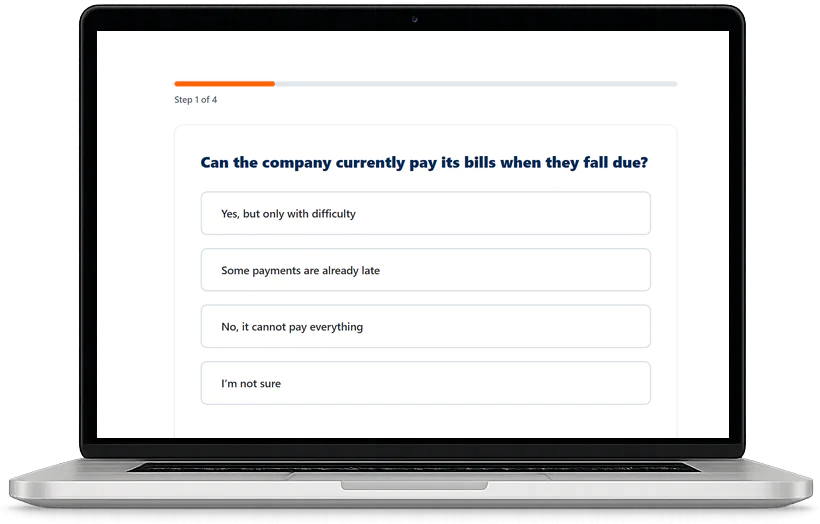
Could Your Company Be Insolvent?
Answer four short questions to see which warning signs apply, how serious the position may be and how soon you may need to act.
See which options may fit your company’s circumstances.
Check my company’s positionSee your result online and receive a copy by email. We only call if you ask.
Warning Signs That Insolvency Advice Is Overdue
We find that directors who need advice rarely present with one dramatic crisis. It is usually a pattern that has been building for weeks or months:
- You are choosing which creditors to pay each month. This is not cash-flow management. It is creditor triage, and it is evidence of insolvency.
- HMRC debts are accumulating. PAYE, VAT, and Corporation Tax arrears compound quickly. HMRC is the most common creditor to petition for compulsory liquidation.
- You are funding the business from personal savings. Injecting personal money to cover company shortfalls increases your personal exposure without fixing the underlying problem.
- Creditors are escalating from letters to legal action. A county court claim or statutory demand is not a bluff. It is the start of an enforcement sequence that ends at a winding-up petition.
- Your accountant has raised concerns. If the person who sees your numbers is telling you the position is unsustainable, the liquidator will ask what they told you and when. Ignoring professional advice is worse than never having sought it.
- You are lying awake at 2am thinking about money. This is not a legal test. But in our experience, the directors who call us at this point are the ones who still have options. The ones who wait until the bailiff arrives usually do not.
What Happens When You Seek Advice
- Free, confidential initial call; no obligation and no fee at this stage
- Practitioner assesses cash-flow and balance-sheet solvency and current creditor pressure
- Options mapped: informal arrangement, CVA, administration, or CVL; with costs and timelines for each
- If formal insolvency is the route, you are told exactly what happens to you as a director and what the investigation covers
- You choose the route and timing; the earlier you engage, the more choice you retain
What Happens in an Insolvency Advice Consultation
The initial consultation is not an appointment to liquidate your company. It is a diagnostic conversation. A licensed insolvency practitioner will review your financial position, assess whether the company is solvent or insolvent, and explain which options are available. These typically include:
- Informal creditor negotiation; restructuring payment terms directly with creditors
- HMRC Time to Pay; spreading tax debts over an agreed repayment period
- Company Voluntary Arrangement; a formal binding agreement with creditors to repay a proportion of the debt
- Administration; court protection while the business is restructured or sold
- Creditors’ Voluntary Liquidation; orderly closure if the business is not viable
We emphasise: the practitioner is not there to push you into liquidation. They are there to help you understand which route fits your situation. In roughly a third of the consultations we facilitate, the company does not need to be liquidated. It needs a different route that the director did not know existed.
Why Waiting on Insolvency Advice Makes Everything Worse
Every week you delay has a measurable cost. The company incurs more debt. The deficiency between assets and liabilities widens. The gap between when you should have acted and when you actually do grows longer. That gap is exactly what the liquidator measures when assessing a wrongful trading claim under section 214.
We have seen the arithmetic. A director who sought advice in January and entered a CVL in February faced a net deficiency increase of £8,000. A director in the same industry with a similar-sized company who waited until June faced a deficiency increase of £65,000.
The second director paid for the delay with a personal contribution order. The first walked away with a conduct report that went no further. Same problem, different timing, completely different outcome.
Beyond wrongful trading, delay also closes routes. A CVA requires a viable business. If you wait until the business has deteriorated beyond viability, the CVA option disappears.
Administration requires assets worth protecting. If you wait until the assets have been consumed by trading losses, administration is pointless. HMRC Time to Pay requires credibility. If you wait until HMRC has already served a statutory demand, the willingness to negotiate drops sharply.
How Seeking Insolvency Advice Protects You Personally
Section 214(3) of the Insolvency Act provides a defence to wrongful trading if you took every step a reasonably diligent person would take to minimise the potential loss to creditors. Seeking professional insolvency advice is the clearest demonstration of that diligence.
We cannot guarantee it is a complete defence, but we can tell you that no director we have worked with who sought advice early and acted on it has faced a successful wrongful trading claim.
The conduct report that the liquidator files with the Insolvency Service includes the date you first sought professional advice.
A report that says “the director consulted a licensed IP on 15 January and entered a CVL on 2 February” reads very differently from one that says “the director did not seek professional advice at any point and the company continued to trade for a further eight months before a creditor petitioned.”
Next Steps: How to Get Insolvency Advice Today
Company Debt’s licensed insolvency practitioners offer free, confidential initial consultations. You do not need to prepare anything for the first call. Just explain the position honestly and the practitioner will tell you where you stand and what your options are.
If any of the warning signs on this page apply to you, make that call today. Not tomorrow. Not next week. The single most consistent pattern we see is that directors who called sooner had better outcomes than directors who called later. There is no exception to that pattern.
Not Sure Where Your Company Stands?
Use the two-minute test to check the warning signs and see how soon you may need to act.
Check my company’s positionEstimates are fineWe only call if you ask us to
FAQs About Seeking Insolvency Advice
Does seeking insolvency advice mean my company will be liquidated?
No. The initial consultation is diagnostic, not prescriptive. The practitioner assesses your position and explains all available options, which may include rescue routes like CVAs, administration, or informal creditor negotiation. In many cases, liquidation is not the recommended outcome.
Is the initial insolvency consultation confidential?
Yes. Licensed insolvency practitioners are bound by professional confidentiality obligations. Your creditors, employees, and business partners will not be informed that you sought advice unless you choose to tell them or a formal insolvency process is initiated.
How much does insolvency advice cost?
Most licensed insolvency practitioners offer a free initial consultation. If you proceed to a formal insolvency process, fees depend on the route chosen: CVAs typically cost £5,000 to £10,000, CVLs from £5,000, and administration from £15,000 or more. The initial advice conversation that determines the right route costs nothing.
Can I seek insolvency advice without my business partner knowing?
Yes. You can consult a practitioner individually and in confidence. However, if the company has multiple directors, all directors share the statutory duty to act when insolvency is probable. At some point, your co-directors will need to be involved in any formal decision. The practitioner can advise on how and when to have that conversation.
What documents should I bring to an insolvency advice meeting?
Nothing is required for the first call. If you want the practitioner to give you a sharper read, have your most recent management accounts, the aged creditors and debtors lists, the HMRC position (CT, VAT and PAYE balances), and a copy of any personal guarantees you have signed. A summary of cash and committed outgoings over the next 30 days is more useful than a year of historic accounts.