Creditors’ Voluntary Liquidation (CVL): Practical Guide for UK Directors




If your company cannot pay its debts and rescue is no longer realistic, a Creditors’ Voluntary Liquidation (CVL) is the usual director-led route for closing it in an orderly way.
Company Debt is a licensed insolvency practice. When a director instructs us, one of our licensed insolvency practitioners takes the appointment as liquidator and runs the CVL from start to finish.
If the business can still pay its way once the debt is dealt with, a CVL is probably the wrong route, and a rescue may fit better. What decides it is whether the business underneath would cover its own costs once the old debt was gone.
Creditors’ Voluntary Liquidation at a Glance
Key Facts
Who it is for
A limited company that cannot pay its debts and has no realistic route back to paying them.
Who starts it
The directors propose it. The shareholders then vote to close the company by special resolution, which needs 75% of the votes.
Who acts as liquidator
A licensed insolvency practitioner. If you instruct Company Debt, that is one of our practitioners. Creditors have the right to choose someone else.
Do directors keep control?
No. Your powers as a director stop when the liquidator is appointed, unless the creditors agree that some continue.
Time to appointment
The legal notice periods are short. Creditors must decide on the liquidator within 14 days of the shareholders’ vote. Getting the records ready is the part you control.
Our fee
£3,500 plus VAT for a straightforward case (one director, no staff, no leases, clean books), plus £500 to £1,500 of disbursements, the external costs of the case.
Company debts
Paid from what the liquidator recovers, in the order the law sets. What cannot be paid ends with the company, except debts you owe personally.
The company
Dissolved three months after the liquidator’s final account is registered at Companies House.
Call the Free Director Helpline on 0800 074 6757 for confidential, no-obligation advice from a licensed insolvency practitioner, or take our two-minute insolvency test first if you are not yet sure where the company stands.
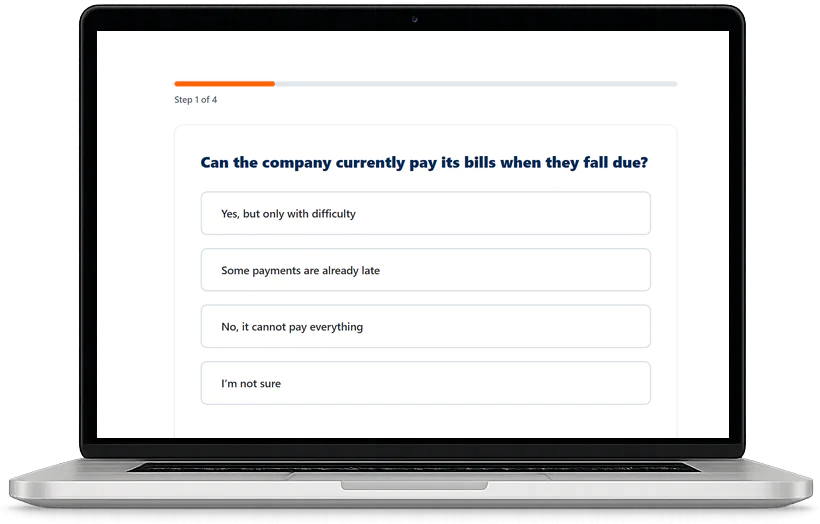
How Serious Is Your Company’s Position?
Answer four short questions to see how urgent the situation may be and which options could fit your company’s circumstances.
Check my company’s positionSee your result online and receive a copy by email. We only call if you ask.
What Is a Creditors’ Voluntary Liquidation?
A Creditors’ Voluntary Liquidation closes an insolvent company under section 84 of the Insolvency Act 1986. The directors propose it, the shareholders vote for it, and a licensed insolvency practitioner takes office as liquidator. There is no court hearing.
It is by far the most common corporate insolvency: 18,525 of the 23,938 registered company insolvencies in England and Wales in 2025 were CVLs, about 77% (Insolvency Service). Our CVL statistics page tracks the monthly figures.
The liquidator sells what the company owns, works out which creditor claims are valid, and pays them in the order the law sets. The company is then dissolved and removed from the register at Companies House.
Voluntary does not mean optional. If the company cannot pay its debts and cannot be rescued, it is likely to be closed one way or another. What is voluntary is who moves first: you, or a creditor with a winding-up petition, a court application to have the company closed.
If you move first, you choose the timing and which insolvency practitioner is put to the creditors, and the records go to someone you have already spoken to.
Wait for the petition, and the court makes a winding-up order and hands the company to the Official Receiver, the civil servant who runs court-ordered liquidations. That route is compulsory liquidation.
What moving first does not buy you is a gentler review of your conduct. The liquidator must report on every director to the Insolvency Service in every insolvent liquidation, and writes that report from the company’s records, not from how the liquidation began.
Is a Creditors’ Voluntary Liquidation Right for Your Company?
A CVL is the right route when two things are true: the company is insolvent, and there is no realistic way to rescue the business. Debt alone does not answer either question.
Section 123 of the Insolvency Act 1986 treats a company as unable to pay its debts if it fails either of two tests.
- Cash-flow test: the company cannot pay its debts as they fall due. Tax, supplier invoices, loan repayments, rent.
- Balance-sheet test: what the company owes, including future and contingent debts such as the rest of a lease, is more than what it owns.
An unpaid statutory demand for more than £750, left for three weeks, also counts as proof. So does a court judgment where enforcement has come back unpaid.
The harder question is the second one. There is a real difference between a company that is short of cash for a few months and one whose business no longer covers its costs. The first may survive with a Time to Pay arrangement, an agreed HMRC instalment plan, or a formal rescue. The second adds debt every month it trades.
| Situation | Likely route |
|---|---|
| Insolvent, and no realistic rescue | CVL |
| Insolvent, but the business still covers its costs | A rescue: a CVA or administration (compared below) |
| HMRC has refused Time to Pay, or the plan has failed | CVL, if recovery is not realistic |
| A winding-up petition has been issued | Urgent advice: the voluntary route may be closing |
| Trading has stopped but debts remain | CVL: strike-off is not safe with unpaid creditors |
| Solvent and closing | A solvent liquidation (MVL) or strike-off |
Then set the debt aside and ask whether the business underneath still wins work and covers its own running costs. If it does, a rescue route may protect it. If the borrowing was the only thing keeping the doors open, a CVL is usually the cleaner answer.
Timing matters for a legal reason too. Trading on while insolvent is not automatically wrongful. The risk under section 214 arises once you knew, or should have concluded, that insolvent liquidation could not be avoided, and you then failed to take every step to minimise creditors’ losses.
Once liquidation is likely, three things put you at risk. Do not repay a creditor you are connected to, such as a family loan or your own loan account, ahead of the others. Do not sell assets for less than they are worth. Do not take on new credit. A liquidator can challenge the first two and use the third as evidence of wrongful trading.
If you are unsure which side of the line the company is on, the two-minute insolvency test is a quick first check. It is a first check, not advice.
How Does a Creditors’ Voluntary Liquidation Work?
The Insolvency Act 1986 and the Insolvency Rules 2016 set the steps and the deadlines between them. Some steps run at the same time.
Step 1
Take Advice and Instruct a Practitioner
A licensed insolvency practitioner checks that the company is insolvent and that a CVL is the right route, then agrees the timetable with you. If you instruct us, our practitioner is the one nominated as liquidator.
Step 2
Board Meeting
The directors resolve that the company cannot continue to trade and propose that the shareholders wind it up.
Step 3
Creditors Are Given Notice
Creditors receive notice asking them to decide on the liquidator. The decision is taken by deemed consent, where the nomination stands unless enough creditors object, or at a virtual meeting.
The decision date must be at least three business days after the notice and no later than 14 days after the shareholders’ vote.
Step 4
Shareholders Vote and the Liquidator Takes Office
The shareholders pass a special resolution: 75% of the votes cast at a meeting, or 75% of all eligible votes if passed in writing (Companies Act 2006, s.283). The liquidator they name takes office, and your powers as a director stop.
The resolution must be advertised in The Gazette, the official public record, within 14 days, and filed at Companies House within 15 days.
Step 5
Statement of Affairs
The directors sign a statement of affairs listing every asset, debt and creditor, verified by a statement of truth, a signed confirmation that it is accurate. It goes to creditors within 7 days of the vote. We prepare it with you from the company’s records.
A material omission from the statement can be a criminal offence unless you show you had no intent to defraud. Tell us about any gap you know of.
Step 6
Creditors Decide
Creditors confirm the liquidator or nominate a different one. If they nominate someone else, their choice generally prevails, though a director, shareholder or creditor can ask the court to decide.
Step 7
The Liquidator’s Work
The liquidator sells the assets, investigates the company’s affairs, agrees creditor claims and pays them in the statutory order. Within three months, the liquidator sends the Insolvency Service a report on the conduct of each director.
Step 8
Company Dissolved
The liquidator files a final account, and the company is dissolved three months after it is registered.
One detail in that order catches people out. The liquidator takes office on the day of the shareholders’ vote, before the creditors have decided anything. Creditors confirm or replace that appointment afterwards.
How Much Does a Creditors’ Voluntary Liquidation Cost?
Our fee for a straightforward CVL is £3,500 plus VAT, which is £4,200 in total. Our cost guide defines straightforward as a single-director company with no employees, no leases and a clean set of books.
Disbursements add £500 to £1,500. These are the external costs of the case, such as the insolvency bond, Gazette notices and statutory mailings. Cases with staff, property or disputed assets are quoted individually.
When you compare quotes, ask what each one covers. Some firms price only the work to get a liquidator appointed. Others price the whole expected case.
If the company has no money, the fee can come from company assets, from the directors, or from a director’s redundancy claim. That claim is open only to a director who was genuinely employed by the company, with at least two years’ service, not one paid only through dividends.
The Redundancy Payments Service decides each claim on the evidence. Do not count on the money before it arrives.
Our guide to liquidation costs explains how CVL fees are set, what pushes them up, and what to do if nobody can fund it. If that is your position, read what to do when you cannot afford to liquidate.
How Long Does a Creditors’ Voluntary Liquidation Take?
There are two different timelines here. The one that changes your day-to-day position is the first.
Getting the liquidator appointed. The statutory notice periods are short: three business days’ notice to creditors, and their decision within 14 days of the vote. The shareholders’ meeting needs 14 days’ notice, but holders of 90% of the shares can agree to less, and a private company can use a written resolution instead.
What takes longer is assembling the records and the statement of affairs. Having bank statements, a list of who the company owes and HMRC letters ready shortens this stage.
From appointment, the company’s creditors deal with the liquidator, not with you.
The whole liquidation. This runs much longer. In an Insolvency Service study of CVLs that began in 2017, half took more than 712 days, about two years, from appointment to dissolution. Property, disputes and HMRC enquiries all add time.
Our liquidation timeline guide sets out each stage and its statutory deadline.
What Happens to You as a Director in a CVL?
Your powers end when the liquidator is appointed. You stop signing for the company, paying its bills and answering its creditors. You must still cooperate: section 235 requires you to give the liquidator information and records when asked.
Your conduct is reviewed in every case. The review is not an allegation. It is a report the law requires on every director of every insolvent company, and the Insolvency Service decides whether anything in it needs action.
You are not personally liable for the company’s debts just because it could not pay them. Personal exposure comes from something separate: a promise you signed, money you owe the company, or specific findings about how you acted.
| Happens in every CVL | Needs particular facts |
|---|---|
| Conduct report to the Insolvency Service | A wrongful trading claim |
| Review of books and records | A claim that you favoured one creditor (a preference) |
| Review of transactions before liquidation | A claim that assets were sold too cheaply (an undervalue) |
| Director questionnaire | Disqualification proceedings |
| Duty to cooperate under section 235 | A claim that you misused company money (misfeasance) |
The left column applies to everyone and says nothing about you. The right column needs the liquidator to prove specific facts, and the court decides. Our guide to liquidator investigations explains how each claim works and the time limits behind them.
Two personal debts survive the company whatever the conduct review finds:
- A personal guarantee. It is a contract between you and the lender, so the liquidation does not touch it. See directors’ personal guarantees.
- An overdrawn director’s loan account. Money you took from the company beyond salary and dividends is a debt you owe it, and the liquidator will normally ask for it back. Dividends paid when the company had no profits to pay them from can be claimed back too. See overdrawn directors’ loan accounts.
Both are easier to plan for before the appointment than after it. Our guide to what happens to directors in liquidation covers the conduct review in full.
What Happens to Company Debts and Employees in a CVL?
The liquidator pays creditors from what the company’s assets raise, in an order fixed by law. Each group is paid in full before the next receives anything.
- Lenders with a fixed charge are paid from the assets that charge covers.
- The costs of the liquidation, including the liquidator’s fee, are paid next (section 115).
- Preferential creditors follow. Employees rank here for wages owed for the four months before the liquidation, up to £800 each, and for holiday pay (Schedule 6). Since 1 December 2020 HMRC also ranks here for VAT, PAYE and employee National Insurance, behind the employees.
- A lender with a floating charge is paid next, after a share of that money is set aside for unsecured creditors, called the prescribed part.
- Unsecured creditors, such as suppliers, landlords and Bounce Back Loan lenders, share what is left.
If nothing is left by the time their turn comes, they receive nothing. Whatever cannot be paid ends with the company when it is dissolved.
Agree with the liquidator when to tell staff, rather than deciding it alone. The answer depends on whether any trading continues to finish work or protect value.
Employees are usually made redundant when trading stops. They claim redundancy pay, unpaid wages, holiday pay and notice pay from the Redundancy Payments Service, which pays from a government fund when an employer cannot. The weekly pay used in those claims is capped at £751 from 6 April 2026.
The liquidator supplies the case details the claims need. Our guide on what happens to employees in liquidation covers the claims and the limits.
CVL Versus Compulsory Liquidation and Rescue Options
Two questions decide the route. Is there a business worth saving? And who will start the process if you do not?
| Route | Fits when | What it means for you |
|---|---|---|
| Creditors’ Voluntary Liquidation | Insolvent, and the business cannot be rescued. | You choose the timing and the proposed liquidator. |
| Compulsory liquidation | A creditor has petitioned the court. | The Official Receiver takes over. You have no say in who acts. |
| Company Voluntary Arrangement (CVA) | Insolvent, but the business is viable and can repay over time. | A formal repayment deal. You keep running the company. Needs 75% of creditors who vote, by value. |
| Administration | The business has value worth saving or selling, or needs protection from creditors now. | An administrator takes control, and creditor action stops. |
A CVA or administration only makes sense if the business can pay its way once the old debt is dealt with. If it cannot, the rescue route delays the liquidation and adds its own costs.
Two other routes sound similar but do a different job. A Members’ Voluntary Liquidation (MVL) is for a company that can pay all its debts. Strike-off suits a company with no debts, and is not safe where creditors are unpaid, because any of them can object.
If a winding-up petition has already been issued, act within days. A CVL can sometimes still start before the hearing, but it does not stop the petition. The court can still make a winding-up order, though it will consider what the other creditors want.
From the day a petition is issued, company payments and asset transfers can be void unless the court approves them. Take advice before moving any money.
How Company Debt Can Help With a Creditors’ Voluntary Liquidation
This is what happens when you instruct us, from the first call to closing the case.
- A free, confidential first call. We look at whether the company is insolvent and whether a CVL, a rescue or a simpler closure fits. We ask about personal guarantees and the director’s loan account then, because both are easier to deal with before the appointment. Taking advice does not alert HMRC or any creditor.
- The paperwork. We prepare the board and shareholder resolutions, the creditor notices and the statement of affairs with you, from the company’s records.
- The appointment. Our practitioner is nominated and takes office as liquidator when the shareholders vote. From then on, creditors deal with us.
- The liquidation. We sell the assets, agree the claims, pay creditors in the statutory order, file the conduct report and close the case.
You do not need complete records before the first call. It helps to know which of these you have: bank statements, management accounts, lists of who owes the company and who it owes, HMRC letters, payroll records, and any loan, lease or guarantee documents.
Call the Free Director Helpline on 0800 074 6757, or take the two-minute insolvency test first if you are not yet sure where the company stands.
Frequently Asked Questions About Creditors’ Voluntary Liquidation
Can directors choose the insolvency practitioner in a CVL?
The directors propose the practitioner and the shareholders name them in the winding-up resolution. Creditors then have the right to nominate someone else, and if they do, their choice generally prevails unless the court decides otherwise.
Do directors need to attend a creditors’ meeting?
Usually not in person. The creditors decide on the liquidator by deemed consent or at a virtual meeting. A physical meeting is held only if creditors owed 10% of the debt object to deemed consent, or if 10% by value, 10% by number or 10 creditors ask for one. You may need to answer questions from the liquidator in writing.
Can HMRC block a CVL?
HMRC does not vote on the shareholders’ resolution, so it cannot block the decision to wind up. As a creditor it can vote on who the liquidator is. It can also carry on with a winding-up petition it has already issued, and the court can still make a winding-up order.
What happens if the company has no assets?
A CVL can still go ahead. With nothing to sell, the liquidator still deals with the creditors’ claims and reports on the directors’ conduct. The fee then has to come from the directors, or from a director’s redundancy claim where one is available.
Am I liable for a Bounce Back Loan after a CVL?
Not for the loan itself. Lenders could not take a personal guarantee for a Bounce Back Loan, so it is an unsecured company debt. Misuse is different. The liquidator reviews how the money was spent, and misuse can lead to a personal claim or to disqualification.
Does a CVL affect my personal credit rating?
The liquidation is recorded against the company, not on your personal credit file. Your own record can be affected if a personal guarantee is called in and you cannot pay it, or if personal insolvency follows.
Can I start a new company after a CVL?
Yes, unless you are disqualified or an undischarged bankrupt. The main restriction is on the name, not on you. If you were a director in the 12 months before the liquidation, section 216 of the Insolvency Act 1986 bars you from reusing the liquidated company’s name, or one like it, for five years unless an exception applies or the court allows it.
Breaking that rule is a criminal offence, and section 217 makes you personally liable for debts the new company runs up while you are involved in running it.
Check How Serious the Position May Be
Answer four short questions to see how urgent the situation may be and which broad options could fit.
Check my company’s positionEstimates are fineWe only call if you ask us to
Related Guides
- Company Liquidation: the three liquidation routes and how a CVL fits among them.
- How Much Does It Cost to Liquidate a Company: what the fee covers and how directors fund it.
- Liquidation Timeline: each stage of a liquidation and its statutory deadline.
- What Happens to Directors in Liquidation: the conduct review in detail.
- Directors’ Personal Guarantees: why a guarantee survives the company.
- Overdrawn Directors’ Loan Accounts: what the liquidator can ask you to repay.
- What Is Wrongful Trading: when trading on becomes a personal risk.
- What Happens to Employees in Liquidation: redundancy and unpaid wage claims.
- Compulsory Liquidation: what happens when a creditor petitions the court.
- Winding-Up Petitions: how to respond before a CVL is no longer available.
- Company Voluntary Arrangement and Company Administration: the rescue routes.
- CVL Statistics: monthly CVL numbers for England and Wales.
- Insolvency Test: a two-minute check of where your company stands.