


Voluntary liquidation means you chose to close. Compulsory liquidation means a creditor forced the court to close it for you. That distinction changes everything: who controls the process, how your conduct is investigated, and how much of the outcome you can still influence.
We speak to directors every week who do not realise they still have a choice. If a creditor is threatening a winding-up petition but has not yet filed one, you can still initiate a voluntary liquidation and retain some control over the appointment of the liquidator and the pace of the process.
Once the petition is gazetted and the court makes an order, that window closes. The Official Receiver takes over, your bank accounts are frozen, and the investigation into your conduct is mandatory rather than discretionary.
Which of the two you are facing is often still undecided at the point directors assume it is settled. That is the part worth getting right, because the difference in your personal position is larger than the difference in procedure.
Voluntary vs Compulsory Liquidation Comparison Table
| Voluntary (CVL) | Compulsory | |
|---|---|---|
| Who starts it | You (the directors and shareholders) | A creditor petitions the court |
| Who controls it | Licensed IP appointed by directors (creditors can replace) | Official Receiver (court-appointed) |
| Director input | You nominate the liquidator and prepare the statement of affairs in advance | You respond to the Official Receiver’s demands after the order |
| Investigation | Conducted by the IP; scope depends on findings | Mandatory investigation by the Official Receiver into every director |
| Bank accounts | Frozen on appointment of liquidator (orderly) | Frozen when petition is gazetted (often without warning) |
| Cost to directors | £3,500 + VAT plus disbursements, paid from company assets where there are any | £0 upfront (creditor pays petition costs) but less control over outcome |
| Timeline | 10 to 21 days to appoint; 6 to 12 months of work; dissolution 3 months later | 18 months to 3+ years |
| Public record | Filed at Companies House | Filed at Companies House plus London Gazette advertisement |
| Perception | Director acted responsibly | Creditor forced the issue |
If a petition has been served but not yet gazetted, the voluntary window is still open, but it closes fast. A Creditors’ Voluntary Liquidation, or CVL, gives you the ability to nominate the liquidator, prepare your records, and demonstrate to the Insolvency Service that you acted responsibly.
If a winding-up petition has been served, you may still be able to convert to a CVL by settling the petitioning creditor’s debt and passing a voluntary winding-up resolution before the court date. Once the petition is advertised in the London Gazette and accounts are frozen, that option disappears and the Official Receiver takes control.
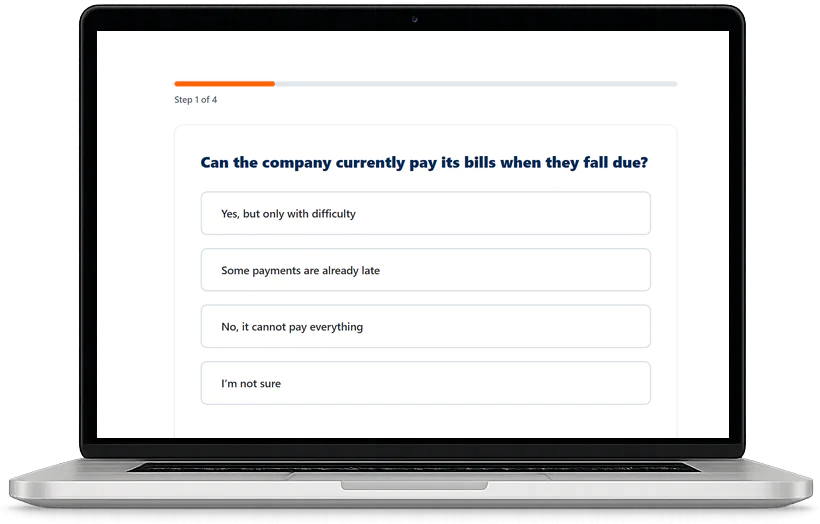
How Serious Is Your Company’s Position?
Answer four short questions to see how urgent the situation may be and which options could fit your company’s circumstances.
Check my company’s positionSee your result online and receive a copy by email. We only call if you ask.
When You Should Choose Voluntary Liquidation
A Creditors’ Voluntary Liquidation (CVL) is the right route when you know the company is insolvent and you want to close it in an orderly way before a creditor forces the issue. You retain the ability to nominate the liquidator, prepare your records properly, and present your conduct in the best possible light.
We advise directors to choose voluntary liquidation when any of these apply:
- You know the company cannot pay its debts and trading is no longer viable.
- A creditor (particularly HMRC) is escalating enforcement but has not yet filed a petition.
- You want to demonstrate to the Insolvency Service that you acted responsibly and sought professional advice.
- You want some influence over which insolvency practitioner handles the case.
- You want to control the timing so you can prepare your records and brief your staff.
The practical advantage of a CVL is that it shows you made the decision. In the conduct report that the liquidator files with the Insolvency Service, a director who initiated a CVL after taking professional advice is treated very differently from one whose company was wound up by a creditor petition after months of ignoring the problem.
We see this distinction play out in disqualification decisions regularly. A director who acted on the advice file is far harder to disqualify than one whose case file opens with a creditor petition.
When Compulsory Liquidation Happens to You
Compulsory liquidation is not a choice. It happens when a creditor owed more than £750 petitions the court to wind up the company, and the court grants the order. The most common petitioning creditor is HMRC, followed by landlords and trade suppliers.
The process starts with the service of a winding-up petition on the company. The rules set a floor rather than a fixed date.
The petition cannot be advertised until at least seven business days after service, and must appear at least seven business days before the hearing, so the minimum gap is roughly a fortnight of business days. Beyond that it depends on the court’s listing.
In that window you can pay the debt, reach a settlement, or prepare to oppose the petition. If you do nothing, the order is almost always granted.
Once the petition is advertised in the London Gazette, your bank will freeze the company’s accounts. The freeze is automatic and can happen within hours of publication, because banks monitor the Gazette for exactly this.
You will not be able to pay staff, cover rent, or fund any trading activity from that point. If you are still trading when the petition is gazetted, the operational impact is immediate and severe.
After the court grants the winding-up order, the Official Receiver is appointed as liquidator. The Official Receiver is a civil servant employed by the Insolvency Service, and their primary duty is to investigate the directors’ conduct.
This investigation is mandatory in every compulsory liquidation, regardless of the size of the company or the amount of debt. In a CVL, the scope of the investigation is at the liquidator’s discretion. In compulsory liquidation, it is automatic.
Comparing Cost and Speed of Voluntary vs Compulsory Liquidation
Voluntary (CVL): Our fee is £3,500 plus VAT for a straightforward case, with £500 to £1,500 of disbursements on top, paid from the company’s assets where there are any.
Where there are none, the funding has to come from somewhere else, usually the director personally or a redundancy claim. No practitioner can take the appointment without it in place, so an empty company does not mean a free liquidation.
Appointment takes 10 to 21 days, the liquidator’s work then runs 6 to 12 months on a straightforward case, and dissolution follows three months after the final account. You control the start date, which lets you prepare.
Compulsory: There is no upfront cost to you as director because the petitioning creditor pays the £352 court fee and a £2,600 deposit. But the total cost to the estate is usually higher.
The Official Receiver’s fees and any private IP’s fees are charged to the company’s assets, and compulsory liquidations tend to be more expensive due to the mandatory investigation and longer timeline.
We tell directors that the apparent cost saving of compulsory liquidation, where you pay nothing upfront, is an illusion. You lose control of the process, the investigation is more intensive, the timeline is longer, and the reputational impact is worse.
A CVL paid for out of company assets is almost always a better outcome than a compulsory liquidation that costs you nothing upfront but leaves you facing a more adversarial investigation and a longer period of uncertainty.
Director Control During Each Liquidation Route
In a CVL, you nominate the liquidator, prepare the statement of affairs at your own pace (within statutory limits), and can brief your staff and key stakeholders before the process goes public. You lose executive control on appointment, but the preparation period is yours.
In compulsory liquidation, you control nothing. The court sets the hearing date, the Official Receiver is appointed without your input, and your first formal interaction is receiving a demand for your statement of affairs within 21 days.
We see directors who went through compulsory liquidation describe it as something that happened to them. Directors who went through a CVL describe it as something they managed. The difference matters, both practically and psychologically.
The Investigation: How Each Liquidation Route Differs
This is where the distinction matters most for your personal position.
In a CVL: The liquidator investigates your conduct and files a report with the Insolvency Service. The scope and intensity of the investigation depends on what the liquidator finds. If your records are clean, the company’s affairs are straightforward, and there are no red flags, the investigation may be relatively light. The liquidator has discretion.
In compulsory liquidation: The Official Receiver must investigate every director’s conduct. There is no discretion about whether to investigate, only about how deeply.
The Official Receiver will examine your bank statements, payment decisions, director’s loan account, and compliance with filing obligations as a matter of course. If they find evidence of unfit conduct, they refer the case to the Insolvency Service’s enforcement directorate for potential disqualification proceedings.
We are not saying the CVL investigation is soft. A good liquidator will investigate thoroughly regardless of the route. But the mandatory, automatic nature of the compulsory investigation means there is no possibility of a quick, clean exit. Every director in a compulsory liquidation is investigated. Not every director in a CVL receives the same level of scrutiny.
Voluntary or Compulsory Liquidation: Which Protects You Best?
If you still have a choice, the CVL is almost always the better route. Our voluntary liquidation guide explains both MVL and CVL in detail. It demonstrates that you acted responsibly, gives you preparation time, lets you influence the liquidator appointment, and results in a less adversarial investigation.
If a winding-up petition has already been served, you may still be able to convert to a CVL before the hearing. This requires paying the petitioning creditor’s debt or reaching an agreement, then passing the winding-up resolution before the court date. We have helped directors make this conversion, and it is worth exploring if the timeline allows it.
If the petition has been gazetted and the hearing is imminent, your options are limited. At that point, the focus shifts from route selection to preparation: organise your records, take legal advice on your personal position, and cooperate fully with whoever is appointed.
Company Debt’s licensed insolvency practitioners can assess which route is available to you and help you act before the choice is made for you. If a creditor is escalating and you have not yet taken advice, get liquidation advice now.
FAQs on Voluntary vs Compulsory Liquidation
Can I switch from compulsory to voluntary liquidation?
If the winding-up petition has been served but the court has not yet made an order, you may be able to pay the petitioning creditor’s debt and then pass a voluntary winding-up resolution. This effectively converts the process to a CVL.
Once the court has made the winding-up order, conversion is no longer possible without the court’s permission, which is rarely granted.
Is voluntary liquidation better for my personal record?
Yes, generally. Initiating a CVL demonstrates that you recognised the company was insolvent and took responsible action.
This is viewed positively in the liquidator’s conduct report and by the Insolvency Service when considering disqualification. Compulsory liquidation, where a creditor had to force the issue, raises questions about why you did not act sooner.
Who pays for compulsory liquidation?
The petitioning creditor pays a £352 court fee and a £2,600 deposit. The Official Receiver’s fees and any private liquidator’s fees are paid from the company’s assets. If the company has no assets, the Official Receiver still conducts the investigation at public expense.
Directors do not pay the costs directly, but the lack of director control over costs means the total estate costs are often higher than in a CVL.
What happens to my bank accounts in each route?
In a CVL, company bank accounts are frozen when the liquidator is appointed. You can prepare for this by making necessary payments (wages, essential costs) before the resolution.
In compulsory liquidation, accounts are frozen when the winding-up petition is advertised in the London Gazette, which can happen weeks before the court hearing. This freeze often catches directors by surprise and can make it impossible to pay staff or cover essential costs.
Can a creditor still petition if I start a CVL?
Once a CVL is in progress, a creditor can still petition the court to convert it to a compulsory liquidation, but the court will only grant this if there is good reason (for example, if the creditor believes the CVL is being conducted improperly or that a compulsory investigation is needed).
In practice, once a CVL is underway with a reputable liquidator, compulsory petitions are rare.
Check How Serious the Position May Be
Answer four short questions to see how urgent the situation may be and which broad options could fit.
Check my company’s positionEstimates are fineWe only call if you ask us to