Manufacturing Insolvency in the UK: Causes, Risks & Solutions for Directors




Manufacturing insolvencies don’t fail at the order book. They fail at the working-capital gap between raw materials in and customer payment out.
You can have a full production schedule, solid contracts, and a queue of finished goods in bay one, and still run out of money on a Wednesday because three customers are paying on 90-day terms and the steel supplier wants 30.
If you are a manufacturing director reading this, the chances are you already know something is wrong.
The signs tend to be specific: the HP company has rung about the injection moulder, the bank has queried the overdraft, or a letter arrived this morning from a supplier exercising a retention-of-title clause over stock you thought you owned.
These are not warning signs. They are consequences. The warning came earlier, when the margin gap between input cost and sale price stopped covering the working-capital cycle, and nobody caught it in time.
Read on for what manufacturing insolvency looks like on the ground, what your legal position is as a director, what sector-specific complications apply (RoT claims, plant on HP, customer tooling, TUPE), and which recovery routes are worth considering before the window closes.
Where we see directors act early, outcomes for them and their employees are consistently better than for those who wait.
Manufacturing Insolvency at a Glance
Quick Answer: Manufacturing Insolvency in the UK
A UK manufacturing company is insolvent when it cannot pay its debts as they fall due (cashflow insolvency under section 123(1)(e) of the Insolvency Act 1986) or when its liabilities exceed its assets (balance-sheet insolvency under section 123(2)).
Manufacturing businesses face both tests simultaneously more often than most sectors.
Long working-capital cycles, high fixed overheads, and extended customer payment terms can leave the cashflow test failed even when the balance sheet still shows net assets.
The options when insolvency is near or confirmed include informal creditor negotiation, a Company Voluntary Arrangement (CVA), administration, pre-pack administration, or Creditors’ Voluntary Liquidation.
Which route fits depends on whether the trading model itself is viable: order-book recovery versus structural margin failure.
When Manufacturing Insolvency Risk Becomes Critical
Risk becomes critical when the working-capital cycle breaks.
In manufacturing, that means the cash absorbed by raw-material purchases and work-in-progress is not returned quickly enough by customer payments to fund the next production run.
Energy-cost spikes, import duty increases after Brexit, or a single large customer moving from 30-day to 60-day terms can tip the cycle from tight to unrecoverable within two or three months.
For directors, critical risk also means personal-liability risk. Once insolvency is a real possibility, your legal duty shifts from advancing the company’s interests to protecting creditors’ interests.
Continuing to trade, authorising payments to preferred creditors, or disposing of assets at below-market value after that point all carry personal consequences under sections 214, 239, and 238 of the Insolvency Act 1986.
Main Director Risk in Manufacturing Insolvency
The main personal risks for manufacturing directors are wrongful trading (s.214 IA 1986), preference payments to connected parties (s.239), and exposure under personal guarantees on HP finance, leases, or bank borrowing.
On top of those, the Insolvency Service reviews director conduct in every liquidation.
Where the records show the director knew the company was insolvent but kept trading, or drew salary while creditors went unpaid, disqualification proceedings under the Company Directors Disqualification Act 1986 become likely.
What Manufacturing Directors Should Do About Insolvency Risk Now
Get independent advice from a licensed insolvency practitioner before you do anything else. Not next week.
If you are already past the point of comfortable denial, if you are managing which suppliers to pay this week and which to defer, the window for the options that keep you in control is narrowing.
The options available at week one are different from the options available at week eight.
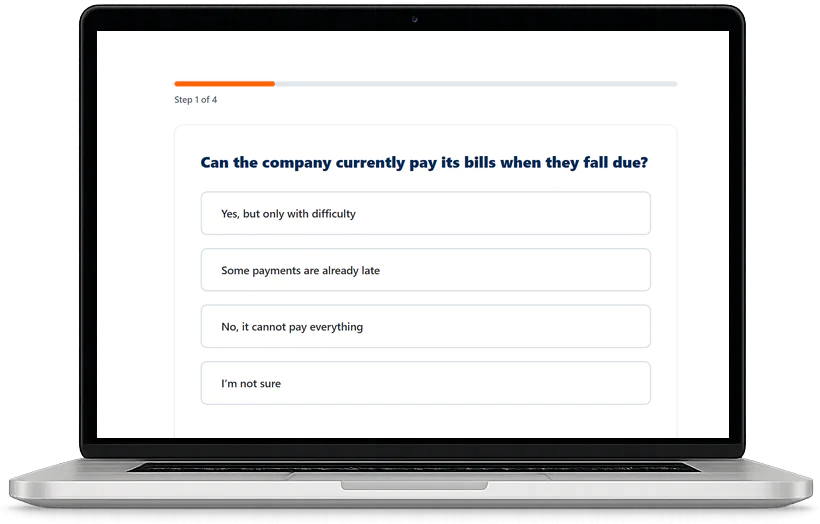
Could Your Company Be Insolvent?
Answer four short questions to see which warning signs apply, how serious the position may be and how soon you may need to act.
See which options may fit your company’s circumstances.
Check my company’s positionSee your result online and receive a copy by email. We only call if you ask.
What Manufacturing Insolvency Means for Your Business
Manufacturing Insolvency: What the Tests Actually Show
The cashflow test and the balance-sheet test both apply. In a manufacturing context, the cashflow test usually breaks first. You have the assets: machinery, stock, WIP.
But you cannot turn them into cash fast enough to pay this month’s PAYE, the materials invoice due on Friday, and the energy direct debit going out on the 1st.
That is cashflow insolvency, and it is where most manufacturing distress starts.
The balance-sheet test catches manufacturers who have been borrowing to cover losses.
When HP finance, invoice discounting, and bank overdraft have all been drawn to maximum, and the machinery carrying those debts is worth less than the book value, the balance sheet turns negative.
At that point, even selling everything would not clear the creditors. In our experience, directors in this position often know the numbers are wrong before they will say it out loud.
Difference Between Manufacturing Insolvency and a Short-Term Cash Squeeze
A short-term squeeze is recoverable: one large customer is late, but the next three invoices will clear it within 60 days.
Insolvency is structural: the working-capital gap is wider than the business can close through normal trading, and closing it would require either a significant injection of capital from outside or a permanent improvement in margins that is not credibly achievable.
The practical test: if you map out the next 13 weeks and cannot find a scenario where the cash position stabilises without new money or a dramatic creditor concession, you are looking at insolvency rather than a squeeze.
That matters because your legal duties change the moment insolvency becomes the likely outcome, not the confirmed one. We build this model with directors at our first meeting and it changes the conversation within the first hour.
When Manufacturing Insolvency Recovery May Not Be Suitable
Recovery is not suitable when the trading model is broken at the gross-margin level.
A manufacturer whose selling prices cannot cover materials, direct labour, and energy before overheads is not suffering from a debt problem. It is suffering from a commercial problem.
Restructuring the debt does not fix a negative contribution margin.
In those cases, the honest conversation is about how to close the company in a way that protects employees, satisfies directors’ legal duties, and preserves whatever can be preserved for creditors.
Sector-Specific Manufacturing Insolvency Risks Directors Often Miss
Retention of Title Claims and Supplier Stock in Manufacturing Insolvency
Most manufacturing supply contracts include a retention-of-title (RoT) clause, rooted in the Sale of Goods Act 1979.
The principle established in the Aluminium Industrie Vaassen BV v Romalpa Aluminium Ltd case is that the supplier retains legal ownership of goods until they are paid for in full.
When a manufacturer enters insolvency, suppliers with valid RoT clauses can apply to reclaim their unpaid stock. The complication is that RoT claims collide with the liquidator’s authority.
Once a liquidator is appointed, the stock is treated as part of the insolvent estate until a supplier successfully proves its claim.
That proof is harder than it sounds: the supplier must trace their specific goods, show they have not been incorporated into finished products, and demonstrate the clause was properly communicated.
By the time the RoT letter arrives on the factory office desk, much of the stock is already in WIP or finished goods. RoT does not automatically extend there.
The practical consequence: suppliers you hoped would wait tend to become urgent once they see an insolvency appointment on Companies House.
When we review the creditor position in manufacturing cases, RoT claims frequently arrive in the first 48 hours after appointment.
Plant and Machinery on HP, Lease, and Chattel Mortgage
The £400,000 injection moulder in bay two may not belong to the company. If it is financed under a hire-purchase agreement or a chattel mortgage, the finance house retains legal title until the final payment is made.
The HP company’s representative arriving to inspect the asset, politely but firmly, is one of the more unambiguous signals that insolvency is public knowledge.
In insolvency, these assets do not form part of the general estate available to unsecured creditors. The finance house can repossess them.
What that means for the factory floor is that the production line may lose critical equipment early in the process, making a going-concern sale or a pre-pack far harder to execute.
Identifying which assets are owned outright, which are on HP, and which are on operating leases should be part of any first-week assessment when you take advice.
Our review of asset registers in manufacturing cases frequently shows that the “owned” base is considerably smaller than the balance sheet implies.
Customer-Owned Tooling Stored on Premises
A specific feature of precision and contract manufacturing is customer tooling stored on the factory site. The dies, jigs, and moulds in bay 3 may belong to your customers, not to the company.
They appear in your premises, they take up space, and on a quick walk-around they look like assets. They are not.
A liquidator who attempts to treat them as part of the realisable estate will face claims from the tooling owners.
Customers with tooling on site typically move quickly on insolvency news. They will want their tooling returned before it is locked up in an administration or sold with the factory floor.
Their urgency is legitimate, but it can disrupt production or a going-concern sale if not managed.
A properly documented asset register showing which tooling is customer-owned, and which is the company’s, is essential due diligence before any formal process begins.
Our standard pre-appointment review includes a physical walk-around for exactly this reason.
TUPE Obligations in Manufacturing Business Sales
If you sell the business, or a part of it, as a going concern, whether through a pre-pack or administration, the Transfer of Undertakings (Protection of Employment) Regulations 2006 (TUPE) apply.
Employees transfer automatically to the buyer on their existing terms.
In manufacturing, where workforces can be large, shift-based, and covered by collective agreements, the TUPE obligations add cost and complexity to any sale.
The statutory redundancy cap is £751 per week from April 2026. Where 20 or more employees are at risk, collective consultation obligations apply.
Failure to consult can trigger protective awards of up to 90 days’ gross pay per employee, payable from the National Insurance Fund if the company cannot meet them.
A buyer doing a pre-pack will price these liabilities into the offer.
Energy Costs, Environmental Permits, and Import Duty Overlays
Energy costs are a margin variable that many manufacturing directors have been slow to model as a structural risk rather than a cyclical one.
A manufacturer running energy-intensive processes (pressing, casting, firing, coating) absorbs energy cost before any sale is made.
When wholesale prices moved sharply from 2021 onwards, the gap between contract prices set 18 months earlier and actual production costs became un-crossable for some operators.
Environmental permit obligations add a different layer.
Manufacturers with environmental permits under the Environmental Permitting (England and Wales) Regulations 2016 (covering waste handling, chemical processes, and emissions) carry obligations that survive into insolvency.
An administrator or liquidator may need to maintain permit compliance to avoid enforcement action from the Environment Agency, even during a sale process.
For chemical or fabric manufacturers, landfill and contamination obligations can turn into significant liabilities that a buyer will price away from.
We flag this risk early with directors in affected sectors because it directly affects the achievable sale price.
Import-facing manufacturers have absorbed a further layer since Brexit: customs duties, import VAT on goods from the EU, and supply-chain lead-time extensions that increase the amount of working capital tied up in transit stock at any moment.
These are operating costs that have permanently altered the margin position for some sectors.
How to Assess Whether Manufacturing Recovery Is Possible
The Manufacturing Viability Test: Order Book Versus Structural Margin Failure
The single most important question in any manufacturing rescue assessment is whether the company is losing money because of a temporary cash gap or because it is structurally uneconomical to trade.
These are different problems and they have different answers.
A WIP audit walk-around the factory tells you something a management accounts pack does not. How much work is genuinely in progress? What is the realistic completion and collection timeline for each job?
Is the order book forward-looking, or is it relying on repeat customers who are themselves at risk?
An honest answer to those questions, combined with a 13-week cashflow model, tells you whether there is a business to rescue and how much runway you have.
We conduct this review with directors at our first appointment, because the picture often looks different at floor level than it does on paper.
Cashflow, Working Capital, and Payment-Term Evidence
Extended customer payment terms (60 to 90 days is common in manufacturing) mean that the cash you have earned this week will not arrive for two to three months. That gap must be funded from somewhere.
If it is being funded by extending supplier credit beyond agreed terms, drawing down invoice discounting to maximum, or deferring HMRC payments, the funding is already borrowed from the future.
The 13-week cashflow model needs to show whether inflows will genuinely exceed outflows on a week-by-week basis once all the deferred obligations are counted.
We work through this modelling with directors as part of our initial advice process.
The cases where rescue is achievable are the ones where the cashflow model shows a credible stabilisation point, even if it requires creditor forbearance or a CVA proposal, and the trading model at gross margin level is sound.
What Creditors Would Receive in Liquidation Versus Recovery
Any formal rescue proposal (CVA, administration, or pre-pack) needs to demonstrate to creditors that they will recover more through the proposed route than through immediate liquidation.
In manufacturing, the liquidation comparison is complicated by the fact that much of the apparent asset base (plant, machinery, stock) realises significantly less than book value when sold quickly.
A specialist press bought for £200,000 may achieve £30,000 at auction. Stock in a sector-specific WIP state may achieve very little.
If creditors can see that a going-concern sale or CVA would deliver meaningfully more than a break-up, you have a viable rescue argument.
If the numbers do not support that case, the rescue route will not get creditor support. Nor should it.
Our role at that point is to model both scenarios honestly and help you reach a decision before the choice is made for you by a creditor.
Recovery Options for a Manufacturing Business in Distress
Company Voluntary Arrangement for Manufacturing Businesses
A CVA is a statutory compromise under sections 1 to 7B of the Insolvency Act 1986.
It binds unsecured creditors (including HMRC, trade creditors, and suppliers with overdue invoices) to a reduced or rescheduled repayment plan, typically over three to five years, while the company continues trading and the directors retain control.
It needs 75% creditor approval by value of those voting.
For a manufacturing business, the CVA is most appropriate when the underlying production economics are sound:
the gross margin is positive, the order book is real, and the debt pile is a legacy of a period of margin compression or a specific capital expenditure that did not pay back as planned.
The CVA does not fix a structurally loss-making operation. But it can give a viable manufacturer the breathing room to trade through a creditor load that would otherwise tip it into liquidation.
HMRC is typically a significant creditor in manufacturing insolvencies, given the level of employer NIC, PAYE, and VAT involved.
Since Crown preference was reinstated on 1 December 2020 under the Finance Act 2020, HMRC has priority status ahead of floating-charge holders for VAT, PAYE, employee NIC, CIS, and student-loan deductions.
That changes the negotiation arithmetic in a CVA. We model this carefully before any proposal is tabled, because the numbers look different once Crown preference is properly factored in.
Administration and Pre-Pack Sale for Manufacturing Companies
Administration places a licensed insolvency practitioner in control of the company and provides an automatic moratorium against creditor action.
For a manufacturing business under acute pressure (suppliers threatening to repossess stock under RoT, the bank demanding repayment, the HP company inspecting the plant), the moratorium can stabilise the position long enough to complete a sale or restructuring.
A pre-pack administration is a specific variant where the sale of the business is agreed before the administrator is appointed, and completed immediately on appointment.
It is commonly used in manufacturing when the trading business has value as a going concern (the customer relationships, the skilled workforce, the production equipment) but the legal entity carrying the debt cannot survive.
The business transfers to a new vehicle; the old company enters administration with its creditors. TUPE applies to the transferred employees.
Pre-packs are scrutinised. The Pre-pack Pool and the Administration (Restrictions on Disposal etc. to Connected Persons) Regulations 2021 impose requirements where the buyer is connected to the old company’s directors.
If you are considering buying back your own business through a pre-pack, independent scrutiny and a written opinion from the Pool are not optional extras. They are legally required where the connected-person test is met.
Our practitioners handle connected-party pre-packs regularly and can advise on whether the process is likely to succeed and what scrutiny it will face.
Creditors’ Voluntary Liquidation for Manufacturing Businesses
When the trading model is not recoverable, Creditors’ Voluntary Liquidation (CVL) is the correct route.
The directors resolve to wind up the company, appoint a licensed insolvency practitioner as liquidator, and the assets are realised for creditors in the priority order set by Schedule 6 of the Insolvency Act 1986 and the Crown preference rules.
For manufacturing businesses, the CVL process involves the liquidator taking control of the factory, reviewing all assets and liabilities, and addressing RoT claims.
It also means dealing with the HP finance houses on secured plant, returning customer tooling, and managing employee redundancies under the National Insurance Fund.
Acting early, before the company has accrued further losses, gives the director a cleaner conduct review and often a better outcome for creditors.
Our guide to rescue versus liquidation routes sets out the full comparison if you need to think through which direction is right for your situation.
HMRC Time to Pay and Informal Creditor Negotiation
Before formal procedures, an HMRC Time to Pay arrangement can defer a tax liability over 6 to 12 months (sometimes longer for viable businesses with a clear repayment proposal).
HMRC will not agree a TTP if they believe the underlying business cannot service the arrangement, so it requires a credible cashflow model.
Getting HMRC to agree a TTP while also managing a major trade creditor and a bank conversation simultaneously is achievable but needs careful sequencing.
Presenting one creditor’s forbearance as evidence to the next is a legitimate negotiating tactic; surprising them is not.
Our team manages this sequencing with directors and the approach consistently produces better outcomes than tackling each creditor separately without a coordinated position.
Director Risks During Manufacturing Insolvency
Wrongful Trading Risk in a Manufacturing Insolvency
Section 214 of the Insolvency Act 1986 allows a liquidator to apply for an order that a director contribute to the company’s assets.
The test is whether the director knew, or ought to have known, there was no reasonable prospect of avoiding insolvent liquidation, and took no steps to minimise the loss to creditors.
The test is objective: what a reasonably diligent person in your position, with your knowledge, would have concluded.
If you were receiving management accounts showing the cashflow position, and the accounts showed insolvency was likely, and you kept trading anyway, the s.214 claim is arguable.
The defence is not “I hoped it would turn around.” The defence is documented evidence that you took positive steps:
sought professional advice, adjusted trading activity, considered and recorded the board’s reasons for continuing, and could demonstrate a genuine belief, backed by evidence, that insolvent liquidation was avoidable.
Board minutes from that period matter.
Where we audit the case files we handle, the directors who fare best under Insolvency Service scrutiny are the ones who can point to a specific date they sought advice and a specific set of actions they took as a result.
Preference and Undervalue Risk for Manufacturing Directors
Section 239 (preferences) and section 238 (transactions at undervalue) of the Insolvency Act 1986 give the liquidator power to unwind payments or disposals made in the run-up to insolvency.
The lookback period for preferences is six months for arm’s-length transactions, two years for connected parties such as family members, fellow directors, or associated companies.
In manufacturing, the typical preference risk is paying a connected supplier ahead of unconnected creditors, or repaying a director’s loan while trade creditors are outstanding.
The typical undervalue risk is selling plant at below-market price to a connected buyer.
A liquidator will examine all payments and disposals in the lookback window. The dangerous payment is not the visible one to the bank.
It is the quiet one to a spouse’s company that appears on the ledger two weeks before the administrator was called.
Board Records and Director Conduct Evidence in Manufacturing Insolvency
The Insolvency Service investigates director conduct in every CVL and most administrations.
They look at the books and records, interview the director under oath if necessary, and produce a conduct report that can lead to disqualification proceedings under the Company Directors Disqualification Act 1986.
The period of disqualification ranges from 2 to 15 years.
A manufacturing business that has failed leaving significant creditor losses, with poor or absent board minutes, will receive closer scrutiny than one where the director can demonstrate they sought advice early, acted in creditors‘ interests, and maintained proper records throughout.
What Manufacturing Directors Should Do About Insolvency Risk
Commission an Honest 13-Week Cashflow Model
Before any other decision, you need to know the actual cash position week by week over the next quarter. Not the management accounts.
The actual cash: what comes in when, what goes out when, which creditors are already overdue, and what the position looks like if the largest customer pays on day 90 rather than day 60.
This is not a document for a board meeting. It is a private diagnostic. If the model shows negative weeks you cannot explain, you have the information you need to make a decision.
Our advice to directors at this point is consistent: act on what the cashflow model shows, not on what you hope will happen.
Audit the Asset Register Against HP Finance and RoT Agreements
Produce a list of every material asset on the factory floor, cross-referenced against its financing arrangement. Which assets are owned outright? Which are on HP, lease, or chattel mortgage?
Which are customer-owned tooling? This audit sounds straightforward but often reveals that the “owned” asset base is substantially smaller than the balance sheet suggests.
A licensed insolvency practitioner needs this information to advise you accurately on what a sale or rescue would actually realise.
We treat the asset audit as part of our standard first-meeting preparation with manufacturing clients, because the numbers change significantly once HP and RoT claims are properly accounted for.
Take Licensed Insolvency Practitioner Advice Before Acting on Any Creditor Demand
A formal statutory demand, an HP repossession notice, or a supplier’s RoT letter creates a specific legal clock. Acting on one without understanding the consequences for the others can accelerate the position in a way that removes options.
An insolvency practitioner can advise on the legal sequencing, negotiate with secured creditors, and assess whether a moratorium through administration would give the company the time it needs.
The Company Debt rescue solutions hub sets out the full menu of procedures and where each one fits. It is worth reading before you call anyone else.
Your Next Step: Rescue or Closure?
Manufacturing insolvency almost always splits into two distinct situations, and the right next step depends on which one you are actually in.
If your gross margin is positive (materials, direct labour, and energy are covered before overheads) and the problem is a working-capital gap, extended creditor terms, or a specific debt load from a period of investment, there is a recovery argument to be made.
A CVA, an administration, or a carefully structured creditor negotiation may be viable.
The order book matters: if you have forward orders at positive margins, a liquidator or administrator selling the business as a going concern has something to sell.
Get an insolvency practitioner to model the CVA or pre-pack scenario and compare it honestly to liquidation proceeds. If the numbers support the rescue, pursue it. If they do not, stop trading losses now.
If your contribution margin is negative (if producing the next batch will cost more than you will receive for it) no rescue procedure will fix that. The trading model is broken.
The correct step is an orderly Creditors’ Voluntary Liquidation, entered voluntarily before a creditor forces compulsory winding up.
A voluntary liquidation gives you more control over the process, a cleaner conduct review, and more opportunity to manage the employee redundancy process properly.
The longer you delay a CVL in a structurally loss-making business, the greater the additional losses to creditors and the greater the personal-liability risk to you under section 214.
We speak to manufacturing directors every week who have been managing this situation for longer than they should.
The consistent finding: the directors who contact us in week two have more options, less personal exposure, and better outcomes for their staff than those who wait until week twelve.
Call us free on 0800 074 6757 for a confidential conversation with a specialist who understands manufacturing businesses.
Not Sure Where Your Company Stands?
Use the two-minute test to check the warning signs and see how soon you may need to act.
Check my company’s positionEstimates are fineWe only call if you ask us to
Frequently Asked Questions About Manufacturing Insolvency
Can a supplier with a retention-of-title clause reclaim stock once a manufacturer enters insolvency?
Yes, if the RoT clause is valid, properly communicated, and the goods are identifiable in their original form. Goods incorporated into WIP or finished products are typically no longer recoverable under RoT. The supplier must trace specific goods and prove they have not been mixed or processed.
A liquidator will assess each RoT claim on its legal merits and will contest weak claims. Getting specialist legal advice on the clause terms before insolvency is formally entered is important for suppliers and directors alike.
What happens to plant and machinery on hire-purchase if the manufacturer enters administration or liquidation?
The HP finance company retains legal title until all payments are made. In administration, the automatic moratorium prevents the HP company from repossessing without court permission or the administrator’s consent during the initial period. In liquidation, the HP company can repossess its asset.
HP-financed plant does not form part of the realisable estate for unsecured creditors. It is a secured asset of the finance house. Identifying all HP and lease agreements early is essential for accurate insolvency modelling.
Does TUPE apply when a manufacturing business is sold through a pre-pack administration?
Yes. TUPE 2006 applies to a pre-pack sale where the business transfers as a going concern. Employees transfer to the buyer automatically on their existing terms. There are specific rules that allow some TUPE-protected terms to be varied in insolvency proceedings under regulation 9, but these rules are narrow.
They require an insolvency practitioner to confirm that the changes are for economic, technical, or organisational reasons entailing changes in the workforce. Where 20 or more employees are affected, collective consultation obligations apply.
What personal liability does a manufacturing director face for wrongful trading under the Insolvency Act 1986?
Under section 214 of the Insolvency Act 1986, a liquidator can apply for a court order requiring the director to contribute personally to the company’s assets. The contribution typically reflects the additional net losses caused to creditors after the point when insolvent liquidation should have been recognised as unavoidable.
The test is objective: what a reasonably diligent director in that position, with that knowledge, should have done. The defence requires evidence of positive steps: documented board decisions, professional advice sought, and trading adjustments made.
How does Crown preference affect manufacturing insolvencies involving HMRC debt?
Since 1 December 2020, HMRC has priority creditor status (Crown preference) for certain taxes: VAT, PAYE, employee National Insurance contributions, Construction Industry Scheme deductions, and student-loan deductions. These rank above floating-charge holders and unsecured creditors.
In manufacturing insolvencies, where employers typically carry significant PAYE and VAT liabilities, HMRC will absorb a substantial share of any floating-charge realisations before unsecured trade creditors or a bank with a floating charge receive anything.
Can long-term customer contracts with termination penalties cause problems in manufacturing insolvency?
Yes. Onerous long-term supply contracts, particularly those with liquidated damages clauses or termination penalties, can crystallise as significant liabilities the moment an insolvency practitioner is appointed.
An administrator or liquidator has the power to disclaim onerous contracts under sections 178 to 182 of the Insolvency Act 1986, which terminates the contract and substitutes a provable debt in the insolvency.
The customer’s claim for that termination liability then ranks as an unsecured debt, potentially increasing the total creditor pool and reducing the return to other unsecured creditors. Mapping contract termination exposure is a key part of pre-appointment planning.