Professional Services Insolvency in the UK: Duties, Risks & Solutions for Firms




A professional firm’s largest asset walks out the door every evening. The cash ledger does not show it.
For solicitors, accountants, surveyors, architects, recruitment consultants and IT service firms, insolvency carries risks that a generic trading company never faces. Your clients are mobile. Your work in progress is perishable.
Your regulator has intervention powers that a creditor does not.
And if you run an SRA-regulated firm, the client account is ringfenced by law: the moment it shows a shortfall, you have a personal liability problem that sits entirely apart from the firm’s trading position.
What follows covers what professional services insolvency looks like in practice, where the personal risk concentrates, and what your real options are.
Our aim is to help you understand the position before a formal process takes the decisions out of your hands.
Professional Services Insolvency at a Glance
Quick Answer: Professional Services Insolvency
Professional services insolvency follows the same statutory tests as any corporate insolvency under section 123 of the Insolvency Act 1986: can the firm pay its debts as they fall due, and do its assets exceed its liabilities?
What differs is the regulatory layer sitting on top.
Solicitors face SRA intervention under the Solicitors Act 1974. Accountants face ICAEW or ACCA disciplinary action. Architects face ARB registration issues on live projects.
And all regulated firms face a run-off professional indemnity insurance (PII) requirement that continues for six years after practice ceases, at a cost that often shocks principals who have never priced it.
When Professional Services Insolvency Becomes Critical
The inflection point is usually one of three things: a client account reconciliation that does not balance, a PII renewal the insurer declines or prices at a figure you cannot fund, or a cash-flow crisis arriving simultaneously with a regulatory compliance event.
Any one of those alone is manageable. All three together is not.
Main Risk in Professional Services Insolvency
For directors and partners of regulated firms, the main risk is personal liability arising before the insolvency process formally begins.
A solicitor whose client account shows a shortfall faces SRA investigation regardless of whether the firm is solvent or not. An accountant who delays PII run-off cover whilst winding down creates personal exposure for claims that post-date the firm’s closure.
These risks do not wait for a CVL or administration appointment. We address them directly below.
What to Do Next About Professional Services Insolvency
If you suspect your firm is insolvent or approaching insolvency, the first call is to a licensed insolvency practitioner with professional services experience, not a general business adviser.
The second is to your professional body or regulatory contact.
These two conversations need to happen within 48 hours of each other, not weeks apart. We explain why that sequencing matters in the sections below.
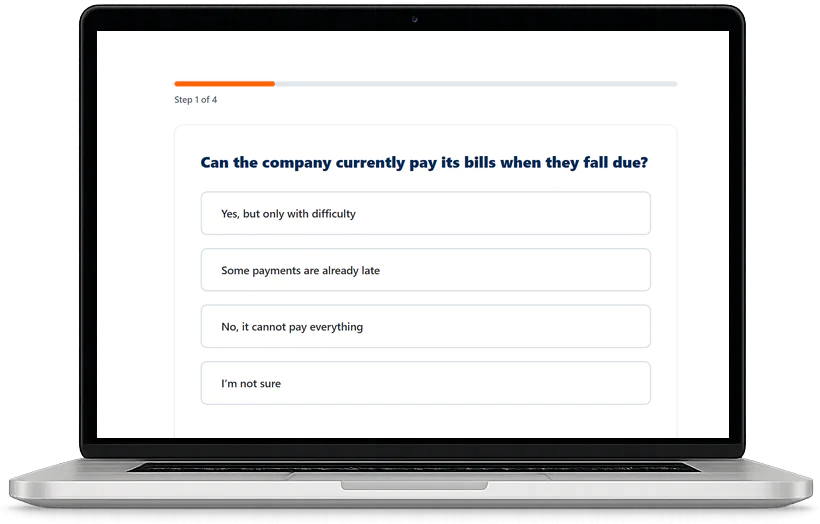
Could Your Company Be Insolvent?
Answer four short questions to see which warning signs apply, how serious the position may be and how soon you may need to act.
See which options may fit your company’s circumstances.
Check my company’s positionSee your result online and receive a copy by email. We only call if you ask.
What Makes Professional Services Insolvency Different?
Professional Services Insolvency Meaning
Professional services insolvency means the same thing legally as any other corporate insolvency.
The firm has failed one or both statutory tests under the Insolvency Act 1986: it cannot pay its debts as they fall due (the cashflow test), or its liabilities exceed its assets including contingent and prospective liabilities (the balance-sheet test).
What differs is not the legal definition but the operational and regulatory consequences that activate the moment the firm crosses that line.
Difference Between Professional Services Insolvency and Ordinary Trading Insolvency
A manufacturing company facing insolvency has physical assets a liquidator can value and sell. A professional services firm’s value is in billable relationships, WIP, and authorisation to practise.
None of those transfer cleanly through a formal insolvency process.
WIP disappears the moment clients exercise their right to instruct someone else. Goodwill is effectively worthless once the regulator takes steps. The firm’s authorisation to practise is not an asset the insolvency practitioner can realise.
This is why we consistently advise professional firms to act earlier than the statutory tests strictly require. By the time the cashflow test is clearly failed, the recoverable value in the firm may already have gone.
When Professional Services Insolvency May Not Be Reversible
For SRA-regulated solicitors’ firms, the critical point of no return is SRA intervention. Under the Solicitors Act 1974, the SRA has power to intervene in a practice where it believes clients’ interests are at risk.
Intervention is not a sanction on you personally. It is the SRA physically taking control of the client files and the client account.
Once intervention happens, the firm’s ability to trade is over, regardless of whether you reach a CVA or administration deal. The intervention itself triggers the effective closure.
For other regulated firms, the equivalent is PII lapse. An RICS-regulated surveyor whose PII lapses during a financial crisis cannot lawfully continue practice. An ARB-registered architect with a CDM duty on an active site creates personal liability the moment cover drops.
How to Assess Whether Professional Services Recovery Is Possible
WIP, Goodwill and the Professional Services Balance Sheet
Work in progress is the largest asset class for most professional firms and the most misleading one on the balance sheet. WIP represents hours billed or accrued but not yet invoiced.
In an insolvency scenario, that WIP is only recoverable if the client relationship survives.
Most clients, once they receive a letter from an insolvency practitioner, instruct alternative advisers. The WIP figure your accounts show today is not the figure a liquidator will recover.
Goodwill works the same way. It has value as a going concern, but in administration or liquidation it is difficult to realise unless you can sell the practice to a buyer with the relevant regulatory authorisation.
For an accounting firm, the buyer needs ICAEW or ACCA accreditation. For a solicitors’ firm, the buyer needs SRA authorisation. That narrows the field considerably and depresses the sale price.
Regulatory Viability Test Before Choosing a Recovery Route
Before committing to a CVA or administration, you need an honest answer to a question most insolvency practitioners will not ask: does the firm remain capable of practising through the recovery period?
A CVA that requires you to trade for three to five years while paying a proportion of profits to creditors only works if clients continue to instruct you, your regulator does not intervene, and your PII remains in place throughout.
Each of those is a separate risk.
We see firms agree CVAs that fail within eighteen months not because the creditor vote was wrong but because the regulatory position was never tested properly before the arrangement was proposed.
If your firm is SRA-regulated, we recommend getting a direct assessment of the firm’s regulatory resilience from a specialist legal regulatory adviser before any formal insolvency process is initiated.
Creditor and HMRC Exposure in a Professional Services Firm
Professional services firms typically have three creditor groups that behave differently from trade creditors: HMRC, the office landlord, and any partner or member who has given a personal guarantee.
HMRC’s position as a secondary preferential creditor was reinstated from 1 December 2020 under the Finance Act 2020, meaning VAT, PAYE, employee NIC and similar taxes take priority over floating charge holders and unsecured creditors.
If your firm has been using collected VAT or PAYE to fund operations, the personal exposure for the partners is significant.
And if the office lease was taken on by a senior partner personally, or if partners guaranteed a bank facility, the insolvency of the LLP or company does not discharge that liability. The landlord can pursue the guarantor for arrears directly.
These obligations need to be mapped before any formal process begins, not discovered afterwards.
Recovery Options for Professional Services Firms
Company Voluntary Arrangement for a Professional Services Firm
A Company Voluntary Arrangement allows the firm to propose a legally binding repayment plan to creditors, requiring approval from creditors representing 75% of the voting debt by value.
For professional services firms, a CVA can work where the practice retains client volume and regulatory authorisation throughout the arrangement period.
It is not viable where the client base depends on the personal reputation of a partner who is leaving, where the SRA has flagged regulatory concerns, or where PII renewal is at risk.
The CVA does not stop regulatory investigation. If the SRA has concerns about client money during the CVA proposal period, it can still intervene.
The moratorium that a CVA provides binds creditors but not regulators acting in the public interest.
For partnerships, the equivalent is a Partnership Voluntary Arrangement. We cover that in our partnership voluntary arrangements guide.
Pre-Pack Administration in Professional Services
A pre-pack administration involves the sale of the business and assets being agreed before an administrator is formally appointed, with the sale completing immediately on appointment.
For professional services firms, a pre-pack can preserve client relationships and fee earner continuity better than a CVA trading on under visible financial distress.
The buyer acquires the WIP, the client files, and the staff. The insolvent entity is left with the debts.
Pre-packs attract scrutiny because they can appear to benefit connected parties. Since 2021, connected-party pre-pack sales require either creditor approval or a report from a pre-pack pool evaluator.
Independent buyers with the necessary regulatory authorisation to take on the practice are not common, which limits how competitive the sale process can be.
Creditors’ Voluntary Liquidation for Solicitors, Accountants and Consultants
Where rescue is not viable, a Creditors’ Voluntary Liquidation is the most common outcome. Directors or designated members convene a meeting, appoint a licensed insolvency practitioner as liquidator, and the firm enters an orderly wind-down.
The liquidator realises whatever assets remain, pays creditors in statutory priority order, and dissolves the entity.
For solicitors’ firms, the SRA will need to be notified immediately and will typically appoint an intervention agent to manage client files and the client account.
For accountants and surveyors, professional body notification is required under membership rules.
The six-year run-off PII obligation continues after closure: you cannot simply let the policy lapse when the firm is wound up.
The run-off premium for a mid-size surveying firm, based on a case we handled, came in at around £35,000.
That cost needs to be funded from the CVL estate or from the partners personally if the estate cannot meet it. For guidance on comparing a CVL against other closure routes, see our CVA vs liquidation guide.
Director and Partner Risks During Professional Services Insolvency
Wrongful Trading Risk When Client Revenue Collapses
Under section 214 of the Insolvency Act 1986, wrongful trading arises where a director or designated member continued trading when they knew, or ought to have concluded, that there was no reasonable prospect of avoiding insolvent liquidation or administration.
The defence is demonstrating that you took every step to minimise the potential loss to creditors.
For professional firms, the wrongful trading question often crystallises around a specific moment: the point at which a major client leaves, the firm’s biggest fee earner resigns, or the PII insurer signals at renewal that cover is in doubt.
If you continued trading for six months after that moment without taking advice or restructuring the cost base, the liquidator will scrutinise the decision carefully.
Board minutes (or their equivalent in an LLP) that show the problem was identified and seriously considered are your best evidence. An absence of records is not neutral. A liquidator reads silence as an absence of governance.
SRA Intervention, Client Account Shortfalls and Personal Liability
This is the risk that distinguishes solicitors’ firms from every other professional services sector. Under the SRA Accounts Rules, managers of an authorised firm are jointly and severally responsible for client account shortfalls.
That liability is not discharged by the insolvency of the firm.
The scenario that ends careers looks like this: the firm’s general office account runs dry, someone draws from the client account to cover wages on a Friday, the reconciliation the following week shows the gap.
Even if the amount is small and the intention was to replenish it within days, the rules have been breached. The SRA will investigate. The managers are personally on the hook. The firm’s insolvency does not change that calculus.
If you are a solicitor reading this and your client account reconciliation does not balance, fix it before you do anything else. This is not a “manage it alongside the insolvency process” problem. It is the most urgent issue in front of you.
Run-Off PII Cover, Personal Guarantees and the Lease You Forgot About
Professional indemnity insurance obligations do not end when the firm closes. For solicitors, the SRA requires six years of run-off cover. For RICS surveyors, RICS rules require run-off cover for at least six years from cessation of practice.
Architects need to consider CDM liabilities on projects still in the construction or post-completion phase. A claim can arrive years after the firm closes, and if you have no run-off cover in place, you face it personally.
Personal guarantees are the other risk that tends to be underweighted until the insolvency process begins.
The senior partner who signed the office lease in personal capacity because the LLP was too new to get commercial terms may have forgotten about it.
The bank facility with a joint and several partner guarantee looks manageable when profits are strong. Neither of those obligations goes away when the firm enters CVL.
Mapping them now, before a formal process, gives you time to negotiate. Discovering them once the liquidator has been appointed does not.
What Directors and Partners Should Do About Professional Services Insolvency
Reconcile the Client Account and Fix Any Shortfall Before Anything Else
If your firm holds client money, the client account reconciliation is not one item on a checklist. It is the first thing you do.
If it shows a shortfall, you notify the relevant partners, document the deficit and its cause in writing, and address it.
This is true even if the amount is small. The SRA Accounts Rules treat all shortfalls the same way: a breach is a breach regardless of scale or intent.
The temptation when a firm is under cash pressure is to leave the reconciliation until the end of the month and deal with the trading crisis first. That instinct is understandable and wrong.
Client money is never part of the insolvent estate under UK law. It sits outside the firm’s assets entirely.
Treating it as a buffer, even temporarily, is a regulatory offence with personal consequences that persist after the firm’s insolvency is resolved.
Get a WIP Valuation Before Instructing an Insolvency Practitioner
Before you appoint an insolvency practitioner, get an independent view of what your WIP is actually worth in a sale scenario, not what the accounts show.
For most professional firms, the gap between the WIP figure in management accounts and the figure a buyer will actually pay is significant. Clients have a right to take their files and instruct anyone they choose.
The practical consequence of overstating WIP is that you enter a CVA or administration on the assumption there is enough value to make the arrangement work, only to find that client departures in the first quarter have cut the recoverable value by a third.
Getting a realistic valuation up front changes the route selection: it may tell you that a CVL is the right answer rather than a CVA, or that a pre-pack is viable where a trading CVA is not.
Contact a Specialist Adviser Within 48 Hours of Identifying the Problem
Time is the resource most professional firms waste in a financial crisis. The instinct is to trade out quietly, to see whether next month’s fees cover the gap, to avoid alarming the staff. We understand that instinct.
We also see what happens when it governs the decision-making for too long: the regulatory position deteriorates, the PII renewal approaches and the insurer has questions the firm cannot answer well, the creditor pressure escalates and the options narrow.
Contacting a licensed insolvency practitioner with professional services experience, and separately notifying your professional body if your regulatory rules require it, does not commit you to any particular outcome.
It gives you an accurate picture of where you actually are and what your real options are. Some options close entirely once formal creditor action begins.
For wider context on the options available to distressed businesses, our company rescue solutions guide covers the full range. Company Debt is a licensed UK insolvency practice. Our licensed insolvency practitioners take appointments where formal procedures are appropriate.
Any conversation is confidential.
Your Next Step as a Professional Services Director or Partner
The split here matters, because SRA-regulated firms face a different immediate risk from non-regulated consulting, IT, or recruitment businesses. Know which category you are in before you decide what to do first.
If you run an SRA-regulated solicitors’ firm: your client account is the first priority. If the reconciliation is clear, your next call is a specialist insolvency practitioner with legal sector experience.
The SRA intervention risk is real and it operates independently of the trading insolvency. Regulatory intervention can foreclose a CVA or pre-pack before it even reaches the creditors.
The window to agree a commercial outcome is shorter than it appears, and waiting costs options rather than preserving them.
If you run an accountancy, surveying, architecture, recruitment, or IT consulting firm: your immediate risk is personal liability through personal guarantees and run-off PII obligations, combined with wrongful trading exposure if you continue trading without a credible recovery plan.
The standard Insolvency Act 1986 framework applies. A CVA, pre-pack, or CVL may all be viable depending on your creditor composition, client retention, and cost structure. None of those routes become easier the longer you delay them.
For both: a confidential conversation with an insolvency specialist costs nothing and closes no options. Continuing without advice costs both.
Related Professional Services Insolvency Guides
Company Rescue Solutions for Distressed Businesses
Our company rescue solutions guide covers administration, CVAs, pre-packs, and informal arrangements for companies facing insolvency, including the conditions under which each route is viable.
Partnership Voluntary Arrangements for Professional Partnerships
Traditional partnerships and LLPs have different insolvency mechanisms from limited companies. Our partnership voluntary arrangements guide explains how a PVA works, when it suits a partnership structure, and how it differs from a CVA.
It also covers our experience of the situations where a PVA is preferable to a CVL.
Not Sure Where Your Company Stands?
Use the two-minute test to check the warning signs and see how soon you may need to act.
Check my company’s positionEstimates are fineWe only call if you ask us to
Frequently Asked Questions About Professional Services Insolvency
Can a solicitors’ firm enter a CVA while an SRA investigation is ongoing?
Yes, a CVA can technically be proposed while an SRA investigation is ongoing, but the SRA investigation is not stayed by the CVA moratorium. The SRA’s intervention powers under the Solicitors Act 1974 operate independently of insolvency proceedings.
If the SRA decides to intervene during the CVA proposal period, the firm’s ability to trade ends immediately, which would make the CVA unworkable. Any CVA proposal for an SRA-regulated firm should be assessed alongside the firm’s regulatory position before it is put to creditors.
Does client money in a solicitors’ firm form part of the insolvent estate?
No. Client money held in a solicitor’s client account is held on trust for the client and never forms part of the firm’s insolvent estate. A liquidator cannot use client account funds to pay the firm’s creditors.
However, if the client account shows a shortfall, the managers of the firm are jointly and severally personally liable for that deficit under the SRA Accounts Rules, and that personal liability survives the firm’s insolvency.
How long does run-off PII cover need to last after a professional firm closes?
For SRA-regulated solicitors’ firms, run-off cover must be maintained for six years from the date the firm’s authorisation ends, under the SRA minimum terms and conditions. RICS-regulated surveying firms also face a six-year run-off obligation under RICS rules.
The obligation is personal to the managers of the firm if the firm’s CVL estate cannot fund the premium. Run-off cover should be factored into any closure cost estimate before choosing a formal insolvency route.
Are LLP members personally liable for the firm’s debts if it becomes insolvent?
In most circumstances, no. The Limited Liability Partnerships Act 2000 limits members’ liability for the LLP’s debts in the same way that limited company shareholders are not liable for company debts.
However, members can become personally liable in specific circumstances: where they have given personal guarantees, where wrongful trading under the Insolvency Act 1986 is established, where misfeasance claims arise, or where regulatory breaches create direct personal liability.
The LLP structure protects members from general trading debts; it does not protect them from misconduct or contractual guarantees they have personally signed.
What happens to a recruitment firm’s client deposits when it enters insolvency?
Recruitment firms operating under the Conduct of Employment Agencies and Employment Businesses Regulations 2003 may hold client deposits or advances. Whether those deposits are held on trust or form part of the firm’s general estate depends on the terms under which they were received.
If the deposit was paid under terms that created a trust, the client may be able to recover it. If it was simply a payment on account that became part of the firm’s general cash, it will be treated as an unsecured creditor claim in the insolvency.
Recruitment firms holding significant client advances should take specific advice on how those sums are characterised before entering any formal insolvency process.
Can a professional firm use a pre-pack administration to sell to its own management team?
Yes, but a connected-party pre-pack sale now requires either creditor approval or a report from an independent evaluator under the Administration (Restrictions on Disposal etc. to Connected Persons) Regulations 2021. This applies where the buyer is a director, designated member, or person connected with them.
For professional services firms, the buyer also needs the relevant regulatory authorisation: an SRA-authorised firm to take on a solicitors’ practice, ICAEW or ACCA membership to take on an accounting practice. The regulatory consent timeline needs to be aligned with the insolvency process timeline, which requires advance planning.
Does HMRC’s Crown preference status affect professional services insolvencies differently?
Crown preference affects all corporate insolvencies commencing on or after 1 December 2020 equally: HMRC ranks as a secondary preferential creditor for VAT, PAYE, employee NIC, CIS deductions and student loan contributions collected but not yet paid.
For professional services firms that have used collected VAT or PAYE to fund working capital under cash pressure, HMRC’s preferential status means those amounts rank ahead of the bank’s floating charge and ahead of unsecured trade creditors.
In practice, this often reduces or eliminates the return to unsecured creditors in a CVL, which has implications for whether a CVA can be structured at a level creditors will vote for.