Cash Flow Problems: Causes, Warning Signs & Solutions for UK Businesses




Cash flow problems rarely announce themselves as a crisis. They announce themselves as a VAT bill we will pay next week, a supplier invoice that slides a few days past terms, a PAYE payment delayed until the large client settles. Each looks manageable. The compounding effect, three or four months in, is what actually sinks the business.
This hub page covers the early-warning signs, the legal consequences of persistent arrears, the informal and formal solutions available at each stage of distress, and the director-liability exposure that compounds as your cash position worsens. Each section links to the deeper guide on the specific topic.
Understanding Cash Flow and Insolvency Basics
Cash flow is the timing of money moving in and out of your business. Profit is an accounting concept; cash flow is an operating one. Your business can be profitable on paper and insolvent in practice. Most companies that enter formal insolvency in the UK were profitable at some point in the 12 months before they failed.
The two statutory tests for corporate insolvency under section 123 of the Insolvency Act 1986:
- Cash-flow test, is the company unable to pay its debts as they fall due? Persistently missed tax, rent, supplier or payroll obligations fail this test directly.
- Balance-sheet test, do the company’s liabilities (including contingent and prospective) exceed its assets? This test is slower to trip and often follows the cash-flow test by months.
Failing either test triggers a specific shift in your director duties under section 172 of the Companies Act 2006. Creditors’ interests now carry real weight in every decision you make, and once insolvent liquidation or administration cannot be avoided, they come first. Everything that follows on this hub assumes that shift is in view.
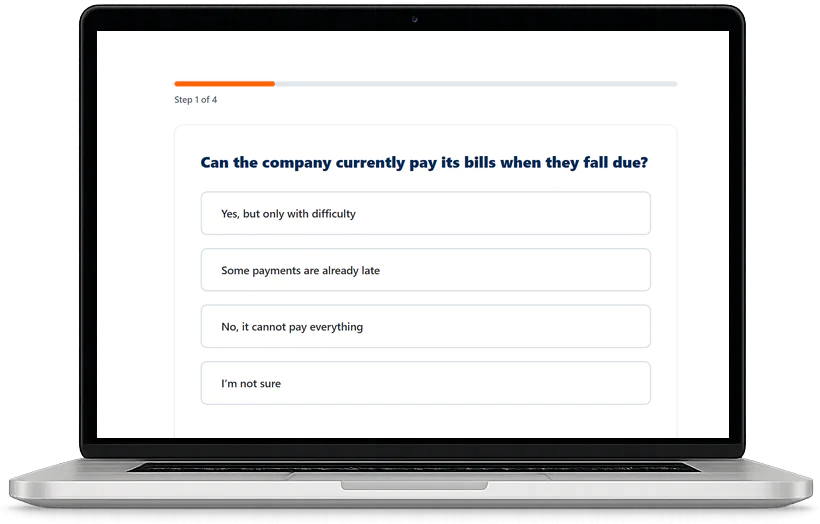
Could Your Company Be Insolvent?
Answer four short questions to see which warning signs apply, how serious the position may be and how soon you may need to act.
See which options may fit your company’s circumstances.
Check my company’s positionSee your result online and receive a copy by email. We only call if you ask.
Common Causes of Cash Flow Problems in UK Businesses
The causes repeat across almost every case we’re instructed on:
- Late-paying customers, the single largest source of small-business cash-flow distress. The Late Payment of Commercial Debts (Interest) Act 1998 entitles commercial creditors to charge 8% plus Bank of England base rate on qualifying late payments, a tool most small businesses under-use.
- Rising tax liabilities, VAT and PAYE payments that were affordable at old trading levels become unmanageable at contracted trading levels.
- Overhead growth outrunning revenue, staff, premises, or equipment commitments made on optimistic forecasts.
- Unexpected costs, equipment failure, compliance fines, lost key-person time, sudden supplier price increases.
- Concentrated customer risk, one customer representing 30%+ of revenue whose payment timing the business cannot influence.
Impact of Delayed Invoices
An invoice paid 45 days late on 60-day terms has consumed 105 days of your working capital. Multiply that across a full aged-debtor ledger and the gap between “profitable on paper” and “insolvent in fact” is exactly the size of your late-payment book. Disciplined credit control is the single largest lever your business has on its own survival.
Early Warning Signs Directors Must Not Ignore
The signals that a company’s cash-flow problem is material, in rough order of severity:
- Overdraft sitting at ceiling most months.
- HMRC correspondence shifting from reminder to formal.
- Rates or rent arrears accumulating.
- Supplier credit terms shortening or being withdrawn.
- Directors injecting personal cash to fund payroll.
- A statutory demand received from any creditor.
Any one of these is a reason to look at your forecast. Two or three together is a reason to instruct a licensed insolvency practitioner for advice on your solvency position and your director duties.
Immediate Risks and Legal Consequences of Cash Flow Failure
Legal consequences escalate on a specific timeline once arrears are formalised:
- County Court Judgments obtained by creditors, 6 years on the company’s public credit record unless the debt is paid in full within one month of the judgment.
- Enforcement by bailiffs or Sheriff Officers, compliance fee £79, enforcement fee £247 plus 7.5% of the sum over £1,900 in England and Wales (fees from 1 May 2026); in Scotland, a 10% surcharge is added when a summary warrant is granted for public debts such as council tax or business rates.
- Statutory demand, an undisputed debt of more than £750 that is not paid, secured or settled within 21 days lets the court treat the company as unable to pay its debts.
- Winding-up petition, payments made after the petition is presented can be void under section 127 of the Insolvency Act 1986, so banks usually freeze the company’s accounts once the petition is advertised in The Gazette.
- Compulsory liquidation, court-ordered wind-up where the petition succeeds. In England and Wales, directors lose control, the Official Receiver is appointed and director conduct is reviewed.
Each stage narrows your options. The restructuring window for a CVA or administration closes sharply once a petition is advertised in The Gazette. Banks usually freeze the company account at that point (section 127 can make payments void from the date the petition was presented), and payroll on the Friday then needs a court validation order, not a phone call to the bank.
Directors who pick up the statutory demand the week it lands still have a CVA or administration open to them. The ones who leave it in the in-tray until the petition is served usually discover the choice has been made for them.
Informal Cash Flow Solutions Before Formal Insolvency
Where the cash-flow pressure is recoverable without formal process, the useful tools:
- HMRC Time to Pay, structured arrangement to repay tax arrears over 6–12 months. Accepted where the arrears are a one-off and future compliance is credible.
- Creditor negotiation, specific, dated, written payment plans offered with immediate partial payment. Suppliers and landlords routinely accept where the alternative is formal enforcement.
- Short-term finance, overdraft extension, invoice finance, asset finance. Useful only where the underlying business is viable.
- Business restructuring, cost reduction, contract renegotiation, strategic change. The earliest and cheapest intervention where the business is structurally sound but operationally stretched.
Formal Insolvency and Rescue Options
When informal solutions are insufficient, four formal routes address the position:
- Company Voluntary Arrangement (CVA), binding agreement to repay creditors a percentage over 3–5 years while continuing to trade. Requires approval from at least 75% by value of the creditors who vote, and it fails if more than half, by value, of the unconnected creditors who vote are against it.
- Administration, statutory moratorium while administrator pursues rescue or sale.
- Creditors’ Voluntary Liquidation (CVL), orderly wind-down where rescue is not viable.
- Members’ Voluntary Liquidation (MVL), solvent closure where the company can pay all debts; typically on retirement or exit.
The choice depends on whether the underlying business is viable if historic debt is restructured. A licensed IP answers that question from the management accounts in an hour.
Directors’ Duties and Personal Liability on Cash Flow Problems
Once insolvency is likely, director duties shift. The routes to personal liability that matter:
- Wrongful trading under section 214, personal contribution to losses caused by continuing to trade after there was no reasonable prospect of avoiding insolvent liquidation or administration.
- Fraudulent trading under section 213, carrying on with intent to defraud creditors.
- Misfeasance under section 212, misapplying company money or property, or breach of any fiduciary or other duty to the company.
- HMRC Personal Liability Notices, unpaid NICs transferred to director personally where non-payment is attributable to fraud or neglect.
- Director disqualification under the Company Directors Disqualification Act 1986, 2 to 15 years.
Documented contemporaneous advice from a licensed IP is the single best defence against these routes. If you take advice while the business is still trading, your options remain open; directors who wait until the petition has been advertised have closed most of them.
Costs and Financial Consequences of Cash Flow Failure
The direct costs compound quickly:
- HMRC interest at 7.75% on late corporation tax (current rate; tracks Bank of England base rate plus 4%).
- HMRC penalties for a late company tax return (£200, rising to £400 if more than three months late), plus 10% of the unpaid tax if the return is still outstanding 18 months after the end of the accounting period (20% if it is more than two years after).
- Supplier late fees and credit-reference damage.
- Court fees and enforcement costs on each creditor action.
- Professional fees on formal insolvency, a CVL for a small company typically £3,000–£6,000 in IP fees.
The indirect costs are often larger: loss of key staff, loss of key customers, reputational damage, director time absorbed in firefighting. Each compounds the original cash-flow problem.
Your Next Step on Company Cash Flow Problems
Cash-flow problems are almost always solvable if addressed early and decisively. The consistent pattern across businesses that recover is not financial wizardry; it is disciplined engagement with your numbers, open communication with creditors, and timely professional advice.
Our licensed insolvency practitioners and business rescue specialists can assess the position in an hour, outline both informal and formal options, and provide the documented advice that protects both the business and the director’s personal position. Call us free on 0800 074 6757 for confidential advice.
Not Sure Where Your Company Stands?
Use the two-minute test to check the warning signs and see how soon you may need to act.
Check my company’s positionEstimates are fineWe only call if you ask us to
FAQs on Company Cash Flow Problems
How do I know if my company is insolvent?
Apply the two tests in section 123 of the Insolvency Act 1986. Cash-flow: can the company pay debts as they fall due? Balance-sheet: do total liabilities (including contingent) exceed total assets? Failing either is insolvency. Persistent missed tax, rent, supplier or payroll obligations fail the cash-flow test directly.
Can a profitable company be cash-flow insolvent?
Yes. And it is a common pattern. Profit is an accrual concept; cash flow is a timing concept. A company can be profitable on the P&L while being unable to pay its debts as they fall due, because the customers owe money that has not yet arrived. Most insolvent businesses were profitable within the previous 12 months.
Does HMRC automatically agree to Time to Pay?
No. HMRC grants Time to Pay where the arrears are a one-off, future compliance is credible, and the proposed schedule is realistic. Serial applicants, businesses with a history of breaching previous TTP agreements, and proposals that do not fit current HMRC policy are declined. Early application, with supporting cash flow evidence, has the best success rate.
What happens if I ignore a CCJ or statutory demand?
CCJs enable enforcement (bailiffs, charging orders, third-party debt orders). Statutory demands, unpaid for 21 days, enable winding-up petitions. Ignored, both lead to mechanical escalation: enforcement fees, frozen bank accounts on petition advertisement, loss of director control on compulsory liquidation. Respond, paying, disputing, or negotiating, before day 21.
Are government-backed loans still available to help with cash flow?
The main COVID-era schemes (Bounce Back Loan Scheme, CBILS) have closed to new applications. The Recovery Loan Scheme closed to new applications in June 2024. Its successor, the Growth Guarantee Scheme, offers lending with a partial government guarantee. Check current gov.uk guidance for the scheme in force in your reference year.
Any scheme borrowing creates commitments of its own and should be part of a broader financial plan for your business, not a substitute for one.