Can’t Pay Business Loans? Legal Risks, Director Liability & Solutions Explained




Business loan defaults rarely arrive in isolation. By the time the standing order has bounced twice and the relationship manager has moved to “can we schedule a call this week”, the cash flow has usually been tightening for six to nine months. The loan is the visible symptom, not the cause.
This page sets out what happens when your limited company cannot meet its business loan repayments, the enforcement path, the specific personal-liability risks (mainly through personal guarantees rather than the loan itself), and the negotiation, restructuring, and formal-insolvency options available to you at each stage of distress.
Recognising the Early Signs of Business Loan Default
The signals that the loan is on a trajectory to default usually show up weeks or months before the first formal missed payment:
- Covenant breach on debt-service cover ratio (typically 1.25x on commercial facilities). Technical default often precedes payment default by a full quarter.
- Relationship manager proactively suggesting review. Banks almost always signal concern before they act.
- Other essential creditors being delayed to protect the loan payment. Rates, suppliers, and VAT slipping.
- Directors injecting personal funds to cover payments.
- Reliance on the overdraft facility sitting at ceiling.
Any one is a reason to forecast your next 90 days. Two or more together is a reason to open the conversation with your lender before the formal default notice arrives. In our experience, directors who raise the issue proactively get materially better terms than those who wait for the demand.
Could Your Company Be Insolvent?
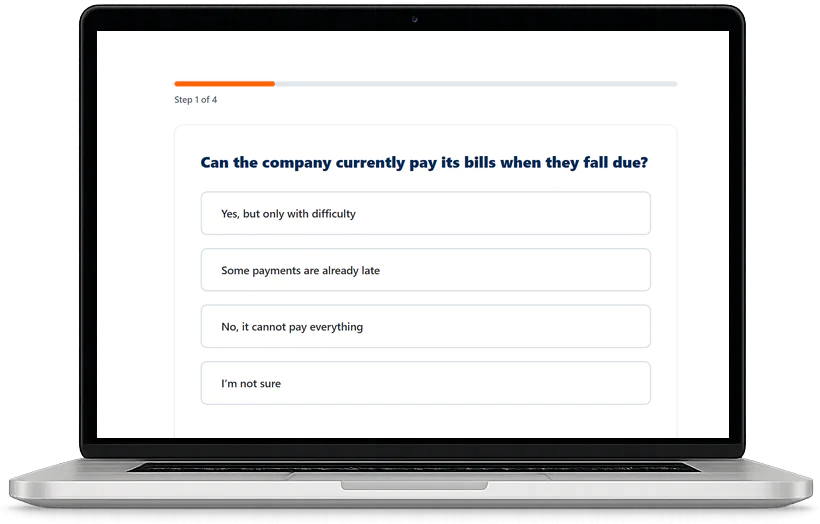
Answer four short questions to see which warning signs apply, how serious the position may be and how soon you may need to act.
See which options may fit your company’s circumstances.
Check my company’s positionSee your result online and receive a copy by email. We only call if you ask.
What Happens When You Default on a UK Business Loan
The lender’s recovery toolkit depends on the facility structure. For a standard unsecured commercial loan:
- Default notice under the loan agreement, giving a period (typically 14–30 days) to remedy the breach.
- Acceleration, the lender declares the full outstanding balance immediately due.
- Formal demand for repayment, often accompanied by a pre-action letter from the lender’s solicitors.
- County court claim for the debt. Judgment in default if the company does not defend.
- Statutory demand, for debts over £750. If the company does not pay, secure or settle the debt within 21 days of the demand being served, it is treated as unable to pay its debts.
- Winding-up petition where the presumption is not rebutted. Once the petition is advertised in The Gazette, the bank will usually freeze the company’s accounts, because payments made after the petition can be void unless the court approves them.
For secured loans (typically over £100,000, or anything secured on specific assets), the lender has additional direct-enforcement routes: realisation of security, appointment of a receiver, or, for a qualifying floating-charge holder, out-of-court appointment of an administrator under Schedule B1 of the Insolvency Act 1986.
Director Liabilities and Personal Guarantees on a Business Loan
A business loan is a company debt. Limited liability is the default. Personal liability arises through specific, enumerated routes, not through the loan itself.
- Personal guarantees on the loan, the most common route. Commercial banks routinely require PGs on loans to smaller companies and first-time borrowers. Facility-specific vs all-monies wording matters enormously: an all-monies PG given on one facility can be called on any other debt the company owes the same lender.
- Secured personal assets, a charge over the director’s property (family home, second property) pledged as collateral.
- Wrongful trading under section 214, a court order to contribute personally where the company kept trading after you knew, or ought to have concluded, that there was no reasonable prospect of avoiding insolvent liquidation or administration.
- Fraudulent trading under section 213, a court order to contribute personally to the company’s assets, with no fixed limit, where the business was carried on with intent to defraud creditors.
- Misfeasance under section 212, including preference payments where a connected-party creditor (often the director’s own loan account) was paid ahead of the lender.
The first two sit on your loan documentation. The last three sit in conduct. Both need review as soon as default is in view for your company.
Practical Options to Manage Unmanageable Business Loan Debt
Where the underlying business is viable but the loan service is temporarily unaffordable:
- Renegotiate with the existing lender. Term extension, interest-only period, temporary payment holiday, covenant reset. Lenders almost always prefer a continuing loan on modified terms to enforcement; the economics of forbearance vs recovery favour forbearance in most cases.
- Refinance with a new lender. Challenger banks and specialist commercial lenders often price aggressively for refinance business. Typically takes 8–12 weeks and may attract early-repayment fees on the existing loan.
- Consolidate multiple facilities. Where the company carries a loan, overdraft, invoice finance, and asset finance, consolidation into a single secured facility can reduce total debt service and simplify covenant management.
- Asset-based refinancing. Sale-and-leaseback on equipment, property, or vehicles can release capital to pay down the loan, at the cost of an operating lease going forward.
- Structured debt restructure. Where multiple creditors are involved, business restructuring through a coordinated informal agreement can reset the debt profile across the board.
Each of these preserves your limited-liability shield. They work only where the underlying trading business can support the revised debt service. Restructuring a loan on top of a structurally loss-making business buys time without solving your problem. We see this pattern often; the restructure question and the viability question need to be answered together.
When to Seek Professional Insolvency Advice on a Business Loan
The triggers for a licensed insolvency practitioner conversation:
- Default notice received and cannot be remedied within the cure period.
- Lender has accelerated the debt or issued a statutory demand.
- Multiple creditor pressures (loan plus PAYE plus VAT plus supplier arrears).
- Personal guarantee exposure is material and the company position is deteriorating.
- Director is considering personal injection of funds to cover payments.
The formal routes available when informal options are exhausted:
- Company Voluntary Arrangement (CVA), binding 3–5 year repayment plan with unsecured creditors (secured loans sit outside unless the secured creditor agrees).
- Administration, statutory moratorium, rescue or sale of the business.
- Creditors’ Voluntary Liquidation (CVL), orderly wind-down where the business is not viable.
A CVL deals with the company’s liability on the business loan: the company’s assets go to its creditors, and the unpaid balance falls away when the company is dissolved. A secured lender can still enforce its security, and the liquidator will review the directors’ conduct.
A CVL does not close out a personal guarantee; the PG remains a personal debt and is pursued separately by the lender against your personal assets. If your loan carries a PG, this needs parallel planning before you enter any formal process.
Your Next Step on Business Loan Default
Two early questions determine everything that follows. First: what does your loan documentation say about personal guarantees and security? Pull your loan file before having the conversation. Second: is your underlying business viable if the loan service is restructured? That is the question a licensed IP answers from your management accounts in an hour.
The pattern we see most often: directors who inject another £30k of personal savings to cover two more repayments, buy three months, and are back in the same meeting with the same lender, minus the £30k. Propping up an unviable debt structure rarely buys time in any useful sense.
Our licensed insolvency practitioners and business rescue specialists can assess the position, explain the negotiation, restructuring, and formal-insolvency options, and handle any personal-guarantee exposure in parallel with the corporate position. Call us free on 0800 074 6757 for confidential advice.
Not Sure Where Your Company Stands?
Use the two-minute test to check the warning signs and see how soon you may need to act.
Check my company’s positionEstimates are fineWe only call if you ask us to
FAQs on Business Loan Arrears
Is there a difference between a CVA and a CVL?
Yes, and the difference is structural. A CVA is a rescue mechanism, the company continues to trade while paying creditors a percentage over 3–5 years. A CVL is a closure mechanism, the company ceases trading, assets are realised, proceeds distributed to creditors, and the company is dissolved. A CVA keeps the business; a CVL ends it.
Can limited company directors be held personally liable for an unpaid business loan?
Not by default. A company business loan is a company debt. Personal liability arises through specific routes: personal guarantees on the loan (common on smaller facilities), charged personal assets, wrongful trading, fraudulent trading, or misfeasance. Review the loan documents and the conduct picture, both determine whether personal exposure is real in the specific case.
How quickly can creditors move to wind up the company for an unpaid loan?
From first formal default to petition typically runs 60–120 days, but the timeline compresses where security is involved. A secured lender can appoint a Law of Property Act receiver within days of default on a charged asset, without any court hearing. Unsecured lenders work through statutory demand and petition, which takes longer but produces a similar outcome.
What if the loan was a Bounce Back Loan or a government-backed scheme loan?
Bounce Back Loans to limited companies were advanced without personal guarantees, so directors are not personally liable for them. The exception is misuse: if the money was used for a non-business purpose, a liquidator or the Insolvency Service can pursue the director personally.
For CBILS loans over £250,000, lenders could take a personal guarantee, but recovery under it was capped at 20% of what was still owed after the business’s assets had been applied. Recovery Loan Scheme terms varied by phase. Check the specific loan documentation, scheme rules vary and have changed over time.
Could I face criminal charges for unpaid business loan debts?
Not for the inability to pay itself, default is a civil matter. Criminal exposure arises from specific conduct: fraud on the loan application (Fraud Act 2006), the criminal offence of fraudulent trading (section 993 of the Companies Act 2006), or misappropriation of loan funds. Ordinary business failure, honestly conducted, does not create criminal exposure.
Is it ever too late to seek help on a business loan default?
Rarely. The menu of options narrows over time, informal restructure becomes formal insolvency; CVA becomes administration; administration becomes compulsory liquidation, but some option exists at almost every stage until the company is formally wound up.
Even after a winding-up petition is advertised, administration can be invoked with the court’s leave. The earlier your intervention, the better your options; but the worst outcome is inaction, not late action.
What if the lender will not agree to a repayment plan?
Two alternative routes. First, refinance with a different lender, moves the problem rather than solving it, but sometimes opens better terms for your business.
Second, enter a formal process. An approved CVA binds unsecured lenders to its terms, but it cannot stop a secured lender enforcing its security without that lender’s agreement. Administration pauses enforcement while the business is rescued or sold.
The presence of a licensed IP in our conversation with the lender often changes their position before the formal process becomes necessary.