Can I Use a CVA to Close a Company?




The management accounts are open on the kitchen table. Suppliers are sending final demands. Someone has mentioned a CVA as a way to draw a line under it all and walk away. Here is the honest answer: a Company Voluntary Arrangement is a rescue tool, not a closure tool, and using it to close a company is not just the wrong choice. It can actively make your position worse.
If your goal is to close the doors for good, you need a different route. The genuine alternatives are Creditors’ Voluntary Liquidation, Members’ Voluntary Liquidation, or voluntary strike-off, depending on whether the company is solvent and whether debts remain. We walk through each one below and explain which fits your situation.
Can You Use a CVA to Close a Company? At a Glance
Quick Answer: Can You Use a CVA to Close a Company?
No, not as a closure strategy. A Company Voluntary Arrangement (CVA) is a formal insolvency procedure under the Insolvency Act 1986, ss. 1-7B, designed to let a viable business repay its debts over time while continuing to trade.
It keeps the company on the register, keeps directors in control, and requires creditors to vote. At least 75% by value under s.4(6) IA 1986 must approve before it takes effect. Dissolution does not happen at the end of a CVA: the arrangement completes, and if the business survives, it carries on.
If your goal is closure, you are looking for a Creditors’ Voluntary Liquidation, a Members’ Voluntary Liquidation, or voluntary strike-off under Companies Act 2006 s.1003, depending on whether the company is insolvent and whether debts remain. We work through each route below.
When Using a CVA to Close a Company Becomes a Risk
The risk is not just procedural. If you enter a CVA knowing the business cannot realistically trade its way back, you may be continuing to trade when you knew, or ought to have known, there was no reasonable prospect of avoiding insolvent liquidation.
That is the wrongful trading territory under s.214 IA 1986, and a later liquidator can ask a court to order you to contribute to the company’s losses personally. A CVA that fails does not produce a clean exit.
It produces a company that has burned further creditor goodwill, incurred IP fees for proposal preparation and supervision, and then enters liquidation anyway. At that point your conduct during the CVA period comes under fresh scrutiny.
Main Director Risk in Choosing a CVA Over a Closure Route
The wrong tool does not just waste time and money. Choosing a CVA when closure was the only realistic outcome delays the moment when your duty to prioritise creditors kicks in clearly.
Every week the company continues trading while technically insolvent is a week of potential exposure. The creditor who served a statutory demand last month is not going to become friendlier if you spend six weeks preparing a CVA proposal that creditors then reject.
What to Do Next if You Want to Close Your Company
If you have already decided the business cannot continue, speak to a licensed Insolvency Practitioner about a Creditors’ Voluntary Liquidation. If you are still unsure whether recovery is genuinely possible, that same conversation will tell you more than any amount of reading.
We recommend getting that advice before the creditor pressure forces the decision for you.
How Serious Is Your Company’s Position?
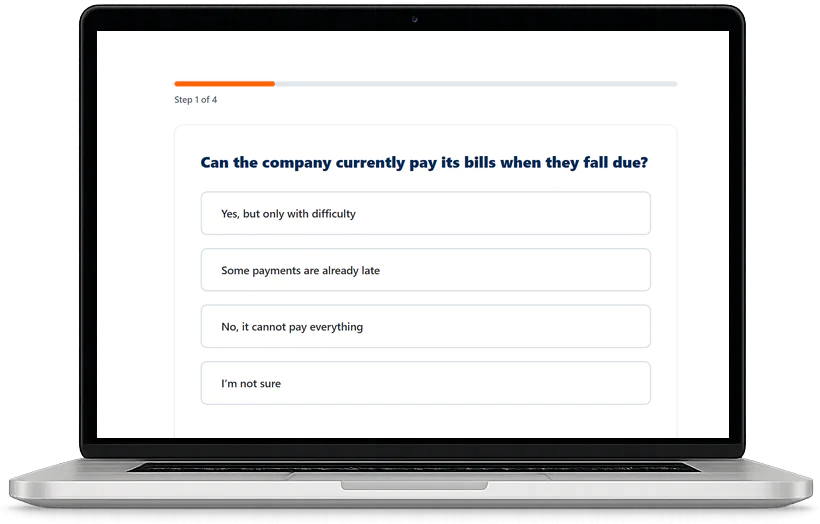
Answer four short questions to see how urgent the situation may be and which options could fit your company’s circumstances.
Check my company’s positionSee your result online and receive a copy by email. We only call if you ask.
Can You Actually Use a CVA to Close a Company?
Legal Position on Using a CVA to Close a Company
A CVA does not close a company. Under Part I of the Insolvency Act 1986, a CVA is an arrangement between a company and its creditors to satisfy or modify the company’s debts, while the company continues to exist and trade.
The Insolvency Practitioner acts as nominee to the arrangement and then supervisor once creditors approve it. The company remains on the Companies House register throughout. No dissolution order is made. No assets are distributed to creditors in the way a liquidation distributes them.
When the arrangement ends, typically after three to five years, the company has either repaid the agreed proportion of its debts and continues trading, or it has failed to meet contributions and enters liquidation.
Either way, a CVA is not a mechanism for closing a company. The law does not use it that way, and attempting to use it that way will produce an outcome neither you nor your creditors will be satisfied with.
When a CVA May Be Appropriate for a Struggling Business
There is a narrow set of circumstances in which a CVA genuinely helps a director under pressure.
If your business has a core trading activity that generates real revenue, a creditor relationship that is straining because of a specific short-term problem, and a realistic cash flow forecast showing the company returning to surplus within a reasonable period, then a Company Voluntary Arrangement can buy the time to make that work.
The phrase “realistic cash flow forecast” is doing a lot of work there. Not optimistic. Not best-case. Realistic. If the management accounts have shown losses for four consecutive quarters and the order book is thinning, that forecast does not exist.
We have reviewed enough CVA cases to know that the ones which succeed share one characteristic above all: there is a viable core business underneath the debt. Strip the debt away and the business works. If you cannot say that honestly, a CVA is the wrong answer.
When Using a CVA to Close Creates the Worst of Both Worlds
Here is the trap that catches directors who come to a CVA looking for an exit route. A CVA can lead to closure, but only if it fails. And a failed CVA is the most expensive route to liquidation you can take.
You pay a nominee fee to prepare the proposal. You pay supervision fees while contributions are made. Creditors are bound by the arrangement during that period, so they cannot chase individually. But if the company cannot meet contributions, the supervisor terminates the CVA and the same creditors, now even more frustrated, can petition for winding up.
The £352 court fee for a winding-up petition and the £2,600 Official Receiver deposit for a creditor petition are waiting at the end of that road. The CVA bought delay, not resolution.
Director conduct during the CVA period is now reviewable: every decision about which creditors got paid, whether new credit was taken. That is the worst of both worlds, and it is avoidable if you make the closure decision cleanly at the start.
Risks Linked to Using a CVA Instead of a Proper Closure Route
Wrongful Trading Risk Under s.214 IA 1986
Once a director knows, or ought to know, that there is no reasonable prospect of avoiding insolvent liquidation, the duty under s.214 IA 1986 is to take every step to minimise potential losses to creditors.
A director who uses a CVA to delay that moment, knowing internally that recovery is not realistic, is not minimising losses. They are extending the period in which losses accumulate. A later liquidator will look at when you first had grounds to know insolvency was inevitable.
If that date is before the CVA proposal was filed, the period of IP fees, continued supplier credit, and HMRC arrears that accumulated during the arrangement all become part of the picture. You need that conversation with an IP before you commit to any process, not after.
IP and Creditor Scrutiny if the CVA Fails
A failed CVA is not a neutral event in the company’s history. When the supervisor terminates the arrangement and the company enters liquidation, the liquidator’s conduct report will cover the period before and during the CVA.
If the CVA proposal contained projections that were not grounded in evidence, or if the company continued incurring credit obligations that it could not reasonably expect to repay, those facts are now part of the record.
The directors we see come through a failed CVA cleanest are the ones who pushed back on optimistic projections at the proposal stage, kept detailed board minutes, and raised concerns formally when trading deteriorated. Your paper trail during a CVA is not an afterthought.
Personal Guarantee Exposure During a CVA
A CVA binds unsecured creditors included in the arrangement. It does not extinguish personal guarantees. If you personally guaranteed a bank loan, a landlord lease, or a supplier credit line, that guarantee remains enforceable by the creditor regardless of the CVA terms, unless the creditor has explicitly agreed in writing to release it as part of the arrangement. Most do not.
Some directors assume a CVA will neutralise their guarantee exposure as part of the rescue process. It does not. For detail on how personal guarantees interact with formal insolvency procedures, see our guide to director guarantees in a CVA. If guarantee exposure is your primary concern, that guide is the starting point, not the CVA proposal itself.
What to Do Before Committing to a CVA to Close Your Company
Check Whether the Business Has Any Real Recovery Prospect
Sit down with the last three months of management accounts and ask one question with brutal honesty: if we removed all the legacy debt tomorrow, would this business generate enough cash to pay its current costs?
If the answer is yes, a CVA may be worth exploring with an IP. If the answer is no, or even “probably not”, then the rescue tool will not help, because there is nothing to rescue.
The supplier final-demand letter on your desk, the HMRC arrears from the last two VAT quarters, the Barclays account that hit zero on the last BACS run: these are symptoms. A CVA treats symptoms by deferring the underlying debt. If the underlying business cannot generate the cash to fund that deferral, the deferral just builds a bigger problem.
Review Which Closure Route Matches Your Company’s Solvency Position
The right closure route depends on whether the company is insolvent and whether it has any realisable assets. We look at each option in the next section.
Before that conversation with an IP, the most useful thing you can do is gather your most recent balance sheet, a list of creditors and amounts owed, and an honest view of what the company’s assets are actually worth if sold quickly rather than as a going concern.
Stock, equipment, receivables: what do they fetch in a distressed sale? An IP can work with that in a first meeting and tell you within an hour which route is realistic.
Get Advice Before the Creditor Pressure Escalates
A statutory demand from a creditor owed more than £750 starts a 21-day clock. A winding-up petition heard in court can restrict what you do with company assets from the date it is presented, not just the date it is heard.
Transactions entered into after that point can be challenged under s.127 IA 1986. The window for an orderly, director-controlled closure through CVL is open now. It starts narrowing the moment a creditor takes formal action. Early advice does not commit you to a particular process. It just means the decision is yours rather than a court’s.
Genuine Closure Options if a CVA Is the Wrong Tool
Creditors’ Voluntary Liquidation, the Standard Insolvent Closure Route
A Creditors’ Voluntary Liquidation is what most directors looking to close an insolvent company actually need. You instruct a licensed IP, shareholders pass a resolution under s.84 IA 1986 to wind up the company, and the IP becomes the liquidator.
Assets are realised, creditors are paid in priority order according to Schedule 6 IA 1986, and the company is eventually dissolved. Directors remain cooperative throughout but lose operational control once the liquidator is appointed.
A CVL is director-initiated: you control the timing, you choose the IP, and you can begin the process before a creditor forces your hand. Compulsory liquidation, by contrast, is initiated by a creditor through the court.
The Official Receiver steps in, not an IP of your choosing, and the investigation of your conduct is more intensive. Choosing a CVL while you still have the choice is almost always the cleaner outcome.
Members’ Voluntary Liquidation, if the Company Is Solvent
If the company can pay all its debts in full, including interest, within twelve months, it is solvent and a Members’ Voluntary Liquidation is available. Directors must swear a Declaration of Solvency before shareholders pass a winding-up resolution.
An IP is appointed as liquidator, realises the assets, pays all creditors, and distributes the surplus to shareholders. MVL is often used to extract retained profits tax-efficiently when a business has genuinely run its course rather than hit a debt crisis.
This route is only available where the solvency declaration is honest. Swearing a false Declaration of Solvency is a criminal offence.
Voluntary Strike-Off, for Dormant Companies with No Creditors
Voluntary strike-off under Companies Act 2006 s.1003 applies only where the company has ceased trading, has no outstanding creditors, no pending litigation, and no contingent liabilities. Directors apply to Companies House to have the company dissolved. Creditors can object during the three-month notice period if debts remain.
Strike-off is not a route for insolvent companies. If the company owes money to HMRC, suppliers, or employees, those creditors can and will object to the application. Using strike-off to escape debts without addressing them is misfeasance and can result in the company being restored to the register, with directors facing personal claims.
Pre-Pack Administration, if There Is a Business Worth Selling
A pre-pack administration is worth considering if there is a viable core business, a customer base, contracts or a brand, that can be sold as a going concern even though the current company structure cannot survive. The administrator markets the business and completes the sale immediately on appointment.
The old company enters administration and then liquidation; the new entity carries on the good parts of the business. Pre-pack is not a back-door way to shed debts and reopen under a new name without scrutiny.
That misuse is precisely what the pre-pack regulations target. It requires a specialist IP and a demonstrable case that the outcome is better for creditors than a straight CVL. For a side-by-side comparison, see our CVA vs liquidation guide.
Your Next Step, the Honest Verdict on Using a CVA to Close
The misconception that a CVA can close a company is one of the most common and most costly misunderstandings we see. It costs time, IP fees, and in the worst cases it extends the period of director exposure rather than ending it.
Here is the split. If your business has a genuine trading core that can cover a repayment plan once the legacy debt is restructured, a CVA is worth a serious conversation with a licensed IP. Read our page on CVA pros and cons and our guide to what happens when a CVA fails before that meeting.
If your goal is simply to close and you know recovery is not realistic, a CVA will delay the inevitable at extra cost while your personal exposure continues to accumulate. The right step is a direct question to a licensed IP: is there a viable business here, or should we move to CVL?
That conversation is confidential, it does not commit you to anything, and the answer will be more useful than any further reading. We recommend getting it before a creditor takes the decision out of your hands.
Check How Serious the Position May Be
Answer four short questions to see how urgent the situation may be and which broad options could fit.
Check my company’s positionEstimates are fineWe only call if you ask us to
Frequently Asked Questions About Using a CVA to Close a Company
1) Does a CVA automatically close a company when it ends?
No. When a CVA completes successfully, the company is released from the debts dealt with under the arrangement and continues trading. Dissolution does not happen automatically.
If you want to close the company after a successful CVA, you would need to initiate a separate process: Members’ Voluntary Liquidation if the company is then solvent, or CVL if debts have accumulated again.
2) Can a CVA write off debts and then let me close the company?
In theory a CVA can compromise debts, after which the company could be wound up voluntarily. In practice, using a CVA purely to reduce the debt load before closure is expensive and unlikely to attract creditor support. Creditors vote on the proposal knowing the company intends to continue trading.
If they suspect the arrangement is a precursor to closure, they have strong reasons to reject it and push for immediate liquidation instead. A direct CVL is almost always cheaper and cleaner if closure is the actual goal.
3) What percentage of creditors need to approve a CVA?
At least 75% by value of creditors who vote must approve the proposal (s.4(6) Insolvency Act 1986). The proposal must also not be opposed by more than 50% by value of unconnected creditors who vote.
If HMRC or a major supplier is owed a large proportion of the total debt, their vote alone can decide the outcome. This is one of the reasons CVAs are fragile when creditor relationships are already strained.
4) If my CVA fails, does the company automatically go into liquidation?
Not automatically, but it is the most common outcome. When a CVA is terminated by the supervisor, creditors regain their ability to pursue individual enforcement. They can then apply for a winding-up order through the court, or directors can initiate a CVL.
A failed CVA does not prevent a director from cooperating with creditors to pursue an orderly CVL, but the negotiating position is weaker and the costs already incurred on the CVA cannot be recovered. See our full guide to what happens when a CVA fails for the full picture.
5) What is the difference between a CVA and a Creditors’ Voluntary Liquidation?
A CVA keeps the company alive and trading while restructuring its debts over several years. Directors remain in control and the company stays on the register. A Creditors’ Voluntary Liquidation ends the company: assets are realised, creditors are paid in order, and the company is dissolved.
CVL is the appropriate route when closure is the goal and the company cannot pay all its debts. The two procedures have different purposes, different costs, and different outcomes for directors and creditors. For a side-by-side breakdown, see our CVA vs liquidation comparison.
6) Can I use voluntary strike-off if the company still has debts?
No. Voluntary strike-off under Companies Act 2006 s.1003 requires the company to have ceased trading and have no outstanding liabilities. If the company has creditors, including HMRC arrears, supplier invoices, or bank debt, those creditors can object to the application during the three-month notice period.
Using strike-off to avoid paying debts is treated as misfeasance, and the company can be restored to the register with directors facing personal liability claims. If the company has debts, a formal insolvency procedure such as CVL is the appropriate route.
7) Does a CVA protect directors from wrongful trading claims?
No. A CVA does not extinguish potential wrongful trading liability under s.214 IA 1986. If the company later enters liquidation, whether because the CVA fails or for any other reason, the liquidator will review director conduct from the point at which the company became insolvent.
If a director pursued a CVA knowing recovery was not realistic, that decision may itself be treated as a failure to minimise creditor losses. The existence of a CVA does not create a shield. Honest, documented decision-making does.