What are the Advantages and Disadvantages of a CVA?




The management accounts are open on the kitchen table. The overdraft is maxed and the HMRC arrears letter arrived last Tuesday. A Company Voluntary Arrangement is one way through this.
Whether it is the right way through depends on your company’s specific position, your creditor mix, and whether your business can sustain five years of structured repayments under supervision.
A Company Voluntary Arrangement lets a trading-but-indebted company restructure what it owes to unsecured creditors over an agreed period, typically three to five years. Directors keep control. The company keeps trading.
None of that comes without cost. You need to understand what you are committing to before 75% of your creditors vote your company into a binding arrangement, and we set out the trade-offs below from the cases we see weekly.
CVA Advantages and Disadvantages at a Glance
Quick Answer: CVA Advantages and Disadvantages
The principal advantage of a CVA is that your company survives a debt crisis without liquidation.
Directors retain control, the business keeps trading, and unsecured creditors are bound by the arrangement once the 75% threshold is reached under sections 1 to 7B of the Insolvency Act 1986.
The principal disadvantage is that you are committing your company to years of supervised repayment. If the plan breaks down, you face liquidation from a weaker financial position than you started.
When a CVA Pros and Cons Assessment Applies
You need this assessment when your company has a viable core business with ongoing revenue, but has accumulated unsecured debt it cannot service from current cashflow.
If your company is simply insolvent with no realistic trading recovery, a CVA will not get past creditor approval. In that case, you should be looking at liquidation options rather than restructuring.
Main Risk in the CVA Advantages and Disadvantages Decision
The main risk is entering a CVA on projections that are too optimistic. We review cases where directors agreed to monthly CVA payments that left no room for a slow quarter, a key customer leaving, or a rate rise.
When the plan breaks, the insolvency practitioner notifies creditors and the CVA terminates.
At that point you face what happens when a CVA fails: usually creditor-led liquidation, with the additional problem that you have spent two years paying into a failed arrangement.
What to Do Next About CVA Advantages and Disadvantages
Get a solvency assessment from a licensed insolvency practitioner before you commit. The assessment is usually free and will tell you whether a CVA is viable, what the realistic repayment level would be, and what alternatives exist.
Do not draft a CVA proposal before you have that conversation.
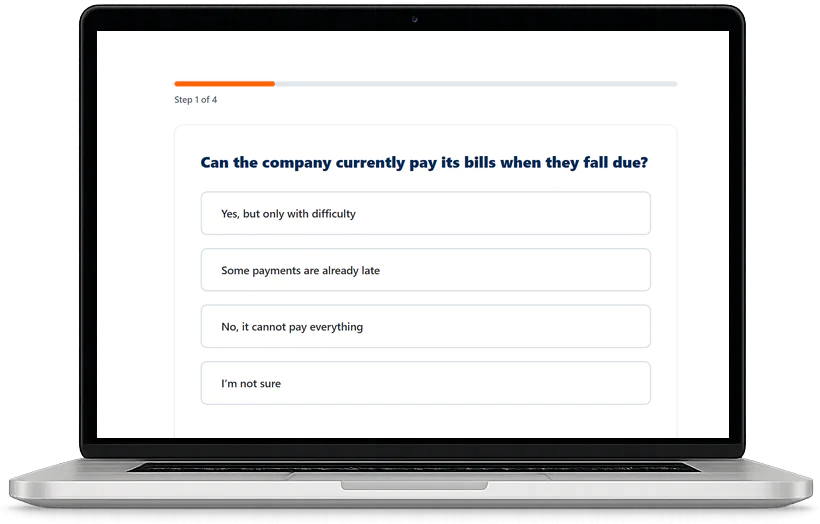
How Serious Is Your Company’s Position?
Answer four short questions to see how urgent the situation may be and which options could fit your company’s circumstances.
Check my company’s positionSee your result online and receive a copy by email. We only call if you ask.
What Are the Main Advantages of a CVA?
Directors Retain Control Throughout the CVA
In a CVA, you keep running the business. That is the sharpest contrast with administration, where an administrator takes over management and your authority as a director is effectively suspended.
Under a CVA you continue to sign contracts, manage staff, and make trading decisions. The insolvency practitioner acts as supervisor, not controller.
For you, that means staff do not find out from a third party. Your suppliers and customers deal with the same people. The business identity remains intact, which matters when your customer relationships are tied to specific individuals rather than the company registration number.
A CVA Freezes Unsecured Debt and Stops Interest Accruing
Once creditors vote to approve the CVA, the arrangement fixes the debt figure. Unsecured creditors cannot add further interest or charges to the amounts included in the CVA.
The Barclays business loan that was running at 8% stops compounding. The trade creditor invoices are locked at their current balance.
For a company that has been watching its total liability grow month by month, this matters: you now know exactly what you owe and exactly what each monthly payment covers.
A CVA can also allow your insolvency practitioner to exit onerous contracts, including leases, supplier agreements, and in some cases employment contracts, where those commitments are disproportionate to the company’s recovery needs.
The 75% Vote Binds CVA Creditors Who Voted Against
Under sections 1 to 7B of the Insolvency Act 1986, if creditors holding 75% in value of the voting debt approve the arrangement, all unsecured creditors are bound by its terms, including those who voted no.
That one trade creditor who wanted immediate payment cannot pursue a winding-up petition while the CVA is live. The moratorium that the arrangement creates gives your company breathing space that is impossible to replicate through informal negotiation alone.
We consider this the most practically significant advantage of a CVA over any informal workout.
Insolvency Practitioner Fees Are Included in the Monthly CVA Payment
Your insolvency practitioner’s fees are built into the agreed monthly repayment structure, not charged separately on top. You have one fixed monthly payment that covers both creditor distributions and professional fees.
There are no surprise invoices for supervisor time.
For a company managing cashflow tightly during recovery, the predictability of a single fixed outgoing is a real planning advantage: not because it is cheap, but because you can model your business around it with precision.
What Are the Main Disadvantages of a CVA?
A CVA Damages Your Company’s Credit Rating for Six Years
The CVA is registered at Companies House and appears on credit reference files. Your company’s credit rating will be affected for six years from the date the CVA is registered.
That means trade suppliers may switch you to cash terms. New finance facilities, such as invoice factoring, asset finance, or a replacement bank facility, will be harder or more expensive to access.
If your recovery plan depends on accessing credit during the CVA period, factor in that the CVA itself makes that harder.
Note what this does not affect: your personal credit rating as a director is not directly damaged by the company entering a CVA, unless you have given personal guarantees in the CVA. That distinction matters, but it does not eliminate the credit risk problem at company level.
Secured Creditors Are Not Bound by CVA Terms
A CVA binds unsecured creditors. It does not bind secured creditors. This is a gap that trips directors up.
If your company’s bank holds a fixed charge over your premises or a floating charge over all assets, the bank can still enforce independently.
HMRC, in its role as a preferential creditor following the Finance Act 2020 reinstatement of Crown preference, can still pursue preferential debts outside the arrangement.
If a significant portion of your debt sits with secured creditors, a CVA does not neutralise their position. The breathing space the 75% vote creates is real but limited in scope.
Some Creditors Will Oppose the CVA and Create Approval Risk
Creditors who prefer a faster resolution over the CVA’s multi-year repayment schedule may vote against the proposal or abstain.
That includes institutional lenders, trade creditors running their own cashflow pressures, and HMRC in cases where HMRC holds a significant share of the debt.
Under the Insolvency Rules 2016 Part 2, creditors can challenge a CVA in court within 28 days of approval if they believe the arrangement is unfairly prejudicial to their interests.
A court challenge does not automatically kill the CVA, but it adds cost, delay, and uncertainty to a process that already demands consistent performance over years.
The CVA Locks Your Cashflow for Three to Five Years
The monthly CVA payment is fixed. Your obligation to pay it does not flex with a quiet trading quarter.
Directors who enter CVAs with projections built on best-case revenue figures regularly find that a single below-par quarter creates a payment shortfall. The insolvency practitioner flags non-compliance. Creditors push for termination.
A CVA avoids liquidation today, but it pins your cashflow for the duration and locks in a level of financial scrutiny that many directors find operationally uncomfortable. That is not an abstract cost.
It is the reality of agreeing to be supervised.
Risks Linked to a CVA Proposal Failing
Director Risk if the CVA Collapses Before Completion
If the CVA fails partway through, the insolvency practitioner’s supervisor report goes to creditors and the company typically moves into liquidation.
The liquidator will review director conduct during the CVA period, not just the period before it began.
Directors who took excessive drawings during the CVA, continued trading without reasonable prospects, or made payments to connected parties during the arrangement face scrutiny under sections 212, 213
and 214 of the Insolvency Act 1986, in the same way as directors in any other liquidation.
The six months and two years preference lookback periods under section 239 of the Insolvency Act 1986 continue to apply. Payments made to connected parties during a failed CVA are examined closely by the liquidator.
Creditor and HMRC Risk if the CVA Is Rejected or Terminated
If creditors reject the initial CVA proposal, because the 75% threshold is not reached, the company loses its moratorium protection immediately. Creditors who had agreed to pause enforcement restart their actions.
HMRC can issue a winding-up petition.
The window to negotiate that the CVA process created closes, often faster than directors expect. Creditors become considerably less willing to negotiate once a formal proposal has failed.
We see this pattern regularly in the cases we handle: the director who had three months to act now has three weeks.
Personal Liability and Guarantee Exposure During CVA Failure
Where directors have given personal guarantees on company debts included in the CVA, those guarantees are not discharged by the CVA arrangement.
If the company fails to complete the CVA and the underlying debt crystallises, guarantee holders, typically banks and asset finance companies, will call on those guarantees.
The CVA protects the company from creditor action. It does not protect you from your personal guarantee obligations. Directors sometimes enter CVAs without understanding this distinction.
Our advice is to map your guarantee exposure before the proposal is finalised, not after.
What Directors Should Check Before Proposing a CVA
Check Whether the Business Can Genuinely Sustain CVA Repayments
Run twelve months of cashflow projections from the actual management accounts, not from memory. Work out what the monthly CVA payment would need to be to satisfy creditors at a level better than liquidation return.
That is the legal test the insolvency practitioner will apply.
Then stress-test that payment against a 15% revenue reduction scenario. If your company cannot service the CVA payment through a mediocre quarter, the arrangement is likely to fail.
We recommend asking the insolvency practitioner to run this stress test with you before the proposal is drafted, not after.
In our experience reviewing failed CVA cases, overstated projections at the proposal stage are the single most common cause of early termination.
Understand the Statutory Basis of the 75% CVA Creditor Vote
The voting threshold under sections 1 to 7B of the Insolvency Act 1986 is 75% in value of voting creditors. A single large creditor holding 26% or more of the unsecured debt can block the CVA by voting no.
Identify your largest creditors before you begin. If HMRC holds more than 25% of the unsecured debt and has indicated it will oppose the arrangement, the CVA will not pass without a modified proposal or additional concessions.
Your insolvency practitioner should conduct a pre-proposal creditor sentiment check as a standard part of the process.
Consider Whether Liquidation or Administration Is a More Realistic CVA Alternative
A CVA is not the right answer for every company with debt. If the business model is broken, not just overleveraged, a CVA extends the problem rather than solving it.
If the company has valuable assets but no trading future, our CVA versus liquidation comparison will usually point toward an orderly wind-down.
If the company needs immediate protection from secured creditor action, administration may be the right entry point, with a CVA considered after the administrator has stabilised the position.
Pre-pack administration is a distinct route worth understanding if asset value rather than debt restructuring is the objective.
Your Next Step
The directors who get value from a CVA have three things in common: a real trading recovery ahead of them, a cost base that has already been reduced, and creditor debt that is genuinely manageable over a three-to-five year payment schedule.
The directors who regret a CVA used it to buy time rather than to restructure. They entered on projections they knew were stretched, made payments for eighteen months, then missed one and watched the arrangement terminate.
Two years later: same liquidation, less cash, more scrutiny.
The real decision is not whether a CVA has advantages. It has several. The decision is whether your specific company, with your specific creditor mix, your specific cashflow, and your specific trading outlook, can complete one.
Get an insolvency practitioner to assess that before you commit. A conversation costs nothing. A failed CVA costs considerably more than going straight to an orderly wind-down would have done.
If you want to explore using a CVA to close a company rather than trade through, that is a different route with different criteria. Understand which question you are actually asking before you start.
Check How Serious the Position May Be
Answer four short questions to see how urgent the situation may be and which broad options could fit.
Check my company’s positionEstimates are fineWe only call if you ask us to
Frequently Asked Questions About CVA Advantages and Disadvantages
What is the main advantage of a CVA over liquidation?
What is the main advantage of a CVA over liquidation?
The main advantage is continuity. In a CVA, your company keeps trading, directors retain control, and employees keep their jobs. In liquidation, the company ceases to exist.
A CVA allows you to continue serving customers and building revenue, which is what funds the creditor repayments. Liquidation distributes whatever assets remain. A CVA creates a repayment stream from an ongoing business. The trade-off is that a CVA demands sustained performance over three to five years, whereas liquidation is a defined endpoint with a known cost.
Does a CVA affect the director personally?
Does a CVA affect the director personally?
A CVA does not directly affect your personal credit rating, provided you have not given personal guarantees on the debts included in the arrangement.
If you have given personal guarantees to a bank, an asset finance company, or a landlord, those guarantees are not discharged by the CVA. If the company fails to complete the CVA and the underlying debt is called in, guarantee holders can pursue you personally. Check your guarantee exposure before the proposal is finalised.
What happens if a CVA fails partway through?
What happens if a CVA fails partway through?
If your company misses payments and the insolvency practitioner certifies non-compliance, the CVA can be terminated. Creditors are notified and the amounts originally owed, less any payments already made, become live debts again.
Creditors can then pursue winding-up petitions or other enforcement. The liquidator appointed after a CVA failure will review director conduct during the CVA period as well as before it.
Directors who took excessive drawings, or who continued trading without reasonable recovery prospects, face scrutiny under the Insolvency Act 1986. See our guide on what happens when a CVA fails for the full picture.
Can HMRC block a CVA?
Can HMRC block a CVA?
HMRC can vote against a CVA proposal. If HMRC holds more than 25% of the voting unsecured debt, a no vote will block approval.
HMRC’s position is not fixed. It depends on the specific proposal, the company’s compliance history, and whether the CVA offers a better return to HMRC than liquidation.
HMRC also has preferential creditor status following the Finance Act 2020 reinstatement of Crown preference for VAT, PAYE, employee NIC, and CIS deductions. Those preferential debts sit above the CVA arrangement and must be addressed separately. Your insolvency practitioner should assess HMRC’s likely position before the proposal is drafted.
How long does a CVA last and what are the payment obligations?
How long does a CVA last and what are the payment obligations?
Most CVAs run for three to five years. During that period you make fixed monthly payments to the insolvency practitioner, who distributes funds to creditors in accordance with the agreed schedule. Your insolvency practitioner’s fees are included within those payments.
You cannot reduce or pause payments without creditor agreement. Doing so risks triggering non-compliance notices.
At the end of the CVA period, any remaining unsecured debt included in the arrangement is typically written off, giving your company a clean starting position. That write-off only happens if you complete the full arrangement. Partial completion does not trigger a proportionate write-off.
Is a CVA public knowledge?
Is a CVA public knowledge?
A CVA is registered at Companies House and appears on the public register. It will also appear on credit reference files for six years. Suppliers, customers, and lenders who run credit checks on your company will see the CVA.
There is no legal obligation to proactively notify clients or customers, but a credit search will disclose the arrangement.
The CVA is less public than administration or compulsory liquidation: there are no court hearings visible to the general public and no administrator appointed to manage the business. However, it is not a private process. Assume any party running due diligence on your company will find it.