How to Reduce Insolvency Risk




You’re profitable on paper. The last management accounts looked fine. Then a single customer went 60 days late, two suppliers asked for pro-forma instead of 30-day terms, and your bank is “reviewing” the overdraft at the next quarterly.
Nothing has actually broken yet. The question on most directors’ minds at this point is whether to ride it out or audit the position properly. Riding it out is what generates the personal liability six months later.
“Reducing insolvency risk” is two different jobs that almost every guide on this topic conflates. One is reducing the chance the company hits insolvency at all. The other is reducing what you, the director, are personally exposed to if it does.
They share some moves but not most of them, and the second job is the one nobody tells you about until the liquidator’s solicitor is already asking for board minutes.
This page separates the two and tells you what to actually do, in the order that matters.
Reducing Insolvency Risk at a Glance
Reducing insolvency risk in England and Wales is a board-level discipline built on three habits: a 13-week rolling cash-flow forecast updated weekly, a contemporaneous board-minute record of every material financial decision (your evidence for the s.214(3) IA 1986 defence that the board took every step to minimise creditors’ losses), and an early licensed-IP conversation as soon as the company nears the section 123 IA 1986 insolvency test. Most disqualification cases trace back to one of these three not being in place.
Quick Answer: Reducing Insolvency Risk
Run a 13-week rolling cashflow forecast, audit your trade-creditor and HMRC position monthly, and document every board decision that touches solvency.
The financial moves reduce the chance of insolvency. The documentation moves reduce your personal exposure if the company ends up there anyway. Both jobs need doing in parallel, because you don’t get to know in advance which one will save you.
Who Should Take Action on Insolvency Risk
Any director of a limited company in England and Wales where one or more of these is true: a single customer represents more than 25% of revenue, HMRC is owed more than one full quarter, debtor days have crept past 75, the bank has hinted at a facility review, or you’ve started watching the bank balance daily.
None of those mean the company is insolvent. All of them mean the work on this page should already be in motion.
Main Director Risk When Insolvency Becomes Real
Wrongful trading under section 214 of the Insolvency Act 1986. Once you ought to have concluded there was no reasonable prospect of avoiding insolvent liquidation, the court can order you to contribute personally to the company’s assets, usually measured by how much worse off creditors were left by the extra trading.
The court doesn’t ask whether you genuinely thought the company would recover. It asks what a reasonably diligent director in your role, knowing what you knew and what you ought to have found out, should have concluded. Documentation is what proves that line for you instead of against you.
What to Do Next About Reducing Insolvency Risk
Take our free insolvency test to see whether the company sits on the safe side of section 123.
If the test flags risk, book an unrecorded conversation with a licensed insolvency practitioner before you take on more credit, sign another personal guarantee, or pay one creditor ahead of others. We do those calls free and we don’t record them; the value is in the second opinion, not the eventual procedure.
Could Your Company Be Insolvent?
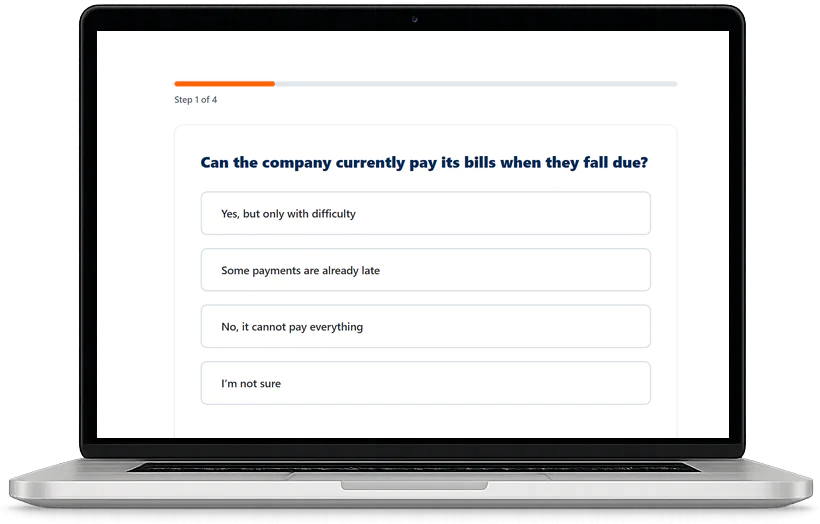
Answer four short questions to see which warning signs apply, how serious the position may be and how soon you may need to act.
See which options may fit your company’s circumstances.
Check my company’s positionSee your result online and receive a copy by email. We only call if you ask.
What “Reducing Insolvency Risk” Actually Means
The Two Different Risks: Commercial vs Personal Liability
Most articles on insolvency risk treat the topic as a financial-controls problem. Watch cashflow. Cut costs. Diversify customers. That’s correct, and it’s the wrong answer for the director who reads it three months too late.
Once a company crosses into the zone where insolvency is foreseeable, the controlling risk shifts from commercial to personal. The question is no longer “how do we save the company” but “how do we make sure the director doesn’t carry the loss when the company goes.”
The split matters because the two jobs need different work. Cashflow forecasting reduces commercial risk. Minuting a board decision about whether to keep trading reduces personal risk.
Cutting a loss-making product line reduces commercial risk. Taking written advice from an insolvency practitioner before signing a new personal guarantee reduces personal risk. Directors often do the first half well and neglect the second, yet the second half is where the large personal claims arise.
Cashflow vs Balance-Sheet Insolvency Tests
Section 123 of the Insolvency Act 1986 sets out two limbs that matter for this page. The cash-flow test asks whether the company can pay its debts as they fall due. The balance-sheet test asks whether liabilities, including contingent and prospective ones, exceed assets.
Failing either limb is enough. Most struggling companies fail the cash-flow limb first, because the balance sheet still carries goodwill, work in progress, or director-loan receivables that look real until you try to convert them.
“As they fall due” is the language that catches most directors out. It does not mean “when the creditor gets aggressive.” It means the contractual due date. PAYE on the 22nd (the 19th if paying by post). VAT one calendar month and seven days after the end of the VAT quarter. Supplier invoices on terms.
If you are routinely paying late on those, the test is already failing, even if every creditor is currently quiet about it. A polite creditor is not the same as a paid one.
When the “Reducing Risk” Frame No Longer Applies
There comes a point where the work changes from prevention to mitigation. Once a creditor has issued a winding-up petition, once HMRC has refused a Time to Pay, or once your accountant has used the word “insolvent” without the word “technically” in front of it, you are no longer reducing insolvency risk. You are managing an insolvency.
The advice on this page assumes you are upstream of that line. If you are not, our page on how to save a struggling business covers the triage work, and our dealing with creditor pressure page covers the immediate enforcement risk.
How to Assess Your Company’s Insolvency Risk
13-Week Rolling Cashflow Forecast
Thirteen weeks, not three months. Weekly columns, not monthly. The whole point is to see the gap before it arrives.
Annual budgets and monthly P&L do not catch a Wednesday in week seven where payroll lands the day before VAT lands and the receipts haven’t cleared yet. A weekly forecast does. Build it from receipts and payments, not accruals. If the model says you’ll be £40,000 short in week nine, that’s the date the work starts, not the date you panic.
Update it every Monday from actual bank balance and reconciled debtors. Save the file with a date in the name and keep the prior version. The version history is what proves later that the board was looking at the position in real time, not reconstructing it from memory after enforcement started. That sounds like paperwork. It is the difference between a defensible decision and an indefensible one.
Trade-Creditor and HMRC Position Audit
Run an aged creditor list monthly. Two columns matter most: anything over 60 days, and anything owed to HMRC. HMRC is the creditor that takes the longest to act and the hardest to negotiate with once it does.
A balance more than one full quarter old, with no agreed Time to Pay, is a strong early-warning signal. It almost always pre-dates the formal cashflow failure by three to six months.
Do a separate pass on whether suppliers have moved you to pro-forma, shortened your terms, or asked for personal guarantees on new orders. Each of those is a market signal that other businesses already think you’re a credit risk.
They tend to know before you do, because they’re running the same kind of forecast on you that you should be running on yourself. Our page on company cash flow problems goes deeper on the operational warning signs.
Director Personal Exposure Audit (PG, DLA, PLN)
Three exposures sit outside the corporate veil and are the ones that hurt if the company goes. Personal guarantees on bank facilities, supplier accounts, or commercial leases. Overdrawn director’s loan accounts, which become recoverable as a debt to the company in liquidation.
HMRC notices that make a director personally liable for company tax: personal liability notices for unpaid National Insurance caused by fraud or neglect, and joint and several liability notices or penalty transfers for PAYE and VAT where the conditions are met, for example deliberate conduct or repeated insolvency.
List all three on a single sheet with current balance, counterparty, and trigger event. Directors can underestimate this number, often because they’ve forgotten about a guarantee signed five years ago for a facility that’s since rolled over. The audit is uncomfortable. The alternative is finding out the number from a solicitor’s letter the week after appointment.
Warning Signs Linked to Rising Insolvency Risk
Trade Creditors Asking for Pro-Forma
When a long-standing supplier moves you off 30-day terms onto pay-before-shipment, they have either had a bad experience with you specifically or with a customer of similar profile. Either way, it tells you the credit insurance market has revised its view of your business.
Trade credit insurance is the quiet engine behind most B2B terms; once it withdraws, terms tighten across multiple suppliers in a short window. That cluster effect is the warning, not any single supplier’s decision.
HMRC Time-to-Pay Refused or Defaulted
HMRC will usually agree a Time to Pay if you ask early, with realistic numbers, before the debt has been passed to enforcement. Refusal at that stage, or default on an arrangement once granted, is a serious signal.
It moves the company into a category where HMRC’s next move is typically a winding-up petition rather than further negotiation. Once that escalation begins, the time available to act in any restructured form shrinks from months to days.
Bank Covenant Breach or Facility Review
If the bank schedules an unscheduled review, asks for additional information outside the usual annual cycle, or hints at moving you to a “specialist” relationship team, treat it as the bank telling you what it expects to do six months ahead.
Banks rarely act first; they act once they’re confident the file will support them later. A facility review is the file being prepared. The director who waits to be told the outcome has already lost two months of useful response time.
Director Documentation Discipline When Insolvency Is in Doubt
This is the section most generic guides never write, and it’s the one that decides whether the director walks away clean or carries the loss personally.
The Supreme Court in BTI 2014 LLC v Sequana SA [2022] UKSC 25 settled the timing: once directors know, or ought to know, that the company is insolvent or bordering on insolvency, or that an insolvent liquidation or administration is probable, they must have regard to the interests of creditors as well as shareholders.
As insolvency becomes more likely, that creditor regard becomes more weighted, until at the point of inevitable liquidation it eclipses the shareholder duty entirely. The doctrinal line is clear. The evidential line, proving when you knew and what you did, sits in the documentation.
Minute Every Board Decision About Solvency
If the board considers the cashflow position, that’s a minuted item. If a director raises concerns about whether to take on a new contract, a new facility, or a new customer with concentration risk, that’s minuted.
If you decide to keep trading after seeing the latest forecast, the reason (the contract you expect to land, the funding you expect to draw) is in the minute, with the date, who said it, and what evidence supported it.
Minutes are not bureaucracy. They are usually the strongest evidence a court will see of what the board actually thought at the time.
The minute that does not exist is the one that hurts most. A liquidator’s investigation that finds a six-month gap with no board record, while the company was clearly in distress, will read that gap as either negligence or evasion. Neither helps you.
Take Written Advice From an Insolvency Practitioner Before Each Major Trading Decision
Once the company is in the zone where insolvency is foreseeable, every significant decision (drawing more debt, signing a new lease, accepting a new contract that materially changes the cashflow shape) should be taken on the back of written advice from a licensed insolvency practitioner.
Not your accountant. Not your solicitor in passing. A licensed practitioner whose advice can be produced later as evidence the board did not act blind.
You don’t have to follow the advice. You do have to be able to show you took it. The protective effect of an IP’s written opinion in section 214 wrongful trading defence is significant; courts have repeatedly distinguished between directors who took qualified advice and acted on it, and those who carried on hoping. Hope is not a defence.
Preserve Cashflow Forecast Assumptions With Date and Author
The forecast itself is not the evidence. The forecast plus the assumptions plus the date plus the author is.
A model that says “we’ll be fine in eight weeks because we expect £200,000 from Customer X” is fine if Customer X paid. It’s harder to defend if Customer X never had the money and the board ought to have known. Save the assumption sheet alongside the forecast, with named individuals against each major recovery line.
Stop Selective and Connected-Party Payments Before Insolvency Is Realistic
Once the company is insolvent, or the payment would make it so, paying one creditor in preference to another, particularly a creditor connected to you, such as a director, family member, or another company you control, exposes the payment to clawback as a preference under section 239 of the Insolvency Act 1986.
Repaying your own director’s loan in the two years before liquidation, while the company is insolvent, is a common preference. It feels rational. It is usually recoverable. The liquidator’s first job is to find these and unwind them, and the recovery comes from you personally.
Our page on insolvent company investigations sets out what a liquidator looks for and in what order. Read it before you make the next payment that favours one creditor.
Options After Insolvency Risk Becomes Real
Informal Agreement or Repayment Plan
If the issue is a single creditor and the underlying business is sound, an informal repayment agreement or HMRC Time to Pay can close the gap without a formal procedure. The conditions are narrow: the creditor cooperative, the cashflow demonstrably real, the duration short.
It works as a tool when the cashflow problem is genuinely temporary. It fails when it gets used to defer a structural problem, because the second default is harder to negotiate than the first.
Rescue or Restructuring Procedure
A Company Voluntary Arrangement binds the company’s unsecured creditors to a repayment plan over typically three to five years, with continued trading. Secured and preferential creditors keep their rights unless they agree otherwise. Administration places the company under a licensed administrator with a moratorium on creditor action.
Both are formal procedures and both leave a public record on the company file. A CVA needs a viable underlying business, so it is not an option where the problem is that the business doesn’t make money. Administration can also be used to sell the business or its assets for a better return than liquidation would give.
Sale, Closure or Insolvency Procedure
If the company has trading value but the legal entity is too damaged to continue, a pre-pack administration sells the trading assets to a new vehicle, often one owned by the directors. Where the buyers are connected to the company like this, the sale needs creditor approval or an independent evaluator’s report, as well as SIP 16 disclosure.
If the company has neither rescue value nor sale value, a Creditors’ Voluntary Liquidation, started by the directors and approved by a shareholders’ special resolution, gives the cleanest line under the matter and the most control over timing and choice of practitioner.
| Procedure | Who Initiates | Trading Continues? | Public Record |
|---|---|---|---|
| HMRC Time to Pay | Director | Yes | No |
| CVA | Director + IP proposal | Yes | Yes |
| Administration | The company or its directors, a qualifying floating charge holder, or a creditor by court application | Often, under administrator | Yes |
| CVL | Directors, approved by a shareholders’ resolution | No | Yes |
Mistakes Directors Make Trying to Reduce Insolvency Risk
Confusing Cost-Cutting With Risk Reduction
Cutting costs reduces the rate of cash burn. It does not reduce insolvency risk if the business model is structurally loss-making, because you’ll arrive at the same destination on a slower train.
Cutting marketing, staff and the office lease does not help if the company is still failing on the same revenue line. Cost reduction is useful only when it preserves a viable revenue base. Otherwise, you’re rearranging the cabin.
Reducing Cashflow Visibility to Avoid Bad News
A damaging behaviour is quietly stopping the weekly forecast because the numbers had become uncomfortable. The logic is human. The legal effect is the opposite of protective.
Section 214 asks what a reasonably diligent director should have known. Stopping the forecast does not insulate you from that standard; it makes you fail it twice, once for the underlying decision and once for choosing not to look.
If the numbers hurt to read, that is the strongest evidence yet that someone outside the board needs to see them.
Treating the Accountant’s Sign-Off as an Insolvency Opinion
Your accountant prepares accounts. Unless they hold an insolvency licence, they are usually not advising on whether the company has crossed the section 123 line, and a court is unlikely to give their reassurance the same weight as a practitioner’s opinion.
Some directors delay taking IP advice because their accountant said the company was “fine”. Fine for the accounts is not the same as fine for the test. The two questions need different qualifications to answer.
Related Insolvency Risk Guides
Three pages run alongside this one and pick up where the work here ends.
- The Corporate Insolvency Test: the section 123 limbs in detail, with the case law and the operational indicators we use when we run the test on a specific date.
- How to Save a Struggling Business: pre-formal triage when the cashflow is already running red but no procedure has begun. Sister page to this one.
- Dealing with Creditor Pressure: what to do when statutory demands, county court claims, or HMRC enforcement letters are already arriving.
Not Sure Where Your Company Stands?
Use the two-minute test to check the warning signs and see how soon you may need to act.
Check my company’s positionEstimates are fineWe only call if you ask us to
Frequently Asked Questions About Reducing Insolvency Risk
How early is too early to speak to an insolvency practitioner?
There is no “too early.” Taking advice 12 months out, when nothing has obviously broken, usually leaves more options and lower personal exposure than waiting until six weeks before a winding-up petition.
The first call is free, unrecorded, and creates no obligation. We tell directors regularly that they don’t need a procedure; that conversation is part of the work, not a sales call.
Will keeping board minutes really change the outcome if the company fails?
Yes, materially. In a section 214 wrongful trading claim, the liquidator and the court reconstruct what the directors knew and when. Contemporaneous minutes are the strongest evidence of that timeline.
Their absence is treated as a gap to be filled by inference, and the inference rarely runs in your favour. We have seen claims dropped at pre-action stage on the strength of a single well-kept minute book.
Can I repay my director’s loan if I’m worried about the company?
Probably not safely. Once the company is insolvent, or the repayment would make it so, repaying a director’s loan in priority to other creditors is a textbook preference under section 239 of the Insolvency Act 1986. A liquidator can recover it from you personally, with interest.
If the company is solvent on both limbs of section 123 and likely to remain so, repayment is fine. If you are reading this page because you are unsure, the answer is to take written advice before the payment, not after.
What does the Sequana case mean for my decisions today?
BTI 2014 LLC v Sequana SA [2022] UKSC 25 confirmed that directors’ duties shift to include creditor interests once the directors know, or ought to know, that the company is insolvent or bordering on insolvency, or that an insolvent liquidation or administration is probable, even if the company is still trading.
Practically, that means once the company is in that position, the day-to-day decisions you make before any formal procedure are already governed by creditor-regard duties. The line is not “when the IP is appointed.” It is earlier, and Sequana is what makes that earlier line judicially clear.
Does reducing insolvency risk mean cutting costs aggressively?
Not by default. Cost cuts that strip out a viable revenue line make the company smaller, not safer.
The risk-reduction work is mostly diagnostic: knowing where the cash actually goes, which customers carry concentration risk, what the personal exposure looks like. Targeted action on the items that show up follows. Aggressive cost-cutting in advance of that diagnosis tends to weaken the business without changing the trajectory.
Should I tell suppliers and the bank if I’m worried?
Selectively. Suppliers and banks generally respond better to early, structured information than to silence followed by a missed payment.
The order matters: take written advice first on what you can safely disclose, then approach the bank with a plan rather than a problem, then negotiate with key suppliers from a position of having a plan in motion.
Disclosure without a plan reads as panic and tightens terms; disclosure with a plan often buys you the runway you need.