Can we Trade Out of Insolvency?




It is Thursday night. You are at the kitchen table with the quarterly VAT return open on the laptop and a Barclays statement showing £4,200 available against a £38,000 VAT bill due on the seventh. The order book for next month is solid, there are two invoices worth £22,000 sitting at 45 days, and a repeat customer has just confirmed a six-figure contract for Q3.
The question you are asking is not “can I pay this quarter” but “can I trade through this and come out the other side?” The honest answer is: sometimes yes, sometimes no, and the difference is decided long before the court is involved.
The law in the UK does not tell you that an insolvent company must cease trading overnight. What section 214 of the Insolvency Act 1986 tells you is that once you know (or ought to know) there is no reasonable prospect of avoiding insolvent liquidation, you must take every step to minimise creditor loss.
Trading on without that, without the paperwork and the professional advice behind it, is what crystallises personal liability.
We see two kinds of director on this call. The first has a genuine case for trading through and simply needs the documented process that protects them. The second has been hoping the numbers will turn around for six months and does not have a reasonable prospect, they have a wish.
This page walks you through the legal framework, the evidence a defensible trade-on decision requires, and the formal routes that let you trade under protection if informal trading is no longer safe.
Can You Legally Trade Out of Insolvency in the UK?
Yes, but only under conditions. English and Welsh law does not impose an automatic duty to cease trading the moment the balance sheet goes negative or you miss a payment. What it does is shift the legal framework around your decisions.
Once the company is insolvent, or insolvency is imminent or probable, the Supreme Court in BTI 2014 LLC v Sequana SA [2022] UKSC 25 confirmed that your directors’ duty under section 172 of the Companies Act 2006 shifts.
You must now have regard to creditor interests alongside (and as the position worsens, ahead of) shareholder interests. Every decision to keep trading is measured against that creditor-interest lens.
On top of that sits section 214 of the Insolvency Act 1986, the wrongful trading provision. If the company goes into insolvent liquidation and it is shown you knew, or a reasonably diligent director in your position ought to have concluded, there was no reasonable prospect of avoiding that outcome, the court can order you to contribute personally to the estate.
“Every step” is not “every heroic step”. It means the reasonable steps a competent director would have taken. Getting specialist advice on file. Minuting the board’s assessment. Stopping fresh supplier credit that you cannot honestly pay. Paying PAYE and VAT as they fall due rather than robbing them to fund trading losses. Our guide to wrongful trading goes through the defence in detail.
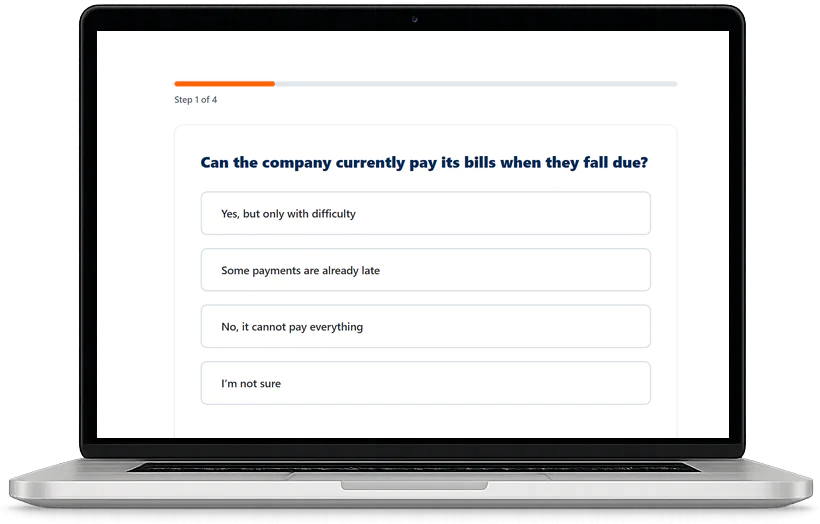
How Serious Is Your Company’s Position?
Answer four short questions to see how urgent the situation may be and which options could fit your company’s circumstances.
Check my company’s positionSee your result online and receive a copy by email. We only call if you ask.
When It Is Defensible to Trade Out of Insolvency
A defensible trade-on case has three ingredients, and all three need to be in the board file before the decision is taken, not reconstructed afterwards.
- A genuine prospect of recovery. A live, confirmed order book that, on realistic collection assumptions, clears the current payables shortfall within a defined window. A lender who has indicated fresh facility, in writing. A one-off loss (bad debt, contract cancellation, litigation settlement) that is identifiably behind you rather than a pattern that continues.
- Documented board decisions at each step. Full board minutes that record the management accounts reviewed, the 13-week cash-flow forecast considered, the creditor-interest weighing done, and the specific decision made. Not “noted and approved”. The minute should read like something you would be comfortable handing to a liquidator on day one.
- Professional advice on file. A licensed IP or an insolvency-specialist solicitor consulted before the trade-on decision, with the advice recorded in writing. The point is not to outsource the decision; it is to show the decision was taken with proper input against the section 214 test.
Without those three, a director who trades through and then ends up in liquidation is arguing against the tide. With them, the file tells the story of a board that took every step a reasonable director would. The paper trail is the defence, and it has to be contemporaneous.
When Trading Out of Insolvency Crosses Into Wrongful Trading
The line is crossed when there is no longer a reasonable prospect of avoiding insolvent liquidation and you keep going anyway. In our casework, the tell-tale signs of a director who has quietly slipped across that line are recognisable:
- The cash-flow forecast has not been updated for three months, or updates rely on “pipeline” revenue rather than contracted orders.
- Supplier invoices are being paid selectively, with the quiet ones (HMRC, the landlord, the pension scheme) falling further behind.
- New customer deposits are being used to pay last month’s wages rather than held against delivery.
- Director loans are going in rather than coming out, and the board has stopped asking when the injections will stop.
- The conversation at board level has shifted from “how do we fix this” to “how long can we hold on”.
When a liquidator reconstructs the timeline afterwards, they look at exactly those indicators. The management pack you signed six months before liquidation is either the section 214 defence or the section 214 smoking gun.
The Sequana Duty Shift: Why It Matters When You Trade Out of Insolvency
Until the Supreme Court decided Sequana in October 2022, the exact timing of the duty shift to creditor interests was uncertain. The Court held that the shift is triggered where the directors know or ought to know that the company is insolvent, or that insolvency is imminent, or that an insolvent liquidation or administration is probable.
That means the shift can happen well before formal insolvency, well before a statutory demand, well before a winding-up petition. It happens at the point where a diligent director looking at the numbers would conclude that the company’s creditors are now the group whose interests need protecting.
Practically, if you are already two quarters into sustained losses, already factoring at 70% rather than 85%, already behind on HMRC, and already asking yourself “can we trade out of this?”, the Sequana trigger is probably already pulled. The question is not whether you have crossed the line, it is whether your board minutes show you recognised that you had.
Formal Routes That Let You Trade Under Protection
If informal trading is no longer defensible but the business still has a future, the Insolvency Act and the Corporate Insolvency and Governance Act 2020 give you structured routes that let you keep operating under creditor protection.
- Company Voluntary Arrangement (Part I Insolvency Act 1986). A proposal to unsecured creditors to compromise historic debt, typically paid from future trading profits over three to five years. Requires 75% in value of creditors voting to approve. You stay in day-to-day control. See our CVA guide.
- Part A1 Moratorium (inserted by CIGA 2020). A standalone 20-business-day moratorium from creditor enforcement, extendable, overseen by a licensed IP as “monitor”. Directors remain in control while a rescue plan is developed.
- Administration (Schedule B1 Insolvency Act 1986). An administrator takes over the company with statutory purposes: rescue the company, or achieve a better result for creditors than liquidation, or realise property to distribute. A powerful automatic moratorium protects the business during the process.
- Restructuring Plan (Part 26A Companies Act 2006). A more recent tool, used on larger matters, that can cram down dissenting creditor classes with court sanction.
Each route has trade-offs. A CVA binds unsecured creditors but demands a disciplined five-year delivery and kills flexibility on new lending. A moratorium buys 20 working days, not a lifetime. Administration transfers control from you to an administrator. None of them is painless, and the one that fits depends on your specific cash, creditor, and lender position.
The Practical Test Before You Decide to Trade Out of Insolvency
The honest test a director can run at the kitchen table, before ringing us, is this. Take the 13-week cash-flow forecast you actually believe, not the optimistic one. Subtract the contracted order-book cash from the contracted payables. If the gap closes inside 13 weeks without further director loans, new overdraft, or unpaid HMRC, you have a case for trading through.
If the gap closes only by assuming new contracts you have not yet signed, or by continuing to stretch HMRC, or by taking a further injection the family cannot really afford, you do not have a case for trading through. You have a preference for doing so. The Supreme Court test in Sequana is about probabilities, not preferences.
Our page on the statutory insolvency test sets out how a licensed IP applies section 123 to your specific numbers, and our guide to company cash flow problems covers the 13-week forecast discipline in more detail.
Your Next Step on Trading Out of Insolvency
The verdict splits into two camps, and the call between them is the most important commercial decision you will take this year.
If you have a confirmed order book, a realistic 13-week forecast that closes the gap, and a willingness to paper the board decisions properly, you have a trade-on case. Your next step is a documented board review with a licensed IP’s advice on file, not a “let’s see how next month goes” conversation. The IP advice plus the minuted decision is the section 214 defence.
If the honest forecast does not close, if HMRC is drifting further behind, or if the conversation at board level has become about surviving another fortnight rather than fixing the underlying problem, informal trading is no longer safe.
Your next step is a formal conversation this week, not next month, about whether a CVA, a moratorium, an administration, or a creditors’ voluntary liquidation is the right protected route.
Call Company Debt free on 0800 074 6757 for a confidential review with one of our licensed insolvency practitioners. We will walk through your 13-week forecast, test whether the section 214 “reasonable prospect” threshold is honestly met, and set out the formal protections available if it is not. Nothing is charged until you instruct us.
Check How Serious the Position May Be
Answer four short questions to see how urgent the situation may be and which broad options could fit.
Check my company’s positionEstimates are fineWe only call if you ask us to
FAQs on Trading Out of Insolvency
Is it legal to keep trading if my company is insolvent?
Yes, provided the board can honestly conclude there is a reasonable prospect of avoiding insolvent liquidation, takes every step to minimise creditor loss, and documents that assessment with professional advice on file. Section 214 of the Insolvency Act 1986 punishes trading that continued after no reasonable director could have seen recovery.
What is the section 214 wrongful trading test?
A director commits wrongful trading if, before winding-up, they knew or ought to have concluded there was no reasonable prospect of avoiding insolvent liquidation and did not take every step a reasonably diligent director would take to minimise creditor loss. The court can order a personal contribution to the estate equal to the increase in net deficiency.
What does it mean to take every step to minimise creditor loss?
In practice it means taking specialist advice, documenting board decisions against the section 214 test, stopping fresh supplier credit you cannot honestly service, keeping current HMRC payments up to date, and considering whether a formal process would produce a better outcome for creditors than continued informal trading. The test is the reasonable-director standard.
How does a CVA allow me to trade out of insolvency?
A Company Voluntary Arrangement under Part I of the Insolvency Act 1986 binds unsecured creditors to accept a compromise of their debt (often 30p to 50p in the pound) typically paid from future trading profits over three to five years. You stay in control of day-to-day management. Approval requires 75% by value of creditors voting, and a supervising IP monitors delivery throughout.
Can a company in liquidation still trade?
No, not in the ordinary course. Once a liquidator is appointed, their statutory duty is to realise the assets and distribute the proceeds. Any trading is limited to what is necessary for a beneficial winding-up, typically completing specific work-in-progress contracts. The Part A1 moratorium and administration are the procedures designed for continued trading under protection; liquidation is not.
When exactly does the Sequana creditor duty kick in?
The Supreme Court held in BTI v Sequana [2022] UKSC 25 that the duty to have regard to creditor interests is engaged where directors know or ought to know the company is insolvent, or that insolvency is imminent, or that an insolvent liquidation or administration is probable. It engages earlier than the section 123 formal insolvency threshold and bites on every trading decision thereafter.