


Am I Solvent? Solvency Tests Explained for UK Businesses
Read More




When a UK limited company can no longer meet its financial obligations, directors must act decisively and lawfully. Insolvency triggers a shift in directors’ duties, increasing scrutiny over decisions made during this period.
A creditors’ voluntary liquidation (CVL) is one formal route to close an insolvent company in an orderly way, placing control of the process with a licensed insolvency practitioner and ensuring creditors are treated according to statutory priorities. While the process can feel daunting, early professional advice is essential to ensure compliance and reduce the risk of personal consequences.
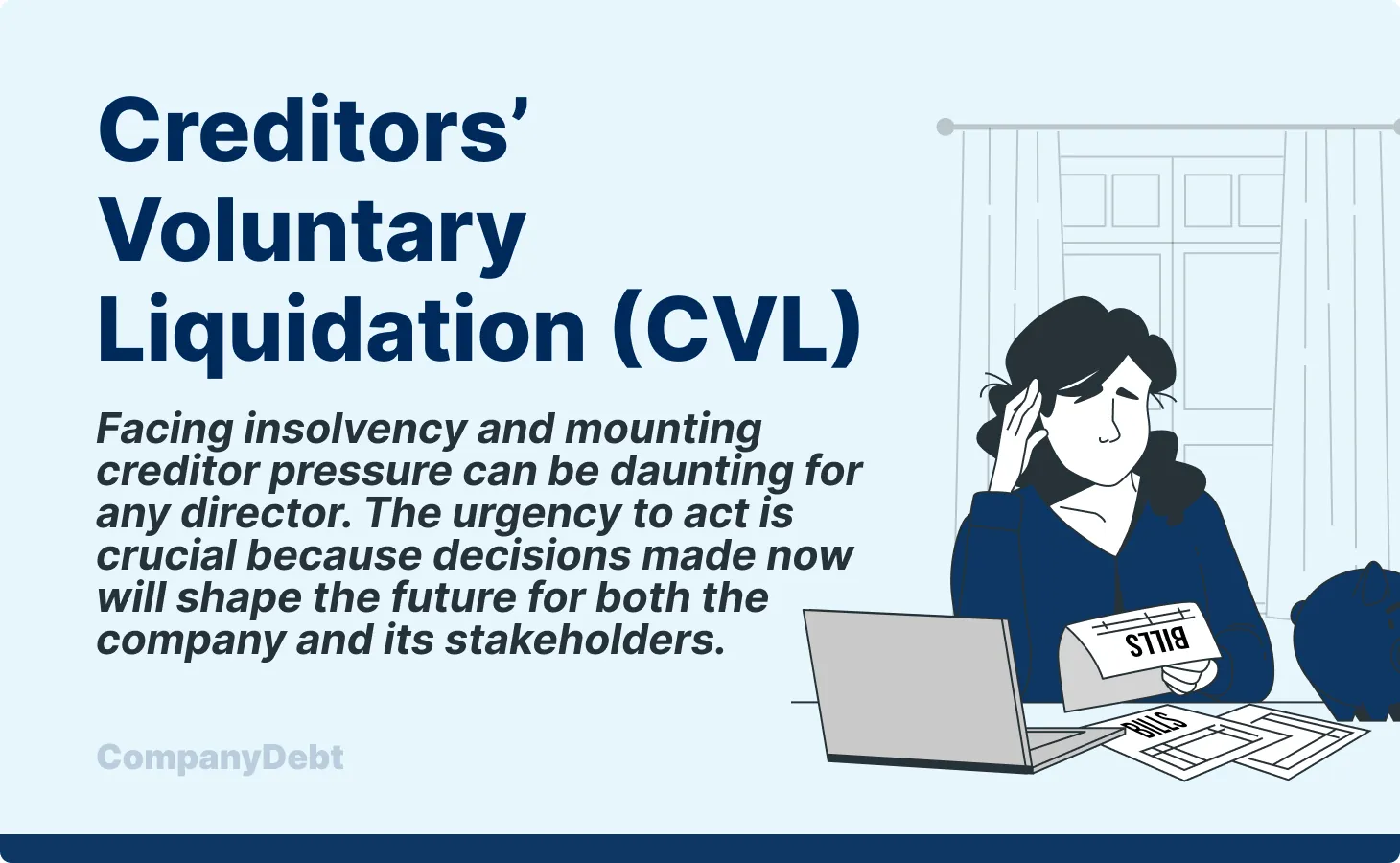
A Creditors’ Voluntary Liquidation (CVL) is a procedure used to wind up an insolvent company. It occurs when the company’s shareholders pass a resolution to place the company into liquidation because it cannot pay its debts as they fall due or its liabilities exceed its assets.
To proceed, shareholders must approve a special resolution to wind up the company, requiring at least 75% of the voting shareholders by value. A CVL is distinct from a members’ voluntary liquidation (MVL), which is only available to solvent companies.
Once the resolution is passed, a licensed insolvency practitioner is appointed as liquidator. From that point, control of the company transfers away from the directors to the liquidator, whose role is to realise assets and distribute funds to creditors in accordance with insolvency law.
For example, where a small manufacturing company faces declining sales and mounting unpaid supplier invoices, directors may conclude there is no reasonable prospect of recovery. Choosing a CVL allows the company to stop trading and be wound up under professional oversight, rather than risking further losses to creditors.
A CVL becomes appropriate when a company is insolvent. Insolvency is assessed using two recognised tests:
Once insolvency is apparent, directors must prioritise the interests of creditors. Continuing to trade when there is no reasonable prospect of avoiding insolvent liquidation can expose directors to wrongful trading claims.
Common indicators that a CVL may be necessary include:
A CVL does not automatically remove personal risk, but taking prompt, informed action can help demonstrate that directors took appropriate steps to minimise losses to creditors.
Failing to act appropriately once a company is insolvent can lead to serious consequences for directors. If a director allows the company to continue trading when they knew, or ought to have known, that insolvent liquidation was unavoidable, a court may order them to contribute personally to the company’s assets.
During a CVL, the liquidator is required to submit a director conduct report to the Insolvency Service. This report assesses the behaviour of directors in the period leading up to insolvency. Where misconduct is identified, this may result in director disqualification under the Company Directors Disqualification Act 1986.
Good practice for directors includes:
✅ Do
❌ Don’t
Prompt action and cooperation can significantly reduce the risk of further personal consequences.
A CVL is one of several insolvency procedures available to insolvent companies. The most appropriate option depends on whether the business has any realistic prospect of rescue.
| Option | Initiation | Purpose |
| CVL | Shareholders | Orderly closure of an insolvent company |
| Compulsory liquidation | Court / creditors | Forced winding-up |
| Administration | Directors / creditors | Rescue or improved creditor outcome |
| CVA | Directors | Repayment plan while trading continues |
If insolvency is unavoidable and rescue is not viable, a CVL is often the most appropriate route.
Directors must first recognise that the company is insolvent and resolve to recommend liquidation to shareholders.
Shareholders pass a special resolution (75% by value) to wind up the company. The resolution must be filed at Companies House and advertised in The Gazette.
Creditors are given the opportunity to approve the appointment of a liquidator using a statutory decision procedure (commonly deemed consent or a virtual meeting). A physical creditors’ meeting is no longer automatic in England and Wales.
Directors must prepare a statement of affairs detailing the company’s assets, liabilities, and creditors. This must be verified by a statement of truth and provided to the liquidator.
A licensed insolvency practitioner is formally appointed and takes control of the company.
Once appointed, the liquidator assumes control of the company. Their primary duties include:
The liquidator also submits reports to the Insolvency Service, including a report on director conduct. The liquidator acts in the interests of creditors as a whole, not the directors or shareholders.
Directors must cooperate fully with the liquidator and provide complete and accurate records. Failure to do so can increase the risk of enforcement action or disqualification.
The liquidator will examine director conduct in the period before insolvency, including decisions around trading, payments, and record-keeping. Honest cooperation and early engagement are essential to mitigating risk.
In a CVL, assets are distributed according to statutory order of priority. In simplified terms:
Not all HMRC debts are preferential, and preferential status applies only to specific taxes. In many CVLs, insufficient assets exist to repay unsecured creditors in full.
Once the liquidation is complete, the liquidator prepares a final account of how the winding-up was conducted. Final meetings or decision procedures are held, and the liquidator files the necessary documents with Companies House.
After this, the company is dissolved and ceases to exist as a legal entity. Although the company ends, investigations into director conduct may continue where appropriate.
1. Can a company trade while a CVL is being arranged?
Directors must avoid trading that worsens creditor losses. Once there is no reasonable prospect of avoiding insolvent liquidation, directors should take steps to minimise losses and seek insolvency advice immediately.
2. Do creditors have the power to reject my liquidator choice?
Yes. Creditors have the right to approve or replace the company’s nominated liquidator through the decision procedure.
3. What if shareholders disagree with going into CVL?
Without the required 75% shareholder approval, a CVL cannot proceed. Other options may need to be explored.
4. Does a CVL remove personal guarantees signed by directors?
No. Personal guarantees remain enforceable despite liquidation.
5. How soon must I stop trading if I suspect insolvency?
As soon as there is no reasonable prospect of avoiding insolvent liquidation, directors must prioritise creditor interests and minimise losses.
6. Could I face disqualification after a CVL?
Yes. Director conduct is reviewed, and misconduct may lead to disqualification.
7. How long does a CVL take?
There is no fixed duration. The length depends on asset realisation, investigations, and the complexity of the company’s affairs.
8. Can a CVL deal with HMRC debts?
Yes. HMRC participates as a creditor, and certain taxes may rank as preferential depending on the insolvency date and debt type.
9. What if the company has no assets?
A CVL can still proceed, but liquidation costs must be funded, often by directors or third parties.
10. Do employees get redundancy pay in a CVL?
Employees may claim statutory redundancy and related payments from the government, subject to limits. Any shortfall may be claimed in the liquidation.
11. Can an MVL be converted into a CVL?
Yes. If a company in an MVL becomes insolvent, the process must convert into a CVL.
12. Are CVL procedures the same in Northern Ireland?
No. Northern Ireland follows its own insolvency legislation and procedures, which differ from England and Wales.
If your company is insolvent or approaching insolvency, early engagement with a licensed insolvency practitioner is critical. Professional advice helps ensure legal compliance, protects creditor interests, and reduces the risk of personal consequences for directors. This guidance is general and should not replace tailored professional advice.