UK Insolvency Flowchart for Company Directors




If your company is in financial difficulty, the number of possible routes is smaller than it feels and the decision tree is more structured than you think. This flowchart maps the key decision points from “the company cannot pay its debts” to the formal outcome, so you can see exactly which path applies to your situation.
We built this flowchart from the questions directors actually ask us, not from the statutory framework in the abstract.
The Insolvency Act 1986 contains dozens of provisions, but the practical decision tree for most UK company directors comes down to five questions asked in sequence. Answer them honestly and you will know which route you are on before you pick up the phone.
Quick Answer: The UK Insolvency Decision Flowchart
Question 1: Can the company pay all its debts within 12 months?
- Yes: The company is solvent. If you want to close, use a Members’ Voluntary Liquidation (MVL) to extract surplus assets at capital gains rates. If you want to continue trading, no insolvency process is needed.
- No: The company is insolvent. Move to Question 2.
Question 2: Is the business viable if the debt problem is resolved?
- Yes: Explore rescue options. Move to Question 3.
- No: The business needs to close. Move to Question 4.
Question 3: How severe is creditor pressure right now?
- Low (letters, calls, early-stage demands): Try informal negotiation first. Contact HMRC for a Time to Pay arrangement. Explore invoice finance or refinancing. See our guide to alternatives to liquidation.
- Medium (statutory demands served, county court claims filed): A Company Voluntary Arrangement (CVA) can freeze creditor action and restructure debt over 3 to 5 years. You need 75% creditor approval by value.
- High (winding-up petition filed or imminent): Administration provides a court-ordered moratorium on all creditor action. This is the strongest rescue tool but the most expensive. Alternatively, pay the petition debt to dismiss it and then pursue a CVA.
Question 4: Do you want to control the closure, or has a creditor already forced it?
- You are choosing to close: Initiate a Creditors’ Voluntary Liquidation (CVL). You nominate the liquidator, prepare your records, and demonstrate responsible conduct. Move to Question 5.
- A creditor has petitioned the court: You are heading toward compulsory liquidation. You can still pay the debt to dismiss the petition, or convert to a CVL before the hearing. If the court grants the order, the Official Receiver takes control. Move to Question 5.
Question 5: Does the company have debts but no assets and no ongoing disputes?
- Yes, and no creditors will object: Voluntary strike-off (dissolution) may be appropriate. Cost: £13. But only if there are genuinely no debts, no assets above £25,000, and no creditor claims that could resurface.
- No, there are debts, assets, or potential disputes: A CVL is the correct route. Strike-off with outstanding debts creates personal liability if a creditor restores the company later.
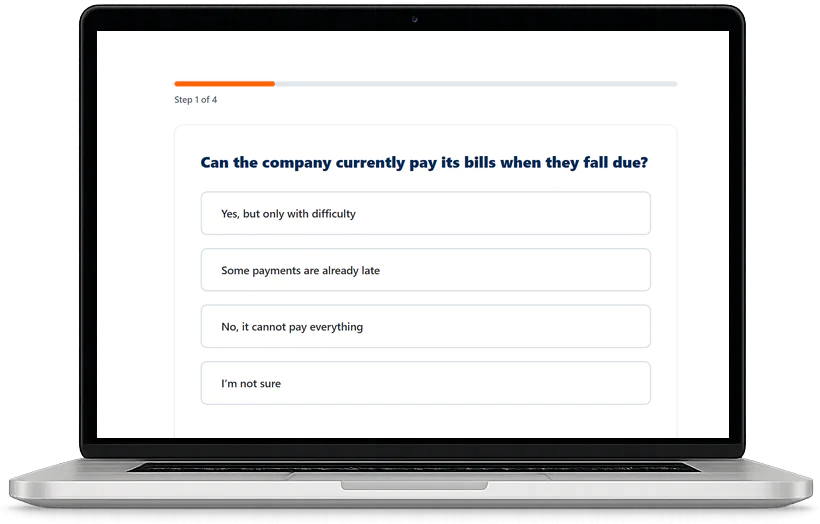
Could Your Company Be Insolvent?
Answer four short questions to see which warning signs apply, how serious the position may be and how soon you may need to act.
See which options may fit your company’s circumstances.
Check my company’s positionSee your result online and receive a copy by email. We only call if you ask.
Where Directors Get Stuck in the Insolvency Flowchart
We find that directors get stuck at three points in this decision tree.
Between Questions 1 and 2: not sure if you’re insolvent. If you are not sure, we can tell you: you probably are. The cash-flow test under section 123 of the Insolvency Act asks whether you can pay debts as they fall due.
If you are juggling creditors, delaying HMRC, or relying on next month’s revenue to cover last month’s obligations, you are failing this test. Get a formal solvency assessment from your accountant.
At Question 2: you think the business is viable but you’re not certain. The test is not certainty. It is whether the core trading operation generates more cash than it consumes on a month-to-month basis, once the specific debt problem is stripped out.
If the business model is sound but a one-off event (a bad debt, a contract loss, an HMRC accumulation) caused the crisis, rescue is worth exploring. If the business has been loss-making for years, rescue is displacement. Our guide on whether to close or save your company goes deeper on this decision.
At Question 4: you want to close but cannot afford the CVL fee. A CVL typically costs from £5,000, paid from the company’s remaining assets. If the company has no assets at all, some insolvency practitioners will still accept the appointment because their fees rank as an expense of the liquidation.
If you genuinely cannot afford to liquidate, speak to a practitioner about your options. Doing nothing is not one of them, because a creditor will eventually petition and the compulsory route is more expensive and more invasive.
The One Rule That Applies at Every Stage of the Insolvency Flowchart
Wherever you are in this decision tree, one principle applies: the earlier you act, the more options you have. Every week of delay narrows your choices, increases your personal exposure, and reduces the value available to creditors.
A director who acts at Question 1 has five routes available. A director who waits until a winding-up petition lands at Question 4 has two, and one of them is already being imposed by the court.
Company Debt’s licensed insolvency practitioners can help you work through this decision tree with your actual numbers, not hypotheticals. A free, confidential consultation will tell you exactly where you sit in the flowchart and what your next step should be.
FAQs on the UK Insolvency Flowchart
What is the fastest insolvency route?
Voluntary strike-off is the fastest (approximately 3 months) but only works for companies with no debts or assets. An MVL takes 6 to 12 months. A CVL takes 12 to 18 months.
Compulsory liquidation is the slowest, typically 18 months to several years. The fastest appropriate route depends on your company’s specific position.
Can I change route after starting an insolvency process?
In some cases. An MVL can convert to a CVL if the company turns out to be insolvent. A CVL can be initiated before a winding-up hearing to avoid compulsory liquidation. A CVA can transition to liquidation if the arrangement fails.
But each conversion adds cost and complexity, which is why getting the route decision right first time matters.
Do I need an insolvency practitioner for every route?
A licensed insolvency practitioner is required for MVL, CVL, CVA, and administration. They are not required for voluntary strike-off (you apply to Companies House directly) or for informal creditor negotiation.
However, even for routes that do not require an IP, a consultation is worthwhile to confirm you are choosing the correct path.
What if my company has no assets at all?
If the company has debts but no assets, a CVL is still the appropriate route if creditors exist. Some IPs will accept no-asset appointments. If the company has no debts and no assets, voluntary strike-off is the simplest route.
Do not use strike-off to avoid liquidation costs if creditors exist. The debts survive dissolution and creditors can restore the company.