What Is the Corporate Insolvency Test? A UK Director’s Guide Under the Insolvency Act 1986




“Am I trading while insolvent?” is the question we tell directors they should be asking three months before they actually ask it.
The corporate insolvency test in England and Wales under section 123 of the Insolvency Act 1986 has four limbs; two procedural (statutory demand + unsatisfied execution) and two substantive (cash-flow + balance-sheet).
If the company fails the cash-flow or balance-sheet test, and you know or ought to know it, you engage the creditor-duty doctrine under section 172(3) of the Companies Act 2006. The Supreme Court’s BTI v Sequana decision in 2022 held that the duty is engaged when the company is insolvent or bordering on insolvency, or when an insolvent liquidation or administration is probable.
Below, we explain how each limb of the test works, how you can run the test on your own company in 90 minutes, and what changes the moment one of the limbs fails.
The 13-week cash-flow forecast is our standard diagnostic tool. The contingent-and-prospective liability inclusion under Eurosail is the rule that catches our clients out. And the dated evidence file you build during the test is what underpins both your s.1157 CA 2006 court-relief defence and your s.214(3) IA 1986 wrongful-trading defence later.
Why the Insolvency Test Matters
Section 123 of the Insolvency Act 1986 sets out four limbs of the corporate insolvency test:
- s.123(1)(a); statutory demand for a debt of more than £750 left unpaid for 21 days
- s.123(1)(b); unsatisfied execution of judgment debt
- s.123(1)(e); cash-flow test: cannot pay debts as they fall due
- s.123(2); balance-sheet test: liabilities exceed assets, including contingent and prospective
The Supreme Court’s decision in BTI 2014 LLC v Sequana SA [2022] UKSC 25 endorsed the rule recognised in West Mercia Safetywear v Dodd [1988] BCLC 250.
Directors must consider creditors’ interests, and balance them against members’ interests, once they know or ought to know the company is insolvent or bordering on insolvency, or that an insolvent liquidation or administration is probable. Creditors’ interests become paramount when insolvent liquidation or administration is inevitable. A mere real risk of insolvency is not enough.
Failing the test does not, by itself, require immediate liquidation. It does, however, trigger a cluster of personal-liability exposures that operate on the director’s own conduct from the point of failure forward:
- s.214 IA 1986 wrongful trading; contribution-order risk if you keep trading once you knew or ought to have concluded there was no reasonable prospect of avoiding insolvent liquidation or administration
- s.212 IA 1986 misfeasance; claim for breach of fiduciary duty on specific transactions
- s.239 IA 1986 preferences; reviewable selective payments in the look-back window
- s.6 CDDA 1986 disqualification; 2-15 year director ban for Schedule 1 conduct breaches
Running the insolvency test honestly is the first step in protecting yourself against all four routes.
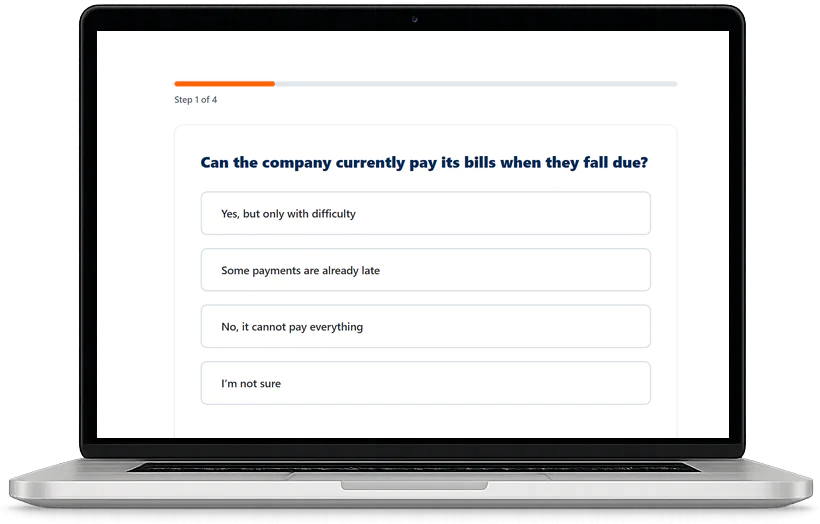
Could Your Company Be Insolvent?
Answer four short questions to see which warning signs apply, how serious the position may be and how soon you may need to act.
See which options may fit your company’s circumstances.
Check my company’s positionSee your result online and receive a copy by email. We only call if you ask.
The Cash-Flow Insolvency Test: Section 123(1)(e)
Section 123(1)(e) IA 1986: a company is unable to pay its debts if “it is proved to the satisfaction of the court that the company is unable to pay its debts as they fall due.”
The “as they fall due” phrase matters. It captures not just current liabilities (debts already overdue) but near-term debts that will fall due in the immediate forecast period.
A company with £50,000 cash, £40,000 of debts overdue today, £60,000 of debts due next week and no facility or incoming receipts to cover the gap is cash-flow insolvent, even though today’s overdue balances alone are affordable.
The 13-week rolling cash-flow forecast is the standard diagnostic tool. Licensed insolvency practitioners require this before recommending any procedure. It captures:
- Opening cash position (today)
- Week-by-week receipts (customer payments + facility drawdowns + equity injections)
- Week-by-week payments (creditors + payroll + tax + lease + finance)
- Closing cash position week-by-week
- Negative closing balance + no available facility headroom = cash-flow insolvency at that point
When we walk a director through this for the first time, a simple Excel template works. The discipline matters more than the format: include everything (especially contingent obligations like quarterly tax payments + annual insurance renewals), be honest about realistic receipt timing (not optimistic), and refresh weekly during the stress period.
The cash-flow test is the more common trigger for SME insolvency. Most companies hit cash-flow insolvency before they hit balance-sheet insolvency.
The Balance-Sheet Insolvency Test: Section 123(2)
Section 123(2) IA 1986: a company is also deemed unable to pay its debts if “it is proved to the satisfaction of the court that the value of the company’s assets is less than the amount of its liabilities, taking into account its contingent and prospective liabilities.”
The contingent and prospective inclusion is the key. The test does not look only at the balance sheet as filed; it adds:
- Contingent liabilities; claims that may or may not materialise (warranty claims, ongoing litigation, dilapidation obligations on leases, cross-guarantees, PG indemnities to other companies)
- Prospective liabilities; future obligations that will arise (future-rent under leases that have not yet been disclaimed, future redundancy obligations, regulatory obligations)
The leading case is BNY Corporate Trustee Services Ltd v Eurosail-UK 2007-3BL plc [2013] UKSC 28. The Supreme Court rejected the Court of Appeal’s “point of no return” wording. The question is whether, on the evidence, the company’s assets are insufficient to meet all its liabilities, taking account of contingent and prospective ones, so that it cannot reasonably be expected to meet them.
For SMEs, the Eurosail test typically engages later than cash-flow insolvency. A company can be cash-flow insolvent (cannot pay this week’s payroll) while still having a positive balance sheet on paper.
But once the contingent + prospective liabilities are added; particularly dilapidation exposure on commercial leases, undischarged guarantees, and warranty obligations; the balance-sheet picture often shifts materially.
Building the contingent + prospective list is part of the diagnostic. Most SMEs underestimate by 20-50% because dilapidations + warranty + cross-guarantee exposures are not on the management accounts.
The Legal Action Limbs of the Insolvency Test
Sections 123(1)(a)-(d) IA 1986 are procedural triggers; they create a presumption of inability to pay without requiring the court to make findings on cash-flow or balance-sheet position.
s.123(1)(a); statutory demand. A creditor owed more than £750 can serve a statutory demand under r.7.3 of the Insolvency (England and Wales) Rules 2016. If the company fails to pay or satisfy the demand within 21 days, the company is presumed unable to pay its debts. This is the most common pre-petition trigger for SME insolvency.
s.123(1)(b); unsatisfied execution. Where a judgment creditor has obtained a court order and the execution officer (HCEO under TCEA 2007) returns the writ unsatisfied in whole or in part, meaning they could not recover the full debt, the company is presumed unable to pay.
This typically follows a CCJ + Warrant of Control where the bailiff finds insufficient assets.
s.123(1)(c)-(d); Scottish + Northern Ireland equivalents. The “unsatisfied execution” route adapted to each jurisdiction’s enforcement framework.
These limbs are presumptions, not conclusions. A company can rebut by showing it has the means to pay (cash + facility + realisable assets sufficient to cover the underlying debt). But absent rebuttal, the presumption is sufficient for the creditor to present a winding-up petition under s.122(1)(f) IA 1986.
In practice, the procedural triggers are how most creditors crystallise their position. HMRC issues statutory demands. Commercial landlords pursue CCJ + enforcement. Trade suppliers escalate to statutory demand once cash is tight.
The substantive tests (s.123(1)(e) cash-flow + s.123(2) balance-sheet) become relevant if and when the matter reaches court; but by then the procedural triggers have usually done the work.
The Consequences of Trading While Insolvent
Failing the insolvency test is not, in itself, a wrong. The risk comes from continuing to trade once you know, or ought to conclude, that there is no reasonable prospect of avoiding insolvent liquidation or administration, without taking every step to minimise the loss to creditors.
The four exposure routes:
Wrongful trading under section 214 IA 1986. Where you knew or ought to have concluded that there was no reasonable prospect of avoiding insolvent liquidation or insolvent administration, and you continued to trade, the liquidator can apply for a contribution-order against you personally.
The court will not make one if you took every step you ought to have taken to minimise the potential loss to creditors.
Re Produce Marketing Consortium Ltd (No 2) [1989] BCLC 520 is the starting point on quantum: the court usually looks at how much the net deficiency grew between the point trading on became wrongful and the date of liquidation, but the final amount is at its discretion.
Recent benchmark: the BHS Group case (2024) produced a £18m collective contribution-order against former directors.
Misfeasance under section 212 IA 1986. Any breach of duty or misapplication of company money or property, such as paying favoured creditors, taking dividends without distributable reserves, or transferring assets at an undervalue. The liquidator pursues misfeasance claims by application to the court; no statutory cap on the recovery amount.
Preferences under section 239 IA 1986. Payments that leave a creditor better off than they would be in a liquidation, made in the 6 months before the insolvency (2 years for connected parties) while the company was insolvent or which made it insolvent, where the company was influenced by a desire to prefer that creditor. For connected parties that desire is presumed.
Re MC Bacon Ltd [1990] BCLC 324: the test is whether the company positively wished to improve the creditor’s position, not merely whether it intended that result.
Disqualification under section 6 CDDA 1986. If the Secretary of State brings proceedings and the court finds your conduct makes you unfit, it must disqualify you. 2-15 year range; voluntary undertaking under s.1A CDDA 1986 avoids court costs.
These four routes compound. Liquidators routinely plead s.214 + s.212 + s.239 in a single claim; disqualification proceedings follow on the conduct findings.
Running the Insolvency Test Yourself, A Working Method
Here is the working method we run with directors. It takes about 90 minutes for a small SME:
Step 1: Build a 13-week cash-flow forecast. Weekly buckets for the next 13 weeks. Opening cash + receipts + payments = closing cash, week by week. Include facility headroom separately (available overdraft, available factoring, available asset finance).
Step 2: Identify the cash-flow failure point. Which week shows the first negative closing balance + no available facility? That is the cash-flow insolvency point under s.123(1)(e). If the forecast shows no failure in 13 weeks, you are not cash-flow insolvent in the immediate forecast horizon (but check the assumptions before concluding).
Step 3: List contingent + prospective liabilities. Lease dilapidations (recent industry rule of thumb: £20-40 per square foot for office space), warranty obligations on completed work, ongoing litigation exposure, cross-guarantees to sister companies, PG indemnities you’ve given other parties, future-rent under leases beyond the next 12 months.
Step 4: Reconcile balance sheet under s.123(2). Take current balance sheet, add contingent + prospective liabilities, calculate the adjusted position. If liabilities (current + contingent + prospective) exceed assets at realisable value, you are likely to be balance-sheet insolvent under the Eurosail test.
Step 5: Document the reasoning. Board minutes recording: financial position reviewed, alternatives considered, professional advice received, decision made, and (post-Sequana) explicit consideration of creditor interests once insolvency is probable. Date the minutes contemporaneously.
The dated evidence file from step 5 is your strongest protection. It supports an application for court relief under s.1157 CA 2006 and is how you prove the steps you took for the s.214(3) IA 1986 wrongful-trading defence, though neither outcome is guaranteed. Without it, the liquidator’s narrative goes unchallenged in any subsequent investigation.
Your Next Step on the Insolvency Test
If either substantive test (cash-flow s.123(1)(e) or balance-sheet s.123(2)) fails:
- Build 13-week cash-flow forecast within 7 days. Excel template sufficient; refresh weekly.
- List contingent + prospective liabilities. Include everything; dilapidations, PGs, warranties, litigation, cross-guarantees.
- Audit creditor pressure points. Which creditors have given notice, issued statutory demand, escalated to litigation? Which have you missed payments to?
- Free IP diagnostic call within 14 days. Most insolvency practitioners offer a free first call; that is market practice, not a legal requirement. Verify the IP on ICAEW (icaew.com/regulation/find-a-firm) or IPA (insolvency-practitioners.org.uk) register.
- Document board decisions contemporaneously. Dated minutes recording each major financial-position review, alternatives considered, advice received, action taken.
The free diagnostic call with a licensed IP costs nothing, and it can show early where your personal liability risk sits. Even if you conclude the company can trade through the difficulty, the dated record of having taken IP advice is strong evidence against a s.214 wrongful-trading claim later.
If both tests fail and rescue is not viable, the formal options are CVA (Pt I IA 1986), Administration (Sch B1 IA 1986), Restructuring Plan (Pt 26A CA 2006), CVL (s.84 IA 1986), or compulsory liquidation on a winding-up petition (s.124 IA 1986). The “engagement before enforcement” rule still applies: pre-petition options outnumber post-petition options 5 to 2.
Not Sure Where Your Company Stands?
Use the two-minute test to check the warning signs and see how soon you may need to act.
Check my company’s positionEstimates are fineWe only call if you ask us to
FAQs on the Corporate Insolvency Test
What are the two main insolvency tests in UK law?
Section 123(1)(e) IA 1986 cash-flow test (cannot pay debts as they fall due) and section 123(2) IA 1986 balance-sheet test (liabilities exceed assets including contingent and prospective). Procedural triggers under s.123(1)(a)-(d) create presumptions but the substantive tests are what matter for director duty + liability purposes.
When does the creditor-duty doctrine engage?
Section 172(3) CA 2006 directs that the duty to promote success of the company for the benefit of members is subject to enactments or rules of law requiring consideration of creditor interests.
BTI v Sequana [2022] UKSC 25 held the duty is engaged when directors know or ought to know the company is insolvent or bordering on insolvency, or that an insolvent liquidation or administration is probable. A mere real risk of insolvency is not enough.
What is the balance-sheet test?
From BNY Corporate Trustee Services Ltd v Eurosail-UK [2013] UKSC 28. The balance-sheet test under s.123(2) is satisfied when the company cannot reasonably be expected to meet its obligations, taking into account contingent and prospective liabilities. Not just snapshot accounting figures.
What happens if I continue to trade after the insolvency test fails?
If you keep trading once you knew or ought to have concluded there was no reasonable prospect of avoiding insolvent liquidation or administration, you risk a s.214 wrongful trading contribution-order. Depending on what happened, you may also face s.212 misfeasance, s.239 preference clawback and s.6 CDDA 1986 disqualification proceedings.
The s.214(3) defence needs you to have taken every step you ought to have taken to minimise the potential loss to creditors; contemporaneous documented decisions are how you prove it.
Can I run the insolvency test myself?
Yes; the methodology is open and documentable. Build a 13-week cash-flow forecast + list contingent + prospective liabilities + reconcile the balance-sheet position + document the reasoning in board minutes. A free IP diagnostic call confirms your analysis at no cost.