Transport & Haulage Insolvency in the UK: Causes, Risks & Solutions for Operators




The fuel card declines at the pump. The HP company rings about the truck. The Traffic Commissioner’s letter sits on the desk next to a load confirmation that will not be paid for another 45 days.
This is what transport and haulage insolvency looks like before anyone has named it.
Haulage insolvency carries sector-specific risks that general business advice misses. Your operator’s licence can be suspended by the Traffic Commissioner the moment your financial standing falls short.
Your rolling stock is mostly financed, so the assets keeping the business moving are not yours to sell.
Your margin problem is rarely fuel. It is the seven days between the load delivered and the customer’s payment terms arriving.
Read on for what haulage insolvency means in practice, what the O-licence exposure means legally, and what your genuine options are if the company is heading towards a formal procedure.
Transport & Haulage Insolvency at a Glance
Quick Answer: Transport & Haulage Insolvency
A haulage company becomes insolvent when it cannot pay its debts as they fall due, or when its liabilities exceed its assets. For operators, insolvency triggers an additional layer of risk.
The Goods Vehicles (Licensing of Operators) Act 1995 requires you to maintain financial standing to hold a standard operator’s licence.
If you cannot demonstrate that standing, the Traffic Commissioner can suspend or revoke the licence, which ends your ability to trade before any formal insolvency procedure does.
When Transport & Haulage Insolvency Becomes Critical
The trigger point for most haulage operators is not a single debt. It is a structural gap: the money owed from loads delivered 30 to 60 days ago does not arrive in time to cover this week’s diesel, repayments, and drivers’ wages.
When HMRC arrears build on top of that, because VAT and PAYE were used as working capital, the creditor pressure becomes acute.
At that point you are not just cash-flow tight. You are technically insolvent, and your duties to creditors have already changed.
Main Risk in Transport & Haulage Insolvency: The O-Licence
The operator’s licence is the business. Without it, a standard goods vehicle operator cannot move a single HGV legally.
The financial standing requirement under the 1995 Act is currently 9,000 euros for the first vehicle and 5,000 euros for each additional vehicle, assessed in sterling at the prevailing rate.
If your balance sheet cannot demonstrate that standing because creditors have frozen accounts, a winding-up petition has been filed, or assets have been repossessed, you may lose the licence. We find this sequence accelerates fast.
Directors who delay getting advice often discover that the Traffic Commissioner’s call arrives before the insolvency practitioner does.
What to Do Next About Transport & Haulage Insolvency
Speak to a licensed insolvency practitioner before you miss the next payroll or before HMRC takes enforcement action. The earlier you get advice, the more options remain open.
Company rescue solutions that preserve your licence and keep your drivers employed are only possible when there is still time to act on them.
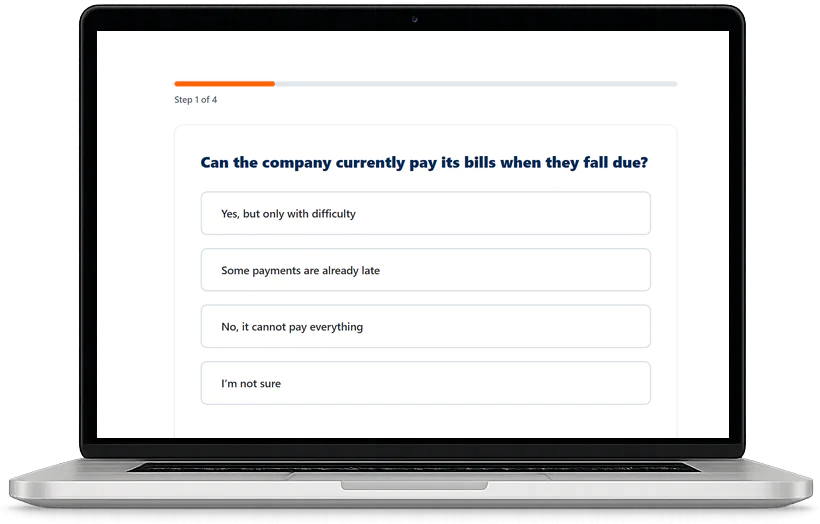
Could Your Company Be Insolvent?
Answer four short questions to see which warning signs apply, how serious the position may be and how soon you may need to act.
See which options may fit your company’s circumstances.
Check my company’s positionSee your result online and receive a copy by email. We only call if you ask.
What Transport & Haulage Insolvency Means for HGV Operators
The Real Cash Flow Problem for Haulage Companies
Most operators know their fuel bill. Fewer track how long working capital is tied up between delivery and payment.
A standard 30-day invoice cycle means revenue from last month’s runs is still sitting with your customers while this month’s diesel, AdBlue, drivers’ hours, and HP repayments are already due.
When a major customer slips to 45 or 60 days, or disputes an invoice, that gap becomes a crisis. Invoice finance and fuel cards extend the problem rather than solving it.
You are borrowing against income you have not yet collected, at rates that come off an already thin margin.
Difference Between Haulage Insolvency and General Business Insolvency
General corporate insolvency law applies. The Insolvency Act 1986 cashflow and balance sheet tests govern whether you are insolvent. But haulage adds regulatory insolvency on top of those tests.
If your company enters administration or liquidation, the administrator or liquidator must notify the Traffic Commissioner. In our experience with haulage cases, the O-licence is often the first casualty where this notification is delayed.
A pre-pack sale of the business that preserves the vehicles and the drivers may still fail if the buying entity cannot demonstrate financial standing or suitable transport management.
That makes the pre-pack route more structurally complex in haulage than in most other sectors.
When Transport & Haulage Insolvency May Not Be Recoverable
Recovery becomes harder when the O-licence is already under investigation, when rolling stock is subject to HP default notices, when key customer contracts have break clauses triggered by insolvency events, or when HMRC has begun enforcement rather than issuing demands.
At that point the question is no longer whether to rescue the business. It is how to close it in a way that limits your personal liability and protects the drivers’ statutory entitlements.
That is a different conversation, and an honest insolvency practitioner will tell you which one you are actually in.
How to Assess Whether Haulage Recovery Is Possible
The O-Licence Financial Standing Test for Haulage Operators
Your first question is whether the business can still demonstrate O-licence financial standing. Pull the most recent bank statements and management accounts.
If the combined available funds, covering cash, undrawn facilities, and confirmed invoice finance, fall below the financial standing threshold for your licence category, you need to address that before any creditor negotiation.
In our assessment work, we check this before anything else.
The Traffic Commissioner has the power to call you to a public inquiry at any point. Insolvency is a material change you are legally required to disclose. Concealing it is not an option.
Cashflow, Load Revenue and Debtor Visibility for HGV Operators
Map your debtor book against your creditor payments for the next eight weeks. What loads are confirmed? What invoices are outstanding and genuinely collectible? Which customers are slow payers and which are at risk of their own insolvency?
We find that in many haulage cases the debtor book looks healthier than it is. Disputed invoices, contra arrangements, and long-tail debtors that will never pay are common.
Once you strip those out, the actual cash available is often materially lower than the management accounts suggest.
Rolling Stock Finance and HP Exposure in Haulage Insolvency
Check whether your HP or lease agreements contain insolvency event clauses. Most do. We routinely see HP companies accelerate the debt or demand return of the vehicle the moment they hear a company is in financial difficulty.
If trucks are repossessed mid-operation, you lose the ability to meet customer commitments, which triggers further contract defaults.
The order of events matters enormously here. Getting a moratorium in place before the HP company acts is one of the key practical reasons to move into administration rather than wait for creditor actions to cascade.
Options for Transport & Haulage Insolvency Recovery
Company Voluntary Arrangement for Haulage Operators
A Company Voluntary Arrangement (CVA) allows a haulage operator to restructure its debts with creditor approval while retaining director control and continuing to trade.
For haulage, the CVA structure needs to address the O-licence position explicitly.
If HMRC is a major creditor, their approval representing a significant proportion of the vote is essential. HMRC’s participation in CVAs in the haulage sector has become more conditional since Crown preference was reinstated in December 2020.
A CVA that works for a haulage business has a realistic repayment schedule, a credible load forecast, and a clear fuel cost assumption. One built on optimistic revenue projections will fail within twelve months.
In our experience, a failed CVA usually leads to liquidation on worse terms than would have been achieved at the outset.
Administration and Pre-Pack Sale of a Haulage Business
Administration places your company under the control of a licensed insolvency practitioner acting as administrator, while a statutory moratorium protects assets from repossession.
For haulage, the moratorium is the key tool: it stops the HP company taking the trucks while a buyer is found.
A pre-pack administration, where a sale of the business and assets is agreed before appointment and completed immediately afterwards, can preserve the fleet, the drivers under TUPE, and the key customer contracts.
The O-licence cannot simply transfer, but the buying entity can apply for its own licence and continue operating.
We would flag that pre-packs in haulage attract scrutiny from creditors and the Traffic Commissioner alike. The commercial rationale for the sale price needs to be demonstrably independent.
We recommend getting an independent valuation of the business before any pre-pack is completed.
Creditors’ Voluntary Liquidation When Haulage Recovery Is Not Viable
If the business cannot be rescued, a Creditors’ Voluntary Liquidation (CVL) is the structured route. Directors initiate the process, a liquidator is appointed by creditors, and the assets are realised for creditor benefit.
Drivers’ statutory redundancy pay and unpaid wages rank as preferential claims under Schedule 6 of the Insolvency Act 1986, meaning they are paid ahead of unsecured creditors from available assets.
The statutory weekly pay cap for redundancy purposes is £751 from 6 April 2026.
Directors who have personally guaranteed finance facilities should take separate advice on their personal position before the company enters any formal procedure.
Director Risks During Transport & Haulage Insolvency
Wrongful Trading Risk for Haulage Directors
Under section 214 of the Insolvency Act 1986, a director can be held personally liable for the increase in company debts if they continued trading when they knew, or ought to have known, there was no reasonable prospect of avoiding insolvent liquidation.
For haulage directors, the practical question is this: if you kept taking on loads, continued to accrue HMRC liabilities, and paid fuel on account while knowing the balance sheet was insolvent, a liquidator will examine those decisions.
The defence, that you took every step to minimise loss, requires evidence of professional advice sought, creditor communication, and active management decisions. Good intentions alone are not enough.
We see directors caught by this regularly in cases where the company kept trading for months after the insolvency point.
Preference Payments and Rolling Stock Disposal Before Haulage Insolvency
Paying one creditor ahead of others in the six months before insolvency, including paying off a personal guarantee to a bank or making a payment to a connected party, can be challenged as a preference under section 239 of the Insolvency Act 1986.
For haulage directors, the risk area is HP payments made selectively: clearing the finance on one truck while letting others default, or making payments to a family member’s repair firm.
Liquidators routinely examine bank statements for the two years before insolvency.
Transactions at undervalue, such as selling a truck to a connected party below market price, carry a two-year look-back under section 238 of the Insolvency Act 1986.
TUPE Obligations and Driver Employment Claims in Haulage Insolvency
If the business or part of it is sold as a going concern, whether through a pre-pack or an asset sale, TUPE 2006 applies. Drivers and other employees transfer to the buyer on their existing terms and conditions.
If they are dismissed in connection with the transfer without an economic, technical, or organisational reason, those dismissals are automatically unfair.
This is not a technicality that disappears in insolvency. Employment Tribunal claims can follow the director personally in some circumstances, particularly where the insolvent company has no assets and the buyer disputes TUPE liability.
What Haulage Directors Should Do About Insolvency
Notify the Traffic Commissioner at the Right Time
You have a legal obligation to notify the Traffic Commissioner of any material change in your company’s circumstances that affects fitness to hold the licence. Insolvency, even a formal CVA, is a material change.
The timing of that notification matters, and our advice is always to get ahead of it rather than wait for the inquiry letter.
Speaking to an insolvency practitioner first means you can notify the Traffic Commissioner with a plan rather than a crisis.
Operators who notify proactively, with an insolvency practitioner alongside them, consistently fare better at public inquiries than those who are called in reactively after enforcement action.
Preserve Evidence of Decisions Made in Creditors’ Interests
Board minutes, management accounts, correspondence with creditors, and professional advice letters are your defence against wrongful trading claims. Keep them.
If you are already in distress, write up the decisions you have been making: when you first understood the company might be insolvent, what steps you took, what advice you sought.
We see directors lose these arguments not because they did the wrong thing but because they cannot show what they did.
A liquidator who finds a paper trail of directors acting responsibly is less likely to bring proceedings than one who finds nothing. The absence of records is never neutral in these investigations.
Get Haulage Insolvency Advice Before HMRC or the HP Company Acts First
We deal with haulage insolvencies where the first call is from a DVSA roadside check that has flagged the operator’s licence as under review. By that point, the options have narrowed significantly.
If you are reading this because you have missed a couple of HMRC payments or had a difficult conversation with your finance company, you still have choices.
The director who calls an insolvency practitioner this week has more options than the one who waits until the winding-up petition arrives.
Your Next Step
The cash flow problem in haulage is rarely fuel. It is the gap between when the load leaves and when the money arrives, and every week that gap is bridged by debt, the insolvency risk compounds.
If your O-licence financial standing is already stretched, if HP payments are being deferred, or if HMRC arrears have been building for more than one quarter, you are probably past the point where informal management fixes the problem.
What you need is a frank assessment: can the business trade forward and service a restructured debt, or is the most responsible thing a controlled winding down that protects your drivers’ claims and limits your personal exposure?
Both answers are legitimate. We work with haulage directors in both situations.
What is not legitimate is continuing to trade while knowingly insolvent without taking professional advice, because that is where personal liability begins. Call us on 0800 074 6757 for a confidential conversation.
Company Debt provides introductions to licensed insolvency practitioners regulated by the recognised professional bodies.
Not Sure Where Your Company Stands?
Use the two-minute test to check the warning signs and see how soon you may need to act.
Check my company’s positionEstimates are fineWe only call if you ask us to
FAQs on Transport and Haulage Insolvency
Can a haulage company keep its operator’s licence during a CVA or administration?
Possibly, but it requires proactive management. A CVA is a material change that must be notified to the Traffic Commissioner. If you can demonstrate continued financial standing during the CVA repayment period and maintain DVSA compliance, the licence may be retained.
In administration, the statutory moratorium protects assets but does not protect the licence automatically. The administrator must engage with the Traffic Commissioner early. Operators who communicate proactively have a better record at public inquiries than those who wait for the regulator to act first.
What happens to financed HGVs if the haulage company enters administration or liquidation?
Hire purchase companies retain title to vehicles until the final payment is made. In liquidation, those vehicles are returned to the HP company rather than sold for creditor benefit.
In administration, the statutory moratorium prevents the HP company from repossessing during the administration period, giving time to arrange a sale or agree a settlement. A pre-pack that includes financed vehicles needs either the HP company’s consent to transfer the agreements or simultaneous settlement of the outstanding balances from sale proceeds.
Do drivers’ jobs transfer if the haulage business is sold in a pre-pack administration?
If the sale constitutes a transfer of an undertaking, TUPE 2006 applies. Drivers and associated staff transfer to the buyer on their existing terms and conditions. The buyer cannot take the work without taking the people who do it.
Where a pre-pack involves buying selected assets rather than the business as a going concern, TUPE may not apply. This is a fact-specific question that the insolvency practitioner and the buyer’s solicitors must assess carefully before completion.
Can I be personally liable for the haulage company’s debts as a director?
Limited liability protects directors from general company debts in most circumstances. Personal liability arises in specific situations: wrongful trading under section 214 of the Insolvency Act 1986 if you continued trading without reasonable prospect of avoiding insolvent liquidation; personal guarantees signed on finance or lease agreements; and misfeasance or fraudulent trading.
If you have personally guaranteed the HP agreements on your trucks or signed a director’s guarantee for a fuel account, that liability exists regardless of what happens to the company.
What is the financial standing requirement for a standard goods vehicle operator’s licence?
Under the Goods Vehicles (Licensing of Operators) Act 1995, operators must demonstrate financial standing of 9,000 euros for the first authorised vehicle and 5,000 euros for each additional vehicle, assessed in sterling at the current exchange rate. This is an ongoing requirement, not just a test at application.
If your financial position deteriorates to the point where you cannot demonstrate this standing, you are required to notify the Traffic Commissioner. Failure to do so and continuing to operate risks licence revocation and potential prosecution under the Road Traffic Act 1988.
How does HMRC’s Crown preference status affect haulage company insolvency?
Since 1 December 2020, HMRC ranks as a preferential creditor for VAT, PAYE, employee NIC, CIS deductions, and student loan deductions collected but not remitted. This means that in a CVL or administration, HMRC’s claims in those categories are paid ahead of floating charge holders and unsecured creditors.
For haulage businesses that have been using VAT and PAYE as working capital, this significantly reduces what unsecured creditors recover and changes the economics of a CVA. HMRC now has more leverage and less need to accept reduced-value CVA terms when they would recover more in a liquidation.